

Listen to this article
Estimated 4 minutes
The audio version of this article is generated by AI-based technology. Mispronunciations can occur. We are working with our partners to continually review and improve the results.
The federal finance minister is standing by his deficit projections after Ottawa’s budgetary watchdog cast doubt on the government’s ability to hit a key fiscal anchor.
Parliamentary Budget Officer Annette Ryan on Thursday released her office’s first economic and fiscal update since she assumed the role in April.
Ryan predicts annual deficits will over the next five years average $4.6 billion higher than Ottawa projected in its spring economic update.
The budget office expects the deficit for this fiscal year will edge down to $71.8 billion — still about $6.5 billion higher than Ottawa’s spring projection.
Ryan argued that annual deficits will be larger mainly because of lower income tax revenue and higher program expenses. Lower public debt charges are expected to offset those pressures somewhat.
One of the Liberal government’s fiscal anchors — a measure of the country’s overall economic health — is maintaining a declining deficit-to-GDP ratio over the forecast horizon.
The PBO’s outlook does see the federal government’s deficit-to-GDP ratio falling from 2.2 per cent in the last fiscal year to 1.5 per cent by 2030-31.
But after “stress testing” that outlook based on historical shocks, the report estimates the odds of Ottawa showing a decline in the deficit-to-GDP ratio every year at less than one per cent.
Tracking operational spending balance
The PBO intends to release projections tracking the federal government’s other fiscal anchor — balancing the operating side of the budget in three years — in a separate report.
The office projects that the debt-to-GDP ratio — a closely tracked metric for fiscal watchers and an anchor under the previous Liberal government — will rise over the five-year horizon. The office estimates the odds of this figure declining over that period at roughly 40 per cent.
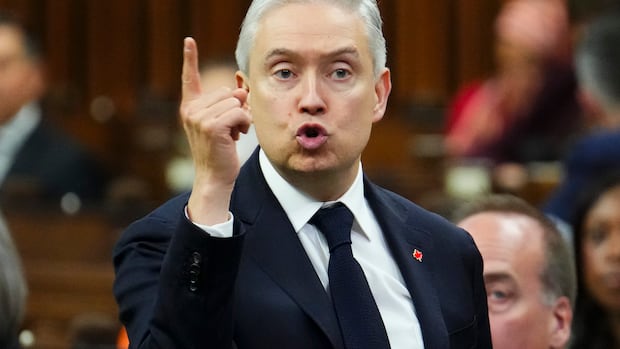
Finance Minister François-Philippe Champagne was set to appear at the parliamentary finance committee on Thursday morning, 15 minutes after the PBO report was released. He did not stop to answer questions on his way into or out of the meeting.
Conservative MP Jasraj Hallan called the PBO’s report scathing during the committee hearing. He argued it “totally debunked” the government’s claims of fiscal sustainability.
“I stand by our projections,” Champagne said in response.
“What Canadians have seen is that we have a declining deficit and I think Canadians understand that’s important to restore fiscal discipline.”
PBO revising growth predictions down
Deficit projections in the spring economic update were smaller than those tabled in Budget 2025 last fall. The government’s fiscal position improved largely due to stronger-than-expected economic performance at the end of last year.
Champagne also pointed to fresh estimates this week from the Organization for Economic Co-operation and Development (OECD), which call for Canada’s economy to grow at the second-fastest pace in the G7 this year and next.
The PBO’s updated outlook for the economy, however, is weaker than the office’s last forecast in September 2025.
The office now sees real gross domestic product rising 1.1 per cent this year and 1.6 per cent next year, slightly lower than the fall projections.
The PBO’s estimates for growth this year are slightly lower than the OECD’s outlook but in line with forecasts from private sector economists used in the government’s spring update.
The budget office’s outlook assumes all tariffs between Canada and the United States currently in place will remain.
The state of the economy has been a hot topic on Parliament Hill this week since Statistics Canada reported a second consecutive contraction in the economy to start the year. But many economists are pushing back against using the “recession” label to describe the marginal declines in GDP.
The Conservatives are laying the blame for what they’ve called a “full-blown recession” at the feet of the Liberal government. Prime Minister Mark Carney has acknowledged “weakness” in the economy but argues federal policies are setting Canada up for long-term growth.
WATCH | Carney and Poilievre spar over the economy: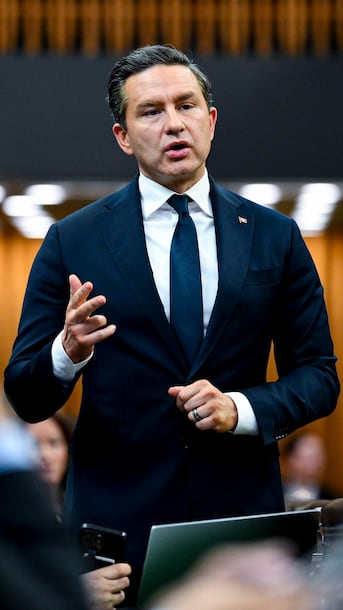
Poilievre pushes Carney on Canada’s ‘technical recession’
In an exchange during question period, Conservative Leader Pierre Poilievre asked Prime Minister Mark Carney whether Canada ‘is in a recession or a technical recession.’ In his reply, Carney said the government is ‘putting in place the foundations of an economy that will be stronger, more resilient, more independent.’
Champagne was asked several times at the committee meeting whether he thought Canada was in a recession or not. He did not answer directly.
Instead, he pointed to the OECD projections and rising business investment in machinery and equipment to argue the “Canadian economy is resilient.”
Hallan accused him of “completely dodging” the question.