

Listen to this article
Estimated 4 minutes
The audio version of this article is generated by AI-based technology. Mispronunciations can occur. We are working with our partners to continually review and improve the results.
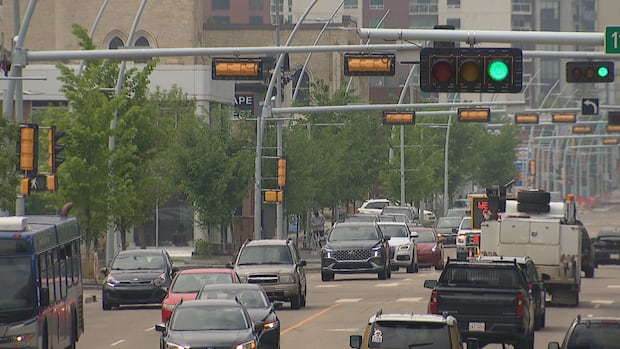
A new traffic report commissioned by the City of Edmonton says there is a perception among survey respondents that traffic safety has declined over the last five years, and that aggressive driving behaviour and societal stressors are to blame.
To put together the report, Narrative Research conducted focus groups and surveyed over 1,000 residents, who listed speeding, road rage, distracted driving, impaired driving and other risky driving behaviours as major concerns when they were on the roads.
Respondents cited ongoing construction and a lack of perceived consequences as reasons for aggressive behaviour on the roads.
CBC News spoke to some drivers and pedestrians in Edmonton. While not everyone agreed on whether roads were more dangerous compared to five years ago, some people, like Jenifer Horvath, said driving behaviour was a main concern.
“People not paying attention, they’re on their phone and the light turns green and they’re still sitting there,” she said.
“Distracted driving continues to be an issue.”
WATCH | Edmontonians report feeling unsafe on roads: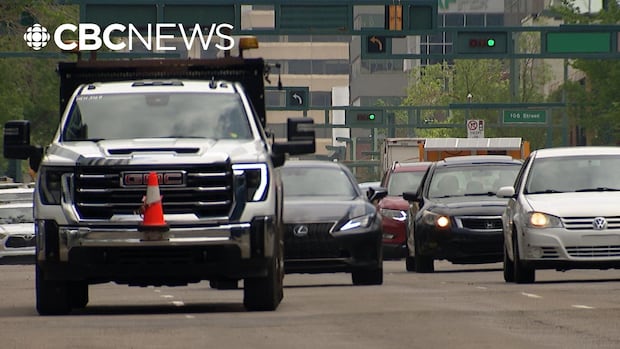
City report shows Edmontonians feeling less safe on roads over last 5 years
A recent traffic safety report commissioned by the City of Edmonton suggests a large portion of residents feel unsafe on the city’s roads. As Travis McEwan reports, their recommendations will be presented to council as a way to improve safety over the next four years.
Ward Karhiio Coun. Keren Tang said road safety is one of the top issues she hears about from her constituents in her southeast riding.
Tang said Edmonton has made several improvements to traffic safety, and steps toward its Vision Zero goal. However, she believes a number of decisions since then have hindered those improvements.
“One of the key things that happened was that the province changed the legislation around photo radar, which is a really critical tool for traffic enforcement,” she said.
“There’s a number of changes that have … sent some signals around what is OK, what is not OK on the road. And as a result, we’re seeing a rise in injury and death.”
In 2024, the Alberta government announced it planned to slash photo radar sites by 70 per cent.
In a statement to CBC News Thursday, a spokesperson from Alberta’s Ministry of Transportation said the province remains committed to working with municipal and police partners to keep road users safe.
The statement said that under the current framework, municipalities can request new photo radar locations as long as they meet the approval criteria.
These criteria include clear evidence of collisions at the location, proof that other safety measures have not worked and a commitment to implement complementary strategies alongside photo radar, the spokesperson said.
Last year, the Edmonton Police Service recorded 32 fatal collisions on city streets, up from 26 in 2024 and 24 in 2023.
The Narrative Research report provides a series of recommendations that city council could consider to improve traffic safety, like increasing law enforcement on roads, public education campaigns on safe driving, expanding traffic-calming measures and improving infrastructure planning.
Debbie Hammond, executive director of the Safer Roads Alliance, said while more visible law enforcement would always be welcome, she believes more needs to be done.
“In most cases we do have good traffic laws, but the reality is, you can’t have unlimited amounts of officers on the road,” she said.
Hammond noted that with a growing population in the province, she believes the infrastructure has not kept pace.
“We don’t necessarily have the capabilities of having another million vehicles on our roads without having improvements to the infrastructure,” she said.
“It’s kind of a multi-layered challenge for sure.”
Hammond said while the city has a big role to play, she believes it’s also up to the provincial government to help encourage safer driving habits.
The government’s transportation ministry spokesperson said Alberta has established a $13-million traffic safety fund. Municipalities can access the fund to improve high-risk intersections through measures such as better signage and road redesign.
“We continue to support police-led enforcement efforts and data-driven safety solutions, while ensuring traffic safety tools are focused on reducing dangerous behaviour,” the province said in the statement.
The new traffic safety report will go to the city’s urban planning committee on Tuesday, where the findings and recommendations will be discussed. Edmonton’s city council would need to approve any recommendations in its next budget.