
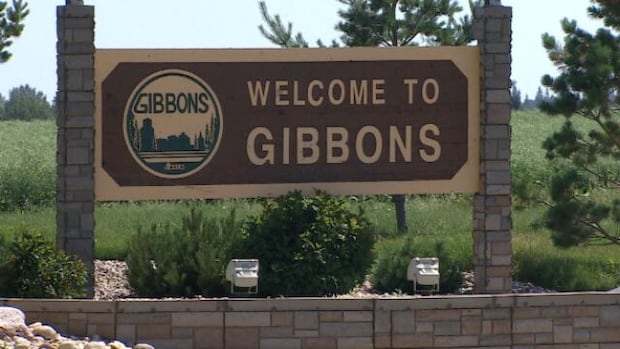
A central Alberta municipality is insisting it has a viable future, despite mounting financial woes and the looming prospect of being absorbed by the surrounding county.
The administration of the Town of Gibbons, located about 40 kilometres north of Edmonton, is pushing back against the findings of a recently released provincial viability review of the town.
The report, which came out on Monday, examined two options: how feasible it would be for Gibbons to remain a town, or whether it would need to dissolve and become a hamlet of Sturgeon County.
In a letter addressed to Alberta Municipal Affairs Minister Dan Williams on Wednesday, the town’s mayor wrote that he takes issue with the report.
“We respect the viability review process and acknowledge the seriousness of the financial, governance, administrative and operational challenges that Gibbons has faced,” Rick Henderson wrote in his letter.
“At the same time, council believes that a number of statements, assumptions and conclusions in the report are incorrect, incomplete or outdated, and that several do not reflect the town’s approved 2026 budget, the legal advice we have obtained or the financial recovery work now well underway.”
The town’s books were in dire shape when residents elected an entirely new town council in October 2025, Henderson said in an interview with CBC News in April. The incoming council found a municipality of 3,200 residents that was more than $12 million in debt. The town’s annual budget is about $3 million, Henderson said.
In December, while struggling to make payroll and having reached its credit limit, the town requested that the province conduct an expedited viability review.
According to the review, the process was “initiated so town residents and property owners understand the financial challenges ahead, and to explore options and solutions that may exist for Gibbons in the future.”
What is being contested
The province’s viability review cites its 2025 Legislative Compliance Review of Gibbons.
“Municipal Affairs examined 61 areas of legislative requirements. The town was found to be non-compliant in 27 of those areas,” the 2026 viability review said.
In his letter to the minister, Henderson refuted this and said “corrective action has been taken on 18 [areas], and work continues on the remaining nine [areas].”
“Alongside this, the town has updated bylaws, advanced new financial policies and strengthened governance processes,” he wrote. “The compliance review identified issues that needed to be fixed — it does not support a conclusion that Gibbons is not viable.”
When asked for comment on the concerns raised by the mayor, Jack Alarie, press secretary for Ministry of Municipal Affairs provided CBC News with a statement that said the ministry “is aware that the Town of Gibbons has shared its perspective on the recent viability review report.”
“The viability review was initiated and expedited at the request of the Town of Gibbons and conducted on an expedited basis to address urgent financial concerns,” Alarie wrote.
“Throughout the process, the town and Sturgeon County had multiple opportunities to participate, including submitting information, attending meetings with the ministry and providing feedback on the draft report.
“The final report provides an objective, factual and evidence-based assessment of the town’s current circumstances and outlines the choice before residents in the upcoming vote.”
Revenue sharing between Gibbons and Sturgeon County has also remained a point of contention. The review states that “Sturgeon County has repeatedly declined proposed revenue-sharing agreements, most recently at their April 28, 2026, regular council meeting.”
“While the town has indicated its intent to continue discussions with Sturgeon County regarding possible revenue-sharing opportunities, long-term solutions to the town’s financial challenges are unlikely to come from other governments,” the province’s viability review said.
“Addressing these pressures will largely require decisions made locally and funded by the residents and property owners of Gibbons, whether the community remains a town or becomes a hamlet within the county.”
Henderson also rejected assertions that the town lacked a strategic plan, which the province maintained needed to be created.
“We have a strategic plan in place, a balanced budget, and a number of the things that were done in regards to services,” he said.
Tim Duhamel is the town’s interim chief administrative officer. He said there were other factors that he believes the province didn’t take into account.
“We’ve included operating debt payments, we’ve included revenue from local improvements, we’ve included significant changes that have reduced the budget, so that we’re balanced,” Duhamel said.
“And none of that was taken into consideration in the report, which is very problematic to us.”
Why it matters
The future of the town hangs in the balance.
On June 10, Municipal Affairs will hold a pre-vote information session at the Gibbons Community Cultural Centre.
Henderson said that while he is hopeful this session can be an opportunity to correct misinformation, he is concerned it will create even more confusion for residents.
A plebiscite will take place on June 24 and 25 for residents to determine whether they wish to remain a town or dissolve into a hamlet within Sturgeon County.
However, Henderson noted that even if the town votes to remain a distinct incorporated municipality, the province retains the overriding power to dissolve it, making resident participation in the plebiscite essential.
“So I’m hoping that we get a strong turnout and a strong vote for remaining a town to send a clear message to the minister, say: ‘Hey, we want to remain a town and we can be viable,’” Henderson said.