
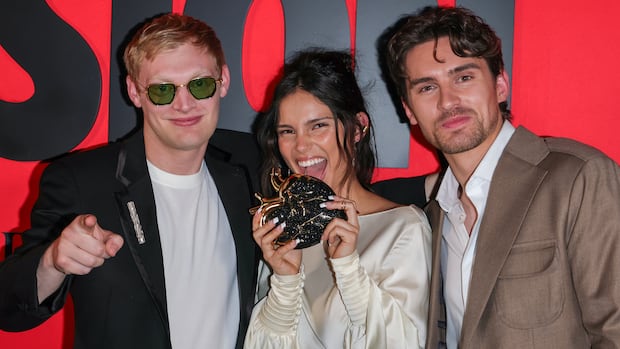
A little indie horror film is making a big splash at the box office this summer.
Obsession is a film about a young man named Bear, who uses a supernatural toy to get his crush Nikki to like him back — with violent and disturbing consequences. Made with a budget of $750,000, the film has now earned more than $68 million at the box office.
Written and directed by Gen Z filmmaker Curry Barker, Obsession recently became the first film since E.T. to see its box office numbers rise week-over-week in its first three weeks.
Today on Commotion, film critics Corey Atad, Kaiya Shunyata and Hanna Flint talk about the remarkable success of this low-budget movie, and how well it tackles the genre of incel horror.
We’ve included some highlights below, edited for length and clarity. For the full discussion about Obsession, as well as Apple TV’s new reboot of Cape Fear and the latest on the CRTC’s streamer investment mandate, listen and follow Commotion with Elamin Abdelmahmoud on your favourite podcast player.
Elamin: Hanna, I’m going to ask you about the ways that Obsession has kind of become its own separate cultural phenomenon. There’s one thing about this movie coming out [and going], like, “OK, that’s an interesting premise for a horror movie.” But the idea that it’s kind of connected on this larger cultural level, what do you make of that?
Hanna: I think maybe if this was made 10 years ago, Nikki would be far more positioned as a villain. But I think what’s really refreshing about Bear, who’s the lead character, is that he’s a nice guy. We’ve seen the “nice guy” trope with Promising Young Woman and On Chesil Beach and such, but here he’s set up as this kind of unassuming guy, and then you realize, no, you’re an absolute villain. Because what you’re seeing is consequence culture. We are seeing the conversation about consent, about dating dynamics. There is a moment in it where we see, after he’s made the wish and Nikki is under his spell, we see the typical rom-com tropey montage of “Look, we’re in love.” But then it switches pretty quickly to realize she is not consenting to this. She doesn’t want to do this. And as it kind of progresses, we just see how in so many ways, Bear could have stopped it, but he chooses not to.
So I think for me, there’s something really courageous about showing this now, especially at a time when there is this interesting dynamic between men and women, and men talking about how they don’t feel comfortable speaking to women. It’s so hard out there, but I think certainly in this way, especially with Inde Navarrette’s performance, this is what it’s like when you’re stuck in a relationship that you don’t want to be part of, and you can’t get out. So for me, you’re always on her side…. Obviously we have the manosphere, and … this issue about why women choose not to date, and men can’t get dates — I think this is really in conversation with that. So, yeah, I thought it was a very surprising horror that I think is very relatable, and very shocking as well.
Elamin: Kaiya, I’ve seen this movie being discussed in terms of a subgenre that people are calling “incel horror.” Do you want to unpack that term a little bit, and talk about how this movie fits into that categorization?
Kaiya: Yeah, so with incel horror, at least to me, you have a protagonist who is male and who is very sheltered, sometimes by their circumstances — thinking about something like Bugonia, and Jesse Plemons in that. And then also, you can have someone who’s in a kind of prison of their own making, which is how I would describe Bear.
There’s an unwillingness to pull themselves out of a situation that they’re in, and instead look for this magical thing that can solve all the problems in their life. And then, the consequence of that, taking no responsibility for the actions that then play out, and have a complete disregard for not just the people in his life but specifically the women in his life. Not just Nikki, but his other co-worker as well. And that’s how it taps into the incel culture of today.
WATCH | Official trailer for Obsession:
Elamin: Let me ask you, Kaiya, as a follow-up to the thing that Hanna mentioned earlier — this idea that if this movie was made 15 years ago, then Nikki would have been the villain. When you watch this movie, do you think this movie is actually doing a good job critiquing incel culture?
Kaiya: Um, I’m like 50-50 on it. I think the intention is to, but I do think there is a concern when we think about audiences of today that — no offense to them — aren’t that smart.
Elamin: Damn.
Kaiya: So I do worry that it can be misconstrued as the “crazy girlfriend” trope again…. And I’m not necessarily sure that the film sets that up, because we don’t really know Nikki at all. We know she wants to quit her job, and she wants to be a writer. That’s all we know about her throughout the whole film. And she doesn’t have feelings for Bear.
Other than that, we watch as she brutalizes other people, she is brutalized herself. So to me, there is a line, and I find that this film doesn’t go over on each side; it very much toes that line between critiquing incel culture and then kind of being a part of it as well.
You can listen to the full discussion from today’s show on CBC Listen or on our podcast, Commotion with Elamin Abdelmahmoud, available wherever you get your podcasts.
Panel produced by Stuart Berman.