
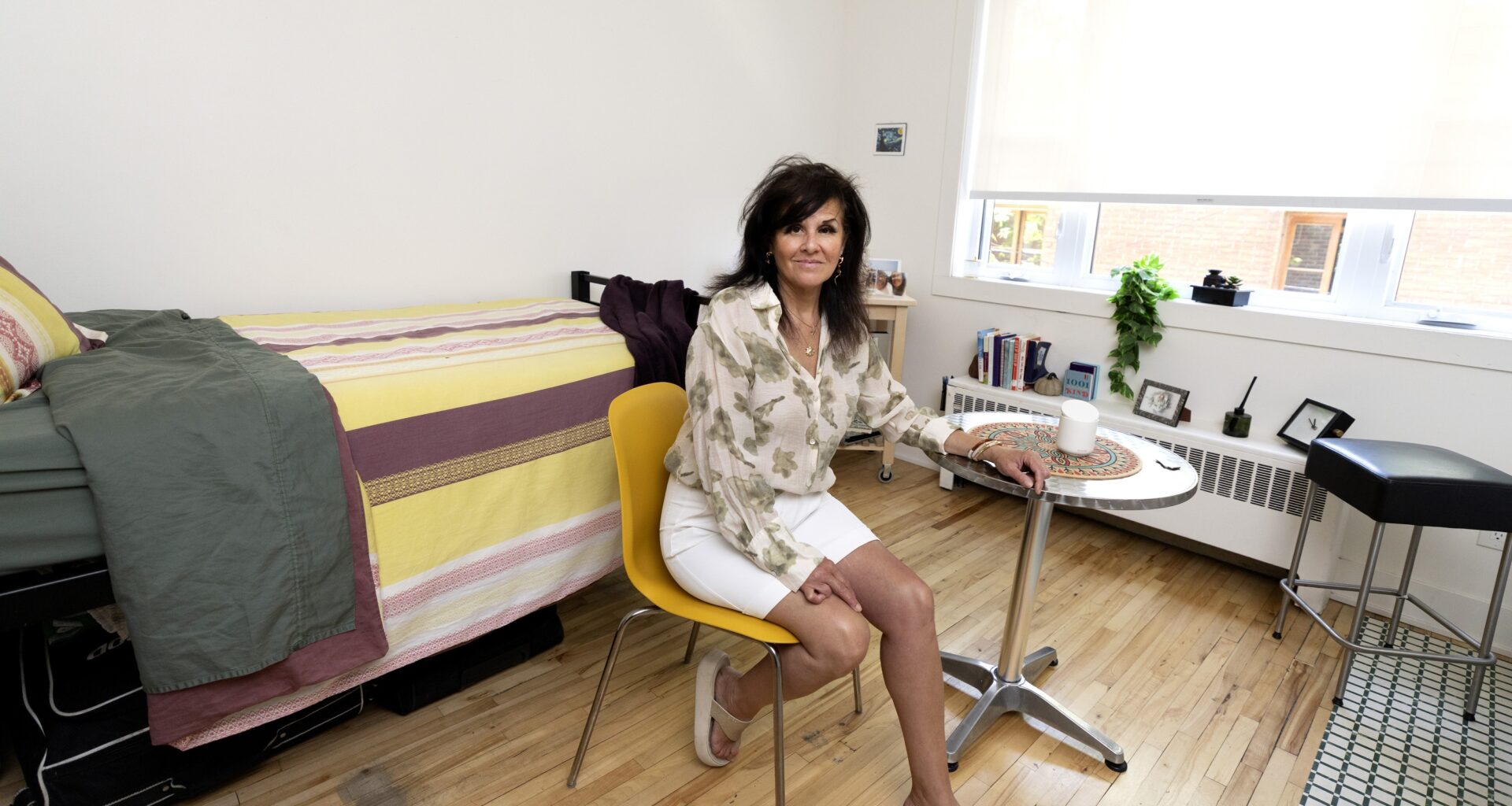
When Mary Fulford, wife of Montreal’s first Anglican bishop, founded the Church Home in 1855 in a small house on St-Dominique St. “for the counsel and protection” of young, single and friendless women arriving from abroad to be governesses and schoolteachers, she couldn’t have known that her vision would be expanded and that her name would one day grace the buildings of two organizations whose mission is serving women in need.
But that is precisely what has come to pass.
The Old Brewery Mission this week inaugurated the Pavillon Fulford on Lartigue Ave., a building with 12 studio apartments for women transitioning out of homelessness. Until the announced name change, it was called Les Voisines de Lartigue.
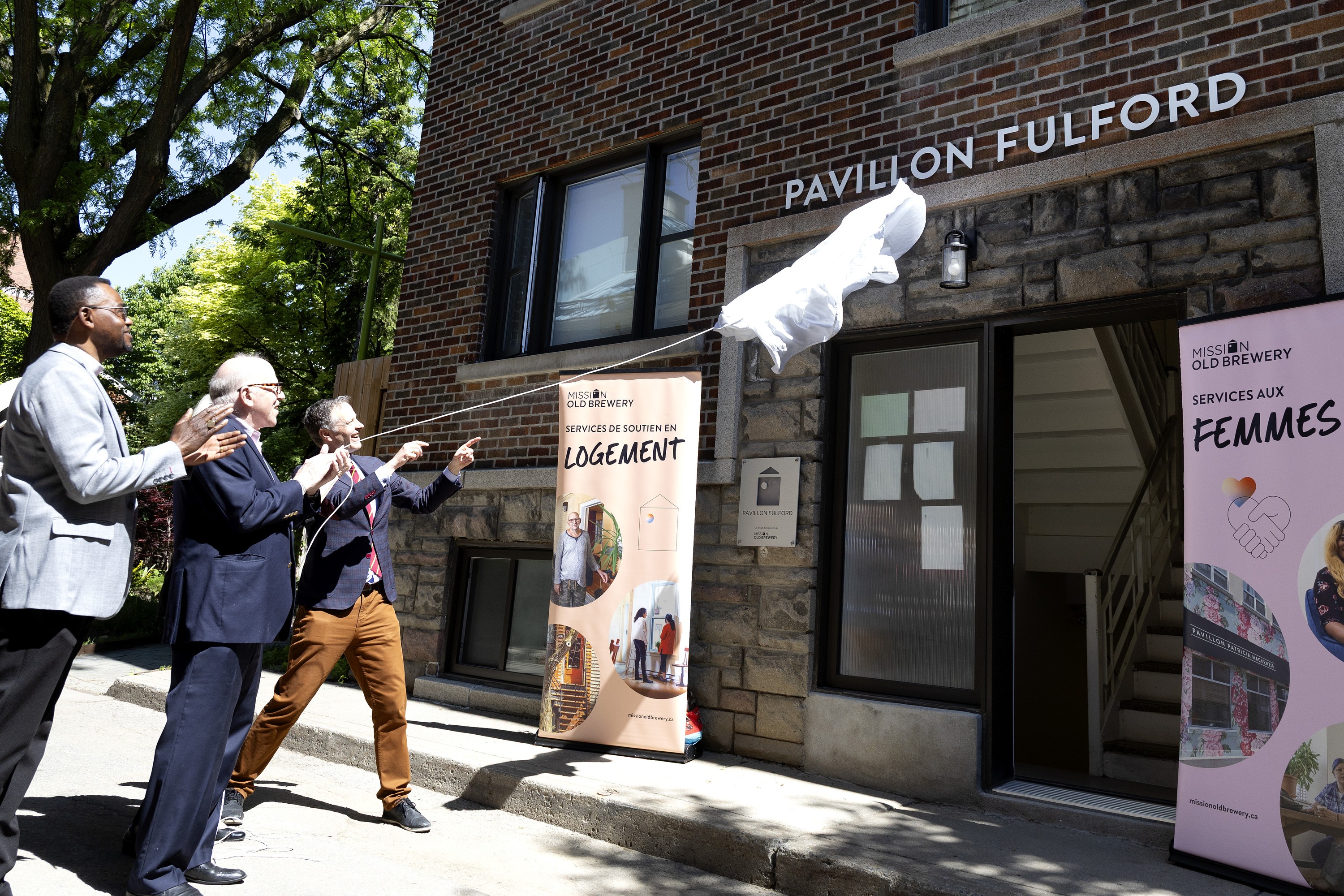 Old Brewery Mission CEO James Hughes, right, leads a group of board members as they reveal the new building signage at the official opening of the Pavillon Fulford in Montreal. Allen McInnis / Montreal Gazette
The new name was unveiled, along with a public acknowledgement of a $2 million donation to the Old Brewery Mission for services for women experiencing homelessness.
The mission of Pavillon Fulford, which welcomed its first residents in August 2022, is to offer individualized psychosocial support and teach life skills and community living tasks as the women prepare to transition to permanent housing, said Kaye Carado, Old Brewery Mission’s transitional housing coordinator for women’s services.
Tracy Mombourquette has been a resident of Pavillon Fulford for 10 months. As someone recovering from addiction, the 58-year-old Nova Scotia native said she knows she needs a structured living environment; she deeply appreciates the support she receives from intervention workers, she said.
Pavillon Fulford is steps from the Old Brewery Mission’s Patricia Mackenzie Pavilion on de Maisonneuve Blvd. E., opened in 1998 as the organization’s first point of service for women experiencing homelessness. Although the majority of Old Brewery Mission clients are men, about 250 of the 1,100 individuals helped each day are women, said Old Brewery Mission president and CEO James Hughes; about 110 of its 524 housing units are for women.
Preliminary results published in April of a census by Quebec’s ministry of health and social services conducted across the province on the night of April 15, 2025, found more than 12,000 individuals experiencing visible homelessness — an increase of 20 per cent from the previous census in 2022. About 80 per cent were in temporary resources such as emergency shelters and transitional housing; just over 5,000 of the 12,077 were in Montreal.
Although most unhoused individuals are men, the proportion of women experiencing visible homelessness in Montreal in 2022 was 29.3 per cent, up from 23 per cent in 2018. But women are disproportionately affected by invisible homelessness. They are less likely than men to be sleeping on the street but more likely to be couch-surfing with friends or remaining in abusive or violent relationships.
Mary Fulford returned to England following the death of her husband, Francis, in 1868 — but the social mission she envisioned for the Church Home endured. The next bishop, Ashton Oxenden, transformed the home into a facility for “ladies in precarious circumstances.” And when Bishop William Bond, who followed Oxenden, dedicated the home’s new location in 1890, a handsome three-storey brick house on Guy St. built in the 1850s, his hope was for it to be “the happy home of many women in their time of need, whether that be from infirmity, bereavement or old age.”
 About 250 of the 1,100 individuals helped each day are women, Old Brewery Mission president and CEO James Hughes says. Allen McInnis / Montreal Gazette
For 131 years, the Fulford Residence, as it came to be known, was a happy home for older women, until declining occupancy and the deaths from COVID of one-third of its 31 remaining residents forced it to close in 2021.
The historic building, with the woodwork and stained glass of its main rooms still in impeccable condition after nearly 170 years, sat vacant for a time, its future uncertain. Developers showed interest, as did Concordia University and Chez Doris, an organization which since 1977 has helped Montreal’s most vulnerable and marginalized women.
Heritage authorities favoured a vocation that would be aligned with Fulford’s original mission and conserve its architectural integrity. In 2021, Heritage Montreal and founding president Phyllis Lambert requested that Quebec’s Ministry of Culture and Communications designate the property, the former summer retreat of potash inspector James Edward Major, a heritage building. In 2024, it did: The designation applies to the building and the site and also to those interiors “of particular architectural integrity and interest.”
That year, Chez Doris purchased the Fulford Residence for $6.5 million. The building, which needs updating, is being restored and repurposed to consolidate services and activities currently spread among three of the organization’s downtown locations: These include a day centre, medical clinic, community space and offices housing services to clients. The anticipated reopening date is 2028.
Twenty rooms on the second and third floors will serve as transitional housing for women who are unhoused or at risk of homelessness. Since 2022 Chez Doris has opened several facilities for this population, including an emergency overnight shelter and three residences.
The organization is honouring the legacy of Mary Fulford as it works to end homelessness, said Chez Doris executive director Diane Pilote. But the needs are only growing. The past three months have seen a 30-per-cent increase in the number of clients turning to Chez Doris for help, she said, and the organization is on track to see 2,000 women this year – up from 1,500 just a couple of years ago.
Last fall, as the owning corporation of the Fulford Residence was winding down, it announced three “leadership grants” to ensure the continuity of the social commitment that had defined its history: $2 million to the Old Brewery Mission for services for women experiencing homelessness and the establishment of Pavillon Fulford; $3 million to Chez Doris ($2 million for its fundraising campaign for the renovation and reopening of the Fulford Residence and $1 million to establish an endowment fund to cover operating costs); and $2 million to the First People’s Justice Centre for its building campaign.
 Bishop Victor David Mbuyi Bipungu of the Anglican Dioeces of Montreal speaks at the Pavillon Fulford opening June 3, 2026. Allen McInnis / Montreal Gazette
“We are so proud to associate the Fulford name with the Old Brewery Mission. It’s an incredible legacy and it’s one we share with Chez Doris, which will run the Fulford Residence,” Hughes said. “We have a common mandate to try to reduce and eliminate homelessness in Montreal.”
Speaking at the unveiling of the newly named Pavillon Fulford, Pilote called Mary Fulford’s vision in founding the Church Home “profoundly human … one that offered not only a roof but also a place of dignity, security and compassion.”
Its vocation evolved, “but never lost its essence,” she said. “What transcends time is the simple and powerful conviction that every women deserves a safe and dignified place.”
And now the Fulford legacy “is not simply being preserved: It is being expanded,” said Elise Monaghan Joubert, director of philanthropy at Chez Doris.
“We are not just witnesses to this legacy. We are its stewards. We carry forward a vision born more than 150 years ago and we adapt it to the needs of today.”