
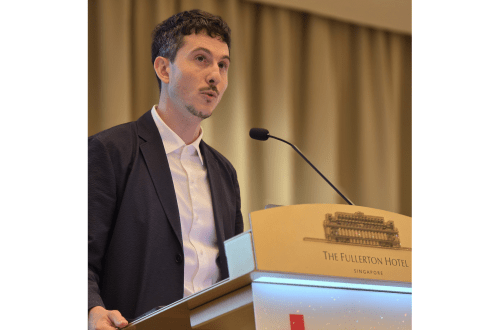
At the Hubbis Independent Wealth Management Forum – Singapore 2026, Christopher Morris, Co-Founder and CTO of WMCockpit, set out the rationale behind WMCockpit and the broader shift he believes the industry must make from portfolio management to holistic wealth management.
His presentation did not dismiss the importance of portfolio management. Instead, it argued that the portfolio is often only one component of a much larger estate, and not always the largest or most consequential lever in determining family wealth outcomes. For many Asia-based high net worth families, real estate, business assets, currency exposure, tax residency, lifestyle decisions and succession planning can have a larger financial impact than marginal improvements in portfolio performance or fee negotiation.
The message was that advisers who remain focused only on liquid portfolios risk missing the more important wealth decisions taking place around them. By contrast, those able to capture, model and discuss the full estate can become the trusted central adviser to the family.
Morris framed this as both a technology challenge and a strategic opportunity. The industry does not only need better portfolio tools. It needs platforms that allow advisers to build a single source of truth across assets, liabilities, structures, documents, scenarios and family-level decisions.
Key Takeaways
The Industry Must Move Beyond Portfolio Management: Morris argued that portfolio management remains essential, but the larger opportunity lies in holistic estate-level wealth management.
The Portfolio Is Not Always The Largest Risk Lever: In a typical Asia-based high net worth family estate, real estate and business assets may represent a much larger share of total wealth than the liquid securities portfolio.
Non-Portfolio Decisions Can Have Greater Financial Impact: Decisions around yachts, tax residency, currency exposure and estate composition can create larger gains or losses than incremental portfolio fee savings.
Technology Must Support Holistic Conversations: Advisers need tools that allow them to model the full estate, not only liquid market portfolios.
Perfect Data Is Not Required To Make Better Decisions: Morris argued for pragmatic estate modelling based on approximate but useful data, rather than waiting for perfect information.
Excel Has Reached Its Ceiling: Spreadsheets remain common, but Morris said they lack scalability, version control, auditability, scenario functionality and robust visualisation.
A Single Source Of Truth Is The Goal: Purpose-built platforms can consolidate fragmented information across assets, documents, structures and scenarios.
The Holistic Adviser Becomes The Family’s Central Point Of Trust: Morris positioned the adviser with the full estate view as the “one confessor” to the family.
The Adviser Who Owns The Holistic View Owns The Client: Those with estate-level visibility are better positioned to understand succession, liquidity needs, family dynamics and future asset flows.
Morris opened by explaining the thinking behind WMCockpit and the firm’s view that the wealth management industry needs to shift from portfolio management to broader private wealth management.
He was careful to acknowledge that portfolio management remains central. It is part of the adviser’s day-to-day role and will always be a core function. However, he argued that the industry’s focus on liquid portfolios can obscure the larger decisions that determine wealth outcomes across a family estate.
In many cases, the portfolio is the most visible source of risk. Stocks move, crypto moves and fixed income prices change daily. These movements are visible on screens and mobile apps, so they naturally become top of mind.
But visibility does not always mean materiality. Morris argued that when advisers look at the broader estate, the portfolio is often not the largest lever.
“The portfolio is what everyone sees every day,” he said. “But it is not always where the biggest money is made or lost.”
He used the example of a SGD50 million family estate, split 75% across real estate and business assets, with the remaining 25% in a US Dollar securities portfolio. Morris described this as a fairly standard allocation for an Asia-based high net worth family.
That example formed the basis for the rest of the presentation. The core question was not whether the portfolio matters. It was whether advisers are giving enough attention to the estate-level decisions that can matter more.
Where The Real Money Is Made And Lost
Morris then moved through a series of scenarios to show how different decisions can affect the same family estate.
The first example was a portfolio fee negotiation. If the family negotiates hard with its asset manager and saves 10 basis points a year on portfolio management fees, the saving is around SGD4,500. Morris described this as good housekeeping, but limited in scale.
The second example was asset manager selection. If the difference between a top-quartile manager and a third-quartile manager is around 2% yield a year, the impact rises to approximately SGD250,000. That is material.
The third example moved outside the portfolio. If the family sells SGD3 million of fixed income assets to buy a yacht, it not only gives up the 3% annual yield on those assets, but may also incur annual running costs of around 10% of the yacht’s value for maintenance, fuel, crew and berthing. On Morris’ assumptions, that could cost approximately SGD390,000 a year.
The pattern is clear. The decisions outside the portfolio can quickly become more financially significant than the decisions inside it.
“Saving 10 basis points matters,” he said. “But it is not the same as understanding the full economic consequence of a lifestyle or estate-level decision.”
Morris extended the argument further with two additional examples. If a family relocates from London to Singapore but fails to get its UK residency planning right, HMRC may still consider the family UK tax resident. On a reasonable set of assumptions, Morris said that could cost around SGD750,000.
Similarly, if the US Dollar falls 10% against the Singapore Dollar, a USD12.5 million portfolio could lose SGD1.25 million in value. That loss would not come from a poor investment decision, but from currency exposure.
For Morris, these examples demonstrate the central point. Portfolio optimisation matters, but estate composition, tax, currency and broader family decisions can have a far greater impact on wealth outcomes.
The Role Of Technology In Holistic Advice
Morris then asked what role technology should play in helping advisers have more holistic conversations with clients.
Estate modelling is naturally messy. Families hold liquid and illiquid assets, multiple currencies, homes, businesses, vehicles, collectibles, trusts, documents and liabilities. The data will rarely be perfect. However, Morris argued that advisers do not need perfection to make better decisions.
He cited an old saying that surgery with a kitchen knife is better than no surgery at all. The analogy was used to make a pragmatic point: imperfect tools may still be better than doing nothing, but the industry should now be able to do much better.
“The estate is messy by nature,” he said. “But messy data is not an excuse for avoiding the estate-level conversation.”
For Morris, technology must allow advisers to work with incomplete but meaningful information. The aim is not to mark every asset with institutional precision every day. The aim is to capture enough of the estate to model scenarios, identify risks and support better decision-making.
This requires a different kind of platform from a conventional portfolio reporting tool.
Blending Liquid And Illiquid Valuations
The first principle Morris identified was the need to blend real-time and illiquid valuations.
A securities portfolio can often be marked to market every 15 minutes through a mobile app. But the same is not true of a house, yacht collection, cars or collectible assets. These may only be formally valued every few years, often when an insurance contract is due for renewal.
Some assets move minute by minute. Others move decade by decade.
Morris argued that estate-level technology must be able to reflect this reality. It should not pretend that all assets can be valued in the same way, at the same frequency, or with the same certainty.
“A portfolio may move every minute,” he said. “A family home or a collection may not need to be marked every Tuesday for the adviser to make a useful decision.”
This is an important distinction. Holistic wealth management requires a broader valuation logic than portfolio management. The objective is not only precision, but relevance.
A full estate platform must be able to accommodate liquid marks, periodic valuations, estimated values and pragmatic assumptions, while still giving advisers a coherent view of the family’s total wealth.
Pragmatic Anchors And The 80-20 Rule
The second principle Morris described was the use of pragmatic anchors.
If a family bought a Singapore property last year, the current value may be only one or two percentage points higher than the purchase price. If the property was bought 25 years ago, the more useful anchor might be the most recent insurance valuation.
In other words, not every asset needs constant revaluation. Advisers need sensible reference points that are good enough to support estate-level decisions.
The third principle was the 80-20 rule. Morris argued that directional hedging based on approximate data is better than making no decision while waiting for perfect data.
This was a central point in the presentation. Wealth management does not require advisers to know everything with absolute precision before they can add value. It requires them to identify the major exposures, understand the likely direction of risk and help families act before problems become more expensive.
“Waiting for the perfect data set can become a decision in itself,” he said. “The better approach is to work with pragmatic anchors and make the estate visible enough to act.”
With these principles in place, advisers can begin to have more meaningful holistic conversations. They can discuss currency exposure, tax risk, liquidity, succession, asset concentration and family-level planning in a more structured way.
Why Excel Has Hit Its Ceiling
Morris said WMCockpit has spoken to a wide range of family offices, independent asset managers, private banks and related firms, and that the message is consistent: Excel has reached its ceiling.
Spreadsheets remain widely used because they are flexible and familiar. But they do not scale well as a family estate becomes more complex. They lack version control, audit control and robust scenario functionality. They are also vulnerable to formula errors, broken references and isolated knowledge sitting with one individual.
Morris referred to the familiar problem of the “rogue cell” or incorrect formula that undermines the integrity of a spreadsheet. He also noted that if a specific person is not at their desk, the organisation may be unable to stress test or run scenarios.
“Excel is flexible, but flexibility is not the same as control,” he said. “At a certain level of complexity, the spreadsheet becomes the risk.”
A purpose-built platform changes the adviser’s ability to work with the family estate. Morris pointed to AI-driven tax modules, simulations, scenario analysis, document repositories and visualisation as examples of what software can add.
For instance, an adviser could model what happens when a daughter is set to inherit part of an estate, and how that inheritance affects her trust. The platform could also store passports, wills, notarial deeds and other relevant documents.
The key is that software can turn fragmented estate information into something structured, visible and actionable.
From Fragmented Data To A Single Source Of Truth
Morris positioned WMCockpit as a response to the fragmentation of family wealth data.
Families often hold information across multiple advisers, institutions, spreadsheets, email chains, scanned documents, trust files and personal records. The result is not only administrative inefficiency, but strategic opacity. No single adviser may have a complete view.
Morris argued that the goal should be a single source of truth. This means consolidating estate information into one platform where assets, documents, scenarios and family structures can be viewed and analysed coherently.
The value of this is not merely operational. It changes the adviser’s role.
“You move from unstructured fragments to a bird’s-eye view of the family,” he said. “That is when the adviser moves into the front row seat.”
In practical terms, Morris described a client walking into a room and seeing their estate presented clearly on screen, or through a dedicated mobile app. The adviser can then use that view to frame conversations around risk, liquidity, inheritance, tax, currency and structure.
This is a different kind of client meeting. It is not only a performance review. It is an estate-level advisory conversation.
The Rise Of The One Confessor
Morris then posed a strategic question to advisers: if you are not the family adviser, who is?
His argument was that every family either already has, or will eventually have, a central trusted adviser. Morris described this person as the “one confessor” – the individual who understands the family history, the relationships, the structures, the assets and the sensitivities around succession.
Families may still use specialist advisers. Tax, legal structuring, insurance wrappers and other technical areas can be delegated to experts. But Morris argued that these specialists often operate in silos. What families need is one central point of trust that can connect the pieces.
“Families can fractionalise the technical work,” he said. “But the trust starts with one person who understands the whole picture.”
This creates a major opportunity for private bankers and wealth managers. If they can move beyond portfolio conversations and develop an estate-level view, they can become far more relevant to the family.
If they do not, someone else will take that position.
The Adviser With The Holistic View Owns The Client
Morris was clear about the commercial implications.
The adviser who owns the holistic view is best placed to understand the client’s future needs. That adviser knows when the family business may need reinvestment capital. They understand which child is set to inherit which assets. They know whether one child may receive a property in the south of France, while another may inherit the bank portfolio.
For a private bank, that information is highly strategic. If one child is certain to inherit the banking portfolio, the institution should want to be in that child’s orbit well before the transfer takes place.
This is where holistic wealth management becomes more than a service enhancement. It becomes a client retention and growth strategy.
“The person with the bird’s-eye view does not just understand the assets,” he said. “They understand the next conversation before the client has even asked for it.”
Morris’ conclusion was straightforward: the one who owns the holistic view is the one who owns the client.
That ownership does not mean controlling the family. It means being the adviser with sufficient trust, context and visibility to guide the family through decisions that sit beyond portfolio performance.
The Darwinian Shift In Wealth Management
Morris framed the move from portfolio management to private wealth management as an evolutionary shift.
Portfolio reporting, performance reviews and asset allocation will remain important. But they are no longer enough to secure the adviser’s position at the centre of the client relationship.
The future adviser must be able to discuss the full estate. That includes liquid assets, illiquid assets, business interests, real estate, tax exposure, residency planning, currency risk, documents, succession and family governance.
Technology is the enabler because it allows advisers to structure and visualise information that would otherwise remain fragmented. It also allows them to run scenarios, identify risks and support decisions with greater clarity.
For Morris, this is the single biggest opportunity in the space for private bankers and wealth managers today.
The presentation ended with a practical invitation to explore how WMCockpit has built around this thesis. But the broader challenge was clear. Advisers who remain confined to portfolio management may find themselves displaced by those who can see the full estate. In a more complex private wealth environment, the front row seat belongs to the adviser who can turn fragmented wealth into a single, actionable view.