
Breadcrumb Trail Links
LifeNew BrunswickSaint John & SouthSalon
Author of the article:
Curt Nason • The night sky
Published Jun 07, 2026 • Last updated 8 hours ago • 3 minute read
You can save this article by registering for free here. Or sign-in if you have an account.
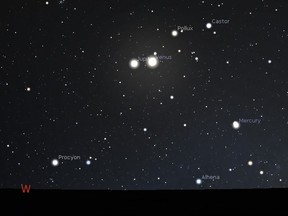 The night sky on June 7 at 10 p.m. Photo by Stellarium/SubmittedArticle content
When doing astronomy outreach I occasionally get asked about the most exciting thing that I have seen in a telescope. Saturn’s rings, lunar craters and comets are always a treat, but what moves me the most is seeing something actually moving in the night sky.
Advertisement 2
This advertisement has not loaded yet, but your article continues below.

THIS CONTENT IS RESERVED FOR SUBSCRIBERS
Subscribe now to read the latest news in your city and across Canada.
Unlimited online access to articles from across Canada with one account.Get exclusive access to the e-Edition, an electronic replica of the print edition that you can share, download and comment on.Enjoy insights and behind-the-scenes analysis from our award-winning journalists.Support local journalism and the next generation of journalists.
SUBSCRIBE TO UNLOCK MORE ARTICLES
Subscribe now to read the latest news in your city and across Canada.
Unlimited online access to articles from across Canada with one account.Get exclusive access to the e-Edition, an electronic replica of the print edition that you can share, download and comment on.Enjoy insights and behind-the-scenes analysis from our award-winning journalists.Support local journalism and the next generation of journalists.
REGISTER / SIGN IN TO UNLOCK MORE ARTICLES
Create an account or sign in to keep reading.
Access articles from across Canada with one account.Enjoy additional articles per month.Get email updates from your favourite journalists.
THIS ARTICLE IS FREE TO READ REGISTER TO UNLOCK.
Create an account or sign in to continue with your reading experience.
Access articles from across Canada with one accountShare your thoughts and join the conversation in the commentsEnjoy additional articles per monthGet email updates from your favourite authors
Article content
All celestial bodies are in motion, both rotating about an axis and moving through space freely or under the gravitational influence of a massive body. This applies to motes of interplanetary dust, planets, stars and galaxies. Earth’s rotation carries us daily on a 1,000 km/h merry-go-round ride as it orbits the sun at 30 kilometres per second. The sun is dragging us along nearly eight times faster in its orbit around our Milky Way galaxy, which is moving at more than twice that velocity. We are used to seeing the sun, moon and the stars moving from east to west as the earth rotates, but can we see them moving relative to each other?
The sun’s blinding intensity prevents us from seeing its movement, but I can tell that it has rotated by sketching its sunspots daily through a telescope equipped with a solar filter. It rotates in 25 days at its equator and at slower rates toward its poles. With the moon orbiting earth every four weeks it moves its own width eastward against the distant stars every hour. We can see this motion with a telescope or binoculars, similar to watching the minute hand of an analog clock, whenever it passes in front of a star or a planet. On June 17 between approximately 5 and 6 p.m. the moon will occult Venus high in the south-southwest. Binoculars and a cloudless sky will be necessary for this challenging view.

Morning Email Telegraph-Journal
Thanks for signing up!
Article content
Advertisement 3
This advertisement has not loaded yet, but your article continues below.
Article content
For the past week stargazers have been watching Venus approach Jupiter in deep western twilight, and for the next few evenings they will appear close. Just remember that Jupiter is currently five times farther from us than Venus is. This daily movement of Venus is like watching the hour hand of a clock. The pair will be too far apart to notice relative movement in a telescope, but a patient vigil with a telescope might detect movement if Venus is very near a star. On July 19 it skims the top of the Beehive star cluster, although twilight and a low altitude will be detrimental.
A small telescope will reveal Jupiter’s four largest moons disappearing and reappearing behind the planet. I have noticed the movement of a comet once when it was near a star, and a few times I have witnessed this with an asteroid. One of my most memorable telescope experiences was observing real-time movement of near-earth asteroid 2002 NY40, which passed within half a million kilometres of earth. That was like second-hand clock movement and it reminded me of playing the Asteroids video game. We don’t see small pebbles entering our atmosphere but the streak of light they create reveals their meteoric passage.
Advertisement 4
This advertisement has not loaded yet, but your article continues below.
Article content
Stars are too far away to detect their movement readily. Barnard’s Star, the nearest one we can see from Canada at a distance of six light years (nearly 60 trillion kilometres), has the fastest apparent motion across our sky and an astrophotographer could tell that it has changed position over a decade. We can indirectly detect movement of the line-of-sight binary star Algol by noticing it dims by a factor of three every few days, when the fainter star passes in front of the brighter one.
Forget about galaxy movement, but if you are patient enough to wait half a billion years you will notice that we have moved closer to the Andromeda galaxy.
For information about the Saint John Astronomy Club contact Curt Nason (nasonc@nbnet.nb.ca) or visit the website http://www.sjastronomy.ca/.
Article content
Share this article in your social network