
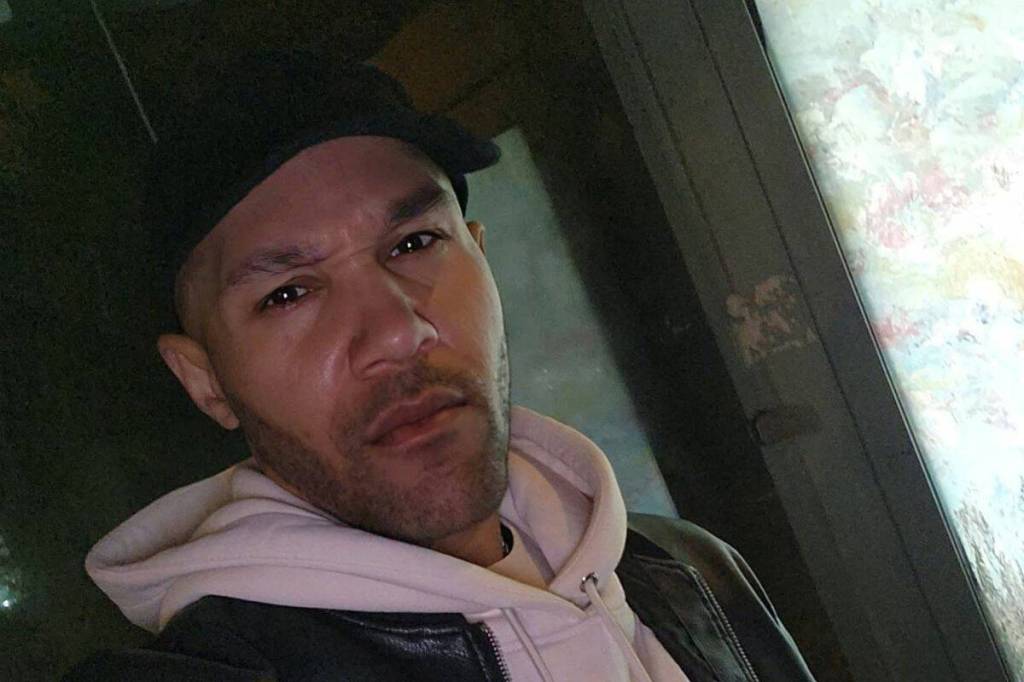
Adam Troy Mann has been found not guilty of assault for allegedly spitting on a corrections officer while he was being moved from his cell at Surrey pretrial for court proceedings.
The judge found Crown had not proved Mann’s guilt beyond a reasonable doubt, mainly due to “weaknesses in the evidence” presented at trial.
Mann, 42, appeared by video in a red prison shirt on Friday (June 5) in Surrey provincial court in front of Judge Jay Solomon. He did not say anything, just smiled and nodded as the judge read his decision.
The alleged incident occurred on April 22, 2025, when corrections officers Sean Okada and Christopher Beaulieu were walking Mann from his cell in the segregation unit to what they call records, where inmates are admitted and discharged, including for court appearances, which he had that day.
Judge Jay Solomon accepted some of the evidence regarding the events leading up to the alleged offence.
Solomon stated that Mann was compliant with the officers until he got in the elevator, but “became agitated and was pushed against the elevator wall,” Solomon said. “He was complaining about the need for handcuffs having been placed on him. Once out of the elevator, the transport continued. Now, with both officers holding the accused, one on each side, using both their hands. I accept the evidence of the officers that they were feeling resistance from the accused, and this caused them to push him against a wall and attempt to get his cooperation once they had left the elevator area.”
“Constable Okada, who was to the right of the accused, observed the accused turn towards him and spit on his face. He estimates they were only approximately 12 inches apart at the time. He does not recall if the accused was saying anything to him at the time, but it was possible. He believes the spitting was intentional because the accused turned in his direction. The officer is certain that saliva left the accused’s mouth and hit him on the face. He didn’t explain where exactly on the face he was struck,” Solomon said.
“Although CCTV does not capture the alleged spitting, it appears to capture Officer Okada wiping the right side of his face approximately one moment or so later. However, Officer Okada was not able to provide any more details of the incident, and could not recall wiping saliva from his face. In general, Officer Okada had a poor memory of details of the transport.”
The one-day trial was held the previous day, on Thursday (June 5), with Crown counsel Tyler Dotten’s two witnesses, Okada and Beaulieu, taking the stand and the defence cross-examining them.
Okada and Beaulieu were separately asked to testify about their versions of events, and defence attorney Casey St. Germain raised several issues, including the reliability of the witnesses.
For instance, during the trial, St. Germain challenged several versions of Okada’s account and described him in closing arguments as a “problematic witness.”
“He appeared to be not testifying from memory, but rather testifying to best guesses and possibilities for a large portion of this evidence, most problematically is that he was not clear when he was doing that. He would make statements that he later would say, well, that was more of a guess or an assumption or something that might have happened,” St. Germain said.
Solomon stated during his reasons for decision that: “At times in cross-examination, he (Okada) admitted to guessing at parts of his evidence when he described events, or he often agreed that or answered with the phrase that ‘anything is possible’ when confronted with suggestions.”
As for Beaulieu’s testimony, during the trial, he stated that he heard a spitting sound, turned, and saw Okada’s face, which he described as showing disgust. St. Germain pointed out that Beaulieu had not reported hearing a noise in his statement to the police or the incident report prepared on the day of the incident.
Solomon also noted this during his reasons for decision, “He (Beaulieu) failed in these reports to say that he didn’t actually observe the spitting occur or see any spit at all. He made no mention of only hearing a spitting sound. This type of information was only provided at trial.”
While the judge found it is “likely” that Mann spat on Okada, he found both witnesses unreliable and said the evidence was not strong enough to convict him beyond a reasonable doubt.
“I find that Officer Okada’s description of the incident still lacks sufficient detail, coupled with his poor memory, to be insufficient to prove the offence. I find Officer Beaulieu to be an unreliable witness due to the significant inconsistencies in his evidence to the statements he gave on the date of the offence,” Solomon said.
He added that he accepted the evidence that Okada and Beaulieu were feeling resistance from Mann while they were transporting him and as a result needed to put him against the wall in an “attempt to get his cooperation.”
Mann was in custody at the time of the alleged assault for a second-degree murder charge in the death of Surrey’s Tori Dunn and an unrelated aggravated assault charge in connection with a May 2024 stabbing of a woman in Whalley.
The trial in Dunn’s death is scheduled for October 2026.
He has stacked up several other charges while he was in custody, including assaulting another inmate, uttering threats and damaging property. He was recently found not guilty of a July 2024 alleged assault on two corrections officers.
Mann remains in custody as he awaits trial on the murder charge in Dunn’s death.
Day 1 recap: Corrections officers testify
On Thursday, June 4, the trial before Judge Jay Solomon included testimony from two corrections officers who were present at the time of the incident, Sean Okada and Christopher Beaulieu.
To start, Crown counsel Tyler Dotten showed the court and Okada 19 security videos from the period leading up to and after the alleged offence, although the actual incident was not captured on camera.
Okada confirmed the date, time, and location of each video, as well as his location in each video. Mann also confirmed with his lawyer beforehand that he was one of the people in the videos.
Okada confirmed that he had not seen the videos until Thursday morning (June 4) in court.
The Crown explained that while witnesses normally do not watch a video of the incident before testifying, he felt it was OK in this incident because there were two witnesses, and one person was needed to authenticate the videos.
“Mr. Okada was taken through the video forensically, and that may have had the effect of towards the latter part of his evidence changing his perspective on the matter from how he viewed it in his mind’s eye before he got on the witness stand. I think that’s a natural thing to happen. That’s why we typically don’t show witnesses the video before they get on the witness stand,” Crown said.
As when Beaulieu testified later in the day, he did not watch the videos first but gave an “independent recollection of what happened,” which the Crown stated, “in large part the video supported the evidence of both officers.”
As Beaulieu later testified, he had seen a portion of one of the videos right after the incident, but recalled that Okada was not present when he had seen it.
After watching the video, the Crown asked Okada and Beaulieu separately a series of questions about the incident and when Mann went from complying with the officer’s directions to not complying.
The alleged incident occurred when corrections officers were walking in from his cell in the segregation unit to what they call records, where inmates are admitted and discharged, including for court appearances.
“He was required in court that day, and that’s why we were called to move him from when he needed to record sleep, so he could attend court,” Okanda said.
Okada stated that Mann was compliant from the time he was removed from his cell in segregation, walked through the unit and went into the elevator. It was in the elevator that Mann allegedly became agitated, and the officers had to use more force and directed him to calm down.
Okada could not confirm if Mann was fully compliant after stepping off the elevator due to the incident being over a year old, but confirmed it was some time after they got off the elevator that Mann allegedly started to become “resistant.”
“So we placed him against the wall once again, and then at that point, that’s where he turned, and he spat on me,” Okada said. When asked, Okada said he would use the word “spat” only in intentional circumstances.
Beaulieu later testified that in the seconds before the incident, he radioed for further assistance, he turned his head to the left towards his radio and away from Okada and Mann, although he reported he could see Okada in his peripheral vision.
Beaulieu stated that he heard a spitting sound, turned, and saw Okada’s face, which he described as showing disgust. Defence attorney Casey St. Germain pointed out that Beaulieu had not reported hearing a noise in his statement to the police or the incident report prepared on the day of the incident.
Instead, his statement to the police made it seem like he had actually seen Mann spit on Okada.
Defence also argued that Beaulieu could have been turning his head for multiple reasons, as he had been seen doing at several points throughout the security footage.
Right after the alleged incident, Okada and Beaulieu used force to bring Mann to the ground. Several corrections officers could be seen entering the frame in the security footage to help Okada and Beaulieu secure Mann.
While on the ground, Okada put a spit mask on Mann, and another officer put additional restraints on him.
Different officers transported Mann the rest of the way to records. St. Germain said Mann received medical care after the incident for injuries.
Okada stated that after the incident, he went to receive medical care, filled out workers’ compensation board forms, and continued his shift until he was called to make a police statement later that day.
Crown asked the officer where he had been spat on and how he knew. Okada said Mann spat on the “left side of his face” and knew he “could feel it” there.
St. Germain challenged several versions of Okada’s account and described him in closing arguments as a “problematic witness.”
“He appeared to be not testifying from memory, but rather testifying to best guesses and possibilities for a large portion of this evidence, most problematically is that he was not clear when he was doing that. He would make statements that he later would say, well, that was more of a guess or an assumption or something that might have happened,” St. Germain said.
She then provided the court with three instances of this happening, but stated that there were several more she had not mentioned.
St. Germain also found Beaulieu’s memory of the incident unreliable, as certain details of the events seemed to have changed when he was pressed further, like how Mann was allegedly resisting the officers right before he was pressed against the wall.
“In my submission, that shows they cannot give an accurate, reliable version of events of what they speak to,” St. Germain said.
She added that there is not enough evidence to prove Mann guilty beyond a reasonable doubt. “I say that you cannot rely on the credibility and reliability of these officers to convict Mr. Mann on such a high standard, namely, beyond a reasonable doubt,” she said.
About the Author: Anna Burns
I cover breaking news, health care, court, Vancouver Rise FC, Vancouver Goldeneyes and social issues-related topics for the Surrey Now-Leader. anna.burns@surreynowleader.com Follow Anna on Twitter.