

On Tuesday, Erica Butler reported for the CBC that the New Brunswick auditor general has raised concerns about a methane-burning electrical plant to be built in that province:
N.B. Power made decisions about its proposed Tantramar gas plant before a proper analysis of other options, according to a new report by the province’s auditor general.
Paul Martin presented his latest report to a committee of MLAs on Tuesday morning, including a chapter focused on N.B. Power’s 25-year deal with ProEnergy to build a 500-megawatt gas and diesel power plant in a rural area north of Sackville.
“There’s just gaping holes in this whole assessment and decision model taken,” Martin told MLAs during questioning.
…
The auditor general’s report estimates the ProEnergy deal could cost N.B. Power at least $2.8 billion over the next 25 years.
The Tantramar plant’s costs give us some indication of what two methane-burning plants proposed for Pictou County will cost people in Nova Scotia. At 300-megawatts each, the Pictou plants are somewhat smaller than the Tantramar plant, but there are two of them. Very likely the costs will be at least in the same ballpark as the Tantramar plant, if not more.
It is as well probable that the Nova Scotia plants will also be operated by the U.S. firm ProEnergy.
Likewise, the New Brunswick auditor general faulted NB Power’s failure to truly consult with Indigenous people, a recurring theme with the Pictou plants.
Backing out a bit, it strikes me as perversely cyncial that Nova Scotia is moving forward with constructing brand new fossil fuel plants in the name of meeting renewable energy demands.
I mean, environmental concerns are almost always placed on the back burner or ignored completely — recall that Premier Tim Houston told me that he has no concerns that fracking for methane will contribute to climate change, the Houston government is opening up offshore drilling for methane because, well, because we don’t truly care about greenhouse gas production, and highways forever, the carbon costs be damned.
But in this one instance, suddenly we have to drop everything and become super concerned about a transitory renewable energy target of 80% by 2030; the target is just one step in the road towards removing all fossil fuel from the grid by 2050, but building the new plants makes sure that ultimate target won’t be met.
Because of the looming 2030 deadline, we can’t fully investigate new battery storage technology that may take a couple of years more to employ but will make the methane plants unneeded.
More to my point, the rush to meet the 2030 deadline means all the usual government safeguards are cast aside — no consultation with Indigenous peoples, no proper environmental assessment, no second looking at the the cozy relationship between the owners of the real estate where the plants will be built and the Houston government.
It’s clear Tim Houston’s fantasy future is the offshore providing methane for the pipeline system that will service the Pictou plants and go to points west, and he sees that there’s a lot of private profit to be made from this scheme. Climate? Forget about that.
(Send this item: right click and copy this link)
Noticed
1. Province to pay for upgrades to Landrie Lake to meet EverWind’s water needs
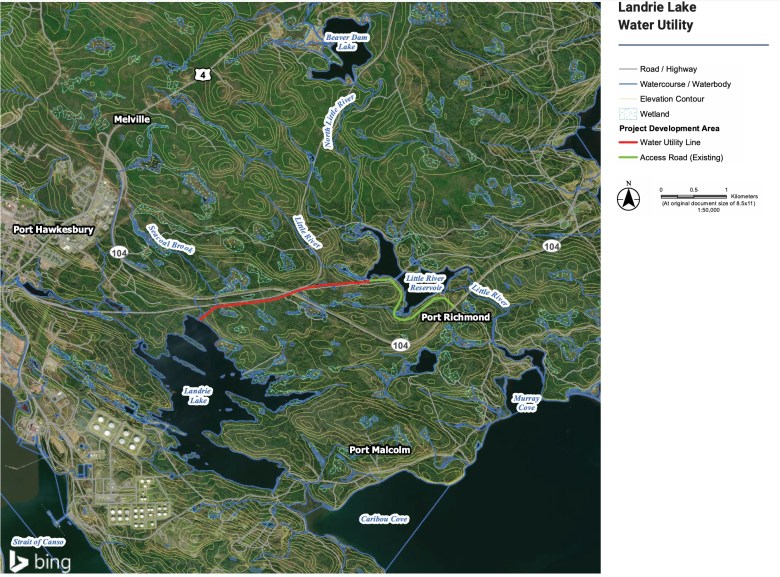 Landrie Lake Water Utility (LLWU) upgrade project map, from a July 2024 update on the project environmental assessment.
In December 2024, Joan Baxter reported on the demands EverWind Fuels will have on Landrie Lake. The lake is managed by the Landrie Lake Water Utility (LLWU) which is co-owned by the Town of Port Hawkesbury and Richmond County.
Currently, LLWU supplies water to the town (that is, its residents), Port Hawkesbury Paper, Tupper Industrial Developers Ltd. (the industrial park), Nova Scotia Power’s Point Tupper coal-burning generating plant, and to the oil tank farm now owned by EverWind.
EverWind bought the oil tank farm from NuStar Energy in 2022, and despite EverWind’s promise to supply ‘green’ energy to the world, the tank farm is EverWind’s only real source of income — the 2.8 million barrel facility basically stores oil for New York customers, and there is a regular flow of oil tankers between EverWind and New York.
EverWind bought the tank farm and the associated shipping terminal with the view that a ‘green’ hydrogen plant can be constructed near Port Hawkesbury, and through the miracle of EU environmental regulations and subsidies from both the Canadian and German governments, the ‘green’ hydrogen (and ammonia) could be stored in what are now the oil tanks, awaiting shipment from the shipping terminal to Germany, creating a glorious non-carbon future and enormous profit for EverWind owner Trent Vichie.
Well, maybe. To work, the plan depends on a few things.
First, of course, are the government subsidies. The Canadian federal government has demonstrated a willingness to play ball — creating a tax rebate regime and even buying EverWind a fleet of tug boats. But the German government is hesitant and appears to be backing away from its earlier support for the plan.
The second thing EverWind needs is a customer. That doesn’t appear to be going well either.
The third thing EverWind needs is water, and lots of it — some 10 million litres per day, or one-third of the available capacity volume of Landrie Lake. This is over and above the water it already uses for the tank farm.
EverWind’s water needs raise two questions:
1) Can an additional 10 million litres/day be drawn from the lake even during Nova Scotia’s increasingly frequent droughts? and
2) Even if that volume can be removed, does the LLWU have the ability to deliver it?
For the first question, LLWU answers ‘yes.’ Even during last summer’s drought, the lake level never fell below 36 million litres per day. “The maximum daily water volume was 9,383,846 litres, while the minimum was 4,843,350 litres… reservoir levels declined during July through September; however, withdrawals remained within approved limits and no service interruptions occurred. No mandatory curtailment measures were required during the reporting period” and the reservoir recharged quickly in the October and November rains.
This feels a little hand-wavey. Seems likely, to me anyway, that future droughts will be even more severe than last year’s. But the agreement between LLWU and EverWind includes a clause that says in the event of drought, deliveries to EverWind “may be curtailed.”
The answer to the second question — can LLWU deliver the water to EverWind? — is a resounding ‘no.’
As Baxter reported, LLWU needs substantial upgrades:
… reinstate the Little River Reservoir Transfer Pumping Station (LRTP) to enhance yield at Landrie Lake. The project will include reinstatement of 2 kms [kilometres] of road abandoned in 1992, replacement of the existing building superstructure and associated equipment, electrical power supply and emergency backup, and reinstatement of 2.6 kms of pipeline and right-of-way from Little River Reservoir to Landrie Lake. At the pipe outlet, a reinforced concrete energy dissipation structure (approximately 230 m [metres] long along an existing mapped watercourse) is being considered to transition flow to stream flow for entry into Landrie Lake, subject to final design.
Who’s going to pay for that? “It’s still not clear who will be paying for the upgrade,” reported Baxter in December 2024.
But now we know.
In a filing with the Nova Scotia Regulatory and Appeals Board last week, LLWU writes that:
(a) The Province agrees to pay to the Water Utility, on the Closing Date, Four Hundred Thousand Dollars ($400,000.00), such amount to be used by the Water Utility solely for construction, repairs and maintenance, operating expenses, and/or to establish a reserve fund for the Water Utility
(b) The Province also agrees to pay to the Water Utility, up to an amount not to exceed Three Hundred Thousand Dollars ($300,000.00) if, within Thee (3) years of the Closing Date, the Water Utility demonstrates, to the satisfaction of the Province, that the Water Utility has spent more than Four Hundred Thousand Dollars ($400,000.00) solely on what the Province considers to be necessary repairs and maintenance of the Utility Assets located at the Utility, during such Three (3) year period.
Which is to say, the province will pay up to $700,000 in order for LLWU to make the upgrades needed to supply EverWind with water.
Parallel to the upgrades at the Landrie Lake facilities, the LLWU is asking the Regulatory and Appeals Board for an as-yet to be determined rate increase.
Also filed recently was a letter of comment from the Maritime Aboriginal Peoples Council, which puts a figure to that rate increase:
On behalf of the Native Council of Nova Scotia (NCNS), the Maritime Aboriginal Aquatic Resources Secretariate (MAARS) would like to express our concerns over the proposed rate increase for the Landrie Lake Water Utility. Given that the rate increase is in direct response to the needs of the EverWind Green Hydrogen facility, these costs should be the sole responsibility of EverWind. It is not the responsibility of the public to cover the costs of industrial developments in Nova Scotia and to approve such a proposal would set a precedent for industrial developers to rely on Nova Scotians to cover the cost of doing business.
As a result, any costs associated with the construction of the updated facility should be the sole responsibility of the industrial developer, EverWind. Additionally, changes made to the rates for customers as a result of the construction of the new pumping station should also be the responsibility of EverWind. Without this development, there would not be a need to reconstruct the pumping station and therefore it is unlikely that water rates would be increased at such a substantial rate.
An increase of 16-23% in water rates has the potential to present significant challenges for existing customers. This could begin to make it impractical for businesses to operate and effectively push new or existing activity out of the Point Tupper and surrounding areas.
You can read the entire letter of comment here.
(Send this item: right click and copy this link)
2. Poverty
 Shelves at a food bank. Credit: Food Banks Canada
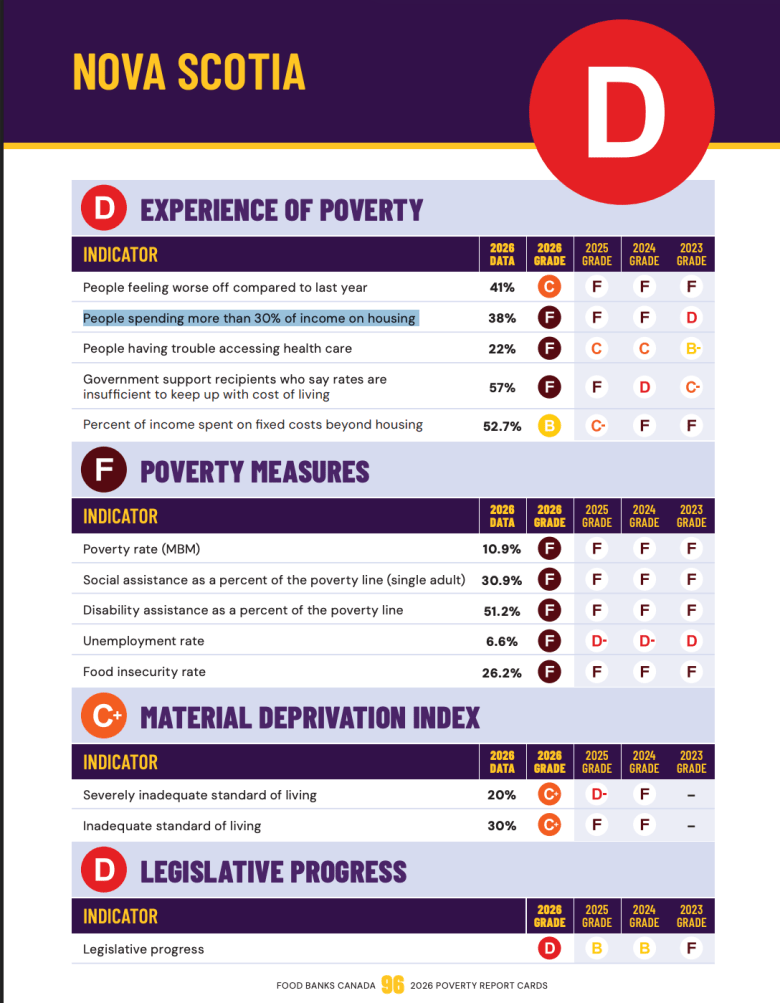
On Monday, Food Banks Canada released its Poverty Report Cards. Nova Scotia got an overall grade of D, and lots of Fs along the way.
The report notes:
Nova Scotia elected Premier Tim Houston’s Progressive Conservatives for a second consecutive term in November 2024. They won 43 of the legislature’s 55 seats, giving them a supermajority. Despite this renewed mandate, Nova Scotia has not updated its poverty reduction strategy since it was first introduced in 2009.
The absence of an updated strategy or clear poverty reduction targets limits accountability for reducing poverty and food insecurity in the province. This gap is significant, as affordability continues to be an issue. Food prices alone have increased by approximately 30% since 2021.
Budget 2026/27 projects a deficit of approximately $1.19 billion. Early announcements included approximately $130 million in grant reductions that will affect a wide range of social programs and community organizations, including education and employment supports, disability services, and programs serving African Nova Scotian and Mi’kmaq communities. Following strong public criticism, the government reinstated $53.6 million in funding for a number of these programs, but several employment and training initiatives remain reduced or eliminated.
On Tuesday, Feed Nova Scotia issued its response to the report, pretty much agreeing with it, writing that:
Nova Scotia’s Poverty Reduction Strategy hasn’t been updated since 2009.
“We are not living in the Nova Scotia of 2009,” says [Ash Avery, Executive
Director of Feed Nova Scotia]. “Housing costs, food prices, and economic pressures have changed dramatically. A poverty reduction strategy that has not been renewed in more than fifteen years cannot adequately respond to today’s reality. Meaningful progress requires measurable targets, accountability, and action.”
Feed Nova Scotia is calling for immediate action, including:
• Increasing social assistance and disability assistance rates to levels that meet basic needs while maintaining indexation
• Restoring and strengthening employment and skills training programs
• Protecting and investing in targeted affordability and poverty reduction supports
• Releasing a renewed provincial poverty reduction strategy with measurable goals, public
reporting, and clear accountability
• Continuing investments in housing, school food programs, and community infrastructure that support food security and stability
(Send this item: right click and copy this link)
THE LATEST FROM THE HALIFAX EXAMINER:
Only 4% of calls to CARE team lead to dispatch of cops, ambulance, says Halifax community safety ED
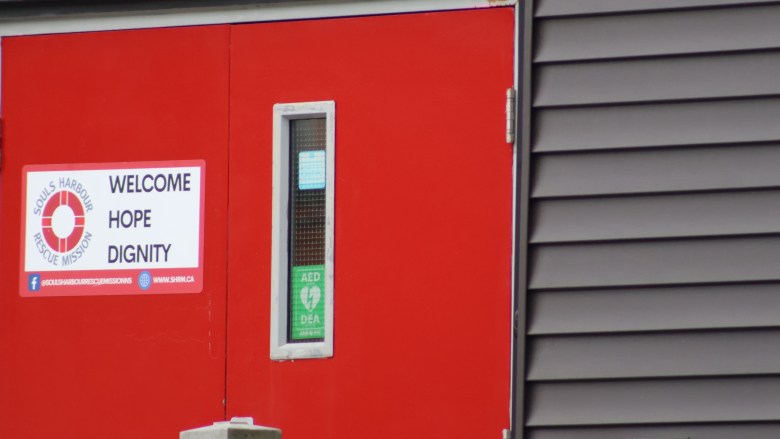 The front doors at Souls Harbour Rescue Mission on Cunard Street in Halifax on March 19, 2026. Credit: Suzanne Rent
Suzanne Rent reports:
The executive director of Halifax’s community safety unit says only 4% of calls to the Crisis Assistance and Response (CARE) team in the first four months of the service have led to calling in police or emergency care.
In that same time period, half of the calls were resolved over the phone.
The CARE team launched in October 2025. The two-year pilot project is funded by Halifax Regional Municipality (HRM) and led by the city’s community safety unit, 211 Nova Scotia, and Souls Harbour Rescue Mission, a non-profit organization that runs shelters and drop-in centres across Nova Scotia.
Click or tap here to read “Only 4% of calls to CARE team lead to dispatch of cops, ambulance, says Halifax community safety ED.”
(Send this item: right click and copy this link)
Government
No meetings
On campus
Dalhousie
Thursday
PhD Defence: Engineering (Agriculture) (Thursday, 9:30am, virtual) — Zheya Lin will defend “Effect of Biosolids Land Application on Soil Carbon and Prediction of Soil Properties Using Mid-Infrared Spectroscopy Technique”
PhD Defence: Biology (Thursday, 2pm, hybrid) — Diana Haider will defend “Bioinformatic Processing and Ecological Stability in Northwestern Atlantic Microbial Time Series”
Movie Night: Last of the Right Whales (Thursday, 5pm, details) — a powerful documentary following the critically endangered North Atlantic Right Whale; learn more about researchers, rescues, and communities working to protect one of the world’s rarest whales
Friday
PhD Thesis Defence: Medical Neuroscience (Friday, 9:30am, hybrid) — Kate Freeman will defend “Polygenic Scores, Sleep, Activity, and Family History as Predictors of Major Mood Disorders”
NSCAD
Artist talk (Thursday, 12pm, Anna Leonowens Gallery 2A) — Petra Bouwers
Literary Events
Thursday
dartspeak Open Mic (Thursday, 7pm, Dartmouth) — details
Atlantic Book Awards Gala (Thursday, 7pm, Halifax Central Library) — tickets $25
Friday
Latte Lit Open Mic (Friday, 6:30pm, Halifax) — details
Weekend
Book signing (Saturday, 1pm, Annapolis Royal) — Corinne Hoebers (Tethered Spirits)
Evergreen Writers Group reading (Sunday, 2pm, Dartmouth) — History, Mystery, Ancestry, Legacy
In the harbour
Halifax
07:00: Zuiderdam, cruise ship with up to 2,364 passengers, arrives at Pier 22 from Sydney, on a 14-day roundtrip cruise out of Boston
08:00: Kastelli Wave, bulker, arrives at Sheet Harbour from Mulgrave
08:00: Silver Arctic, cargo ship, arrives at Pier 42 from Saint-Pierre
13:00: Onego Deusto, cargo ship, sails from Pier 27 for Baie Comeau
15:30: Zuiderdam sails for Portland
16:30: Oceanex Sanderling, ro-ro container, moves from Autoport to Fairview Cove
17:00: Don Quijote, car carrier, arrives at Autoport from Gloucester, Massachusetts
Cape Breton
05:45 AlgoScotia, oil tanker, moves from Sydney anchorage to Government Wharf
15:00: AlgoScotia sails for Halifax
16:30: Indigo Sun, oil tanker, arrives at EverWind from New York
Footnotes
On Tuesday, I had a tooth pulled. Somehow in the process I was infected with something or another and found myself bedridden all day Wednesday with flu-like symptoms, minus respiratory stuff. My mouth was fine; it was the rest of me suffering. Around 1am this morning, however, I had the night sweats, and that seems to have mostly cured me. I’m exhausted from the ordeal, but I guess otherwise back to normal.