
About 375 million years ago, the ancestors of all land vertebrates hauled themselves out of the water and onto land.
How they managed that transition, using fins not yet evolved into proper legs, is one of the great questions in the history of life.

A new study has found a clue in an unexpected place: the clumsy, flopping walk of modern fish that can cross dry land when they need to.
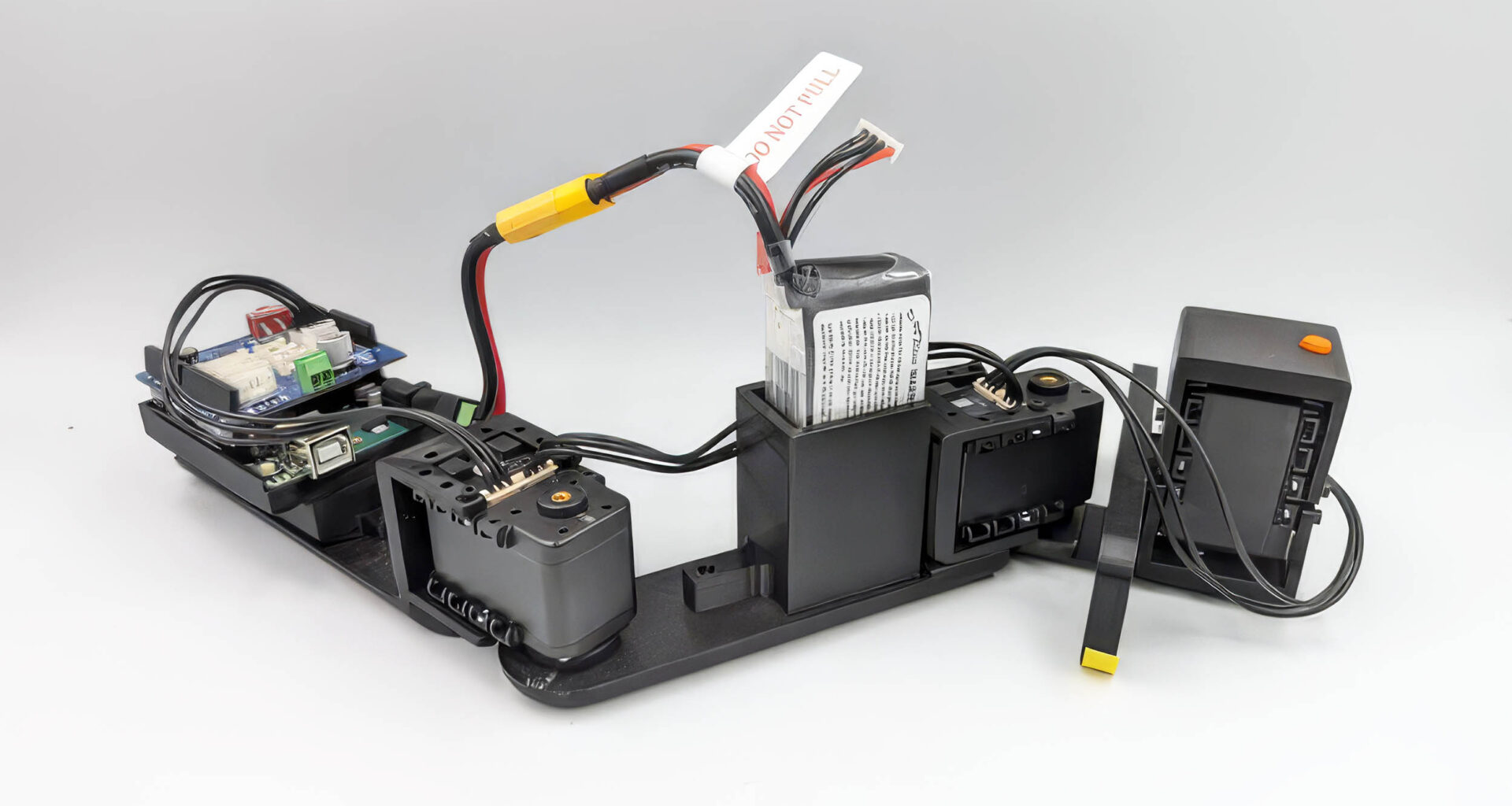
The research, led by the University of Cambridge, combined computer models and a purpose-built robot fish to study how several unrelated species of walking fish move on land.
What the researchers found was that despite having evolved independently, across very different branches of the evolutionary tree, these fish all use essentially the same basic walking pattern.
The same simple mechanical solution keeps reinventing itself and it may be the same solution ancient fish stumbled upon when they first ventured onto shore hundreds of millions of years ago.
Fish that can walk
Several species of living fish can move on land when they have to.
Bichirs, lungfish, catfish, sculpin, or snakeheads are far more comfortable in water, but capable of propelling themselves across dry ground when the need arises.
“If you’ve got the ability to walk on land and your predator doesn’t, then you can escape and hopefully the predator moves on,” said lead author Michael Ishida from Cambridge’s Department of Engineering.
“You’ve also got the ability to move from one shallow-water environment to another, like tide pools for example.”
What nobody had done before was look across multiple unrelated walking fish species and ask whether they share the same underlying locomotion principles.
Ishida, working in Fumiya Iida’s lab and collaborating with biologists and palaeontologists, set out to answer that question.
Recurring kinds of motion
The team started by building a computer model based on the movements of Polypterus senegalus – the grey bichir, a species native to Africa – and several other walking fish.
The model kept finding the same pattern regardless of which species it was based on.
“We kept seeing this recurring kind of walking motion, although it’s very primitive,” Ishida said.
“A number of different fish, spread out across the evolutionary tree, and not closely related to each other, all do it. It’s such a simple movement and can recur from a very basic starting point.”
The team named it the “undulating tripod gait.” It works like this: the fish anchors itself using its front fins or head, then uses its tail to push the body forward around that anchor point.
“It looks like a swimming fish dumped onto land,” Ishida said. “A swimming fish uses its body to propel itself through the water, so if you take that, put it on land, give it some ability to shuffle its front fins, that’s exactly what it’s doing.”
Building a robot to test it
Computer models are convincing up to a point. So the team built a physical robot fish and tested what it found.
“We tried all kinds of different gaits on the robot, and every other gait we tried was slower,” Ishida said.
“Any time we changed how the body bended, or what sequence it was bended in, it was worse. It was surprising that the optimal walking pattern in the simulation and robot matched what the real fish actually do.”
That convergence across three different lines of evidence – real fish observations, computer modelling, and robotics – is what makes the finding compelling.
The gait isn’t just common among walking fish. It appears to be the mechanically optimal solution to the problem of moving on land without proper legs.
And that’s probably why it keeps appearing independently across evolutionary history.
What this reveals about ancient fish
The deeper implication of the research points back 375 million years, to fossil fish like Tiktaalik – the famous “fishapod” whose fins showed early signs of the wrist and finger bones that would eventually become tetrapod limbs.
Tiktaalik and its relatives were the fish making the first tentative excursions onto land, and understanding how they moved is a question palaeontologists have been working on for decades.
The Cambridge team suggests that a similar combination of computer modeling and robotics could be applied to fossil species, using what we know of their anatomy to simulate their movement and test how they might have walked.
If the undulating tripod gait is as mechanically fundamental as the new study suggests, it’s a plausible candidate for how those ancient animals first propelled themselves out of the shallows.
The gait is clumsy, primitive, and looks nothing like how any land animal walks today. But 375 million years ago, it may have been enough.
Click here for a short video demonstration of the fish-like robot locomotion.
The study is published in the journal Nature Communications.
—–
Like what you read? Subscribe to our newsletter for engaging articles, exclusive content, and the latest updates.
Check us out on EarthSnap, a free app brought to you by Eric Ralls and Earth.com.
—–