
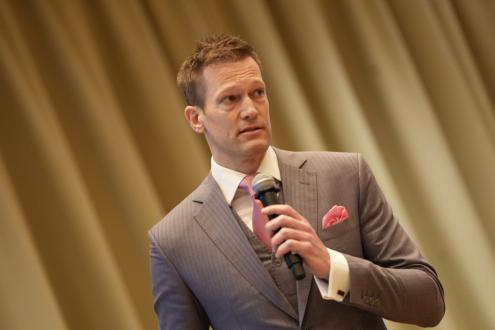
At the Hubbis Independent Wealth Management Forum – Singapore 2026, Yann Mrazek, Founder and Managing Partner at M/HQ, set out a concise but pointed perspective on how global financial centres are evolving.
His presentation framed the past 15 years as a period of profound geographic and structural rebalancing. Where global finance was once dominated by the US, Europe and old-money centres, Mrazek argued that the pendulum has shifted decisively towards the East, with Singapore, Hong Kong and the Middle East playing a far more central role in the allocation, structuring and servicing of wealth.
The message was not that established Western centres have disappeared. It was that the expectations of modern proprietary investors have changed, and that financial centres must now compete on a different set of criteria: reputation, privacy, control, and fiscal predictability..
For independent asset managers, fund managers, ManCos, financial advisers and corporate service providers, Mrazek’s conclusion was clear. Future growth is unlikely to come from remaining locked into a single jurisdiction. The opportunity lies in being selectively global, following clients as they divide their time and capital between key jurisdictions increasingly found in Asia and the Middle East.
Key Takeaways
Global Financial Centres are Shifting East: The world has moved away from a Western-dominated financial centre map towards a more balanced landscape involving Asia and the Middle East.
Singapore and the UAE have Gained Ground: Singapore and the UAE both rank within the top 10 global financial centres according to the latest Global Financial Centres Index (GFCI 39) and confidence in these jurisdictions has grown over the last five years.
Modern Proprietary Investors want Regulation with Flexibility: Clients are attracted to highly regulated jurisdictions that also provide exemptions for proprietary wealth and investment structures.
Privacy has Become a Core Differentiator: Privacy vis a vis the public, is a “new super commodity”, particularly when delivered within a compliant environment. Transparency to the regulator brings credibility. Privacy vis a vis the public brings control and security.
Control Matters More Than Legacy Structures: Families are seeking structures that allow them to retain control over governance, investments and operations. They value flexibility as family portfolios expand into private equity, private debt, digital assets, angel investments and other alternative asset classes.
Fiscal Predictability is More Important than Tax Optimisation Alone: Tax remains relevant, but clients increasingly value jurisdictions where the fiscal environment is stable, clear and predictable.
Strategic Presence Matters More Than Global Scale: Independent asset managers and advisers risk being left behind if they remain anchored to a single market. The answer is not global expansion everywhere, but selective investment in the jurisdictions where clients are already building their next wealth, investment and family office hubs.Asia and the Middle East are Becoming a Multi-Hub Client Corridor: Mrazek sees Singapore, Dubai and Abu Dhabi as key centres in the next phase of client growth.
A Financial Centre Map Redrawn
Mrazek opened by reflecting on how dramatically the global financial centre landscape has changed over the past 15 years.
He recalled a world previously dominated by the West. The US, old Europe and old-money jurisdictions sat at the centre of global financial flows. Luxembourg retained relevance. Asia had a role, but it was largely concentrated around Singapore, Hong Kong and, to a lesser extent, Tokyo. The Middle East was far less prominent than it is today.
That landscape has changed materially. Mrazek described a “huge pendulum shift” towards the East, driven by fundamental rather than superficial forces. Technology, regulatory adaptation, changing client expectations and the evolution of finance itself have all altered the competitive positioning of financial centres.
“The map of global finance has not just expanded,” he said. “It has been redrawn around where clients now see relevance, flexibility and future growth.”
For Mrazek, the most important point is that clients are watching these shifts closely. They are not passive observers of jurisdictional change. They assess where regulatory frameworks are improving, where structuring options are more effective, and where their capital and families can be served more effectively.
That client perspective matters because financial centres ultimately compete for confidence. The centres that rise will be those that can demonstrate both credibility and adaptability.
Proprietary Money has Changed
Mrazek then turned to proprietary wealth, drawing on M/HQ’s work servicing 450 single family offices out of the UAE.
He said this client base is attracted to a specific model: highly regulated jurisdictions that also provide exemptions for proprietary wealth. In other words, clients want robust regulation, but they want proportionality. They do not want structures designed for third-party financial institutions imposed indiscriminately on private capital.
This distinction is central to the modern family office and proprietary wealth market. Regulation provides credibility and comfort. But proprietary investors also require flexibility, especially when structuring family wealth, investing directly, or allocating to alternative asset classes.
“The modern proprietary investor is not looking for less regulation,” he observed. “They are looking for the right regulation, applied in a way that understands private capital.”
Mrazek said clients also value regulators and registries that are open to suggestion and willing to partner with industry, rather than simply acting as policers of business. This shift in regulatory tone is becoming a competitive advantage for jurisdictions that want to attract sophisticated wealth.
He noted that proprietary investors surveyed by M/HQ have perceived the UAE much more favourably over the past five years. He added that they said the same about Singapore.
For Mrazek, this reflects a broader pattern. Clients are reassessing jurisdictions not only on tax or prestige, but on whether the operating environment can support their future needs.
Sophisticated regulation, not overregulationA central theme in the presentation was the changing relationship between regulation and proprietary wealth.
Mrazek argued that modern proprietary investors increasingly want highly regulated jurisdictions. This may seem counterintuitive to those who assume private capital is seeking lighter oversight. But for serious family offices and proprietary investors of the kind M/HQ works with, credible regulation can provide legitimacy, banking access, reputational comfort and institutional confidence.
However, the regulatory environment must distinguish between proprietary wealth and third-party financial activity.
Clients want structures that allow them to manage their own capital without being overburdened by rules designed for asset managers handling external money. This is where exemptions for proprietary investment structures become important.
“Regulation is no longer the deterrent,” he said. “The deterrent is regulation that does not understand the difference between managing your own wealth and managing someone else’s.”
This helps explain the appeal of jurisdictions that combine high regulatory standards with practical structuring flexibility. Mrazek positioned this as one reason why Singapore and the UAE have strengthened their relevance among global family office and proprietary investment clients.
The winners, in his view, will be jurisdictions that can provide both confidence and proportionality.
Privacy as the New Super Commodity
Mrazek described privacy as the “new super commodity” for proprietary investors.
This was not framed as secrecy or regulatory avoidance. Rather, it was positioned as the ability to preserve privacy within a compliant environment. For UHNW families and proprietary investors, privacy remains an essential concern, but it must now operate alongside transparency, reporting obligations and legitimate regulatory expectations.
The jurisdictions that can balance those priorities are likely to continue rising.
“Privacy has not disappeared as a client priority,” he said. “It has become more valuable precisely because it now has to exist inside a compliant framework.”
This creates a clear divide between financial centres. Jurisdictions that can offer privacy, predictability and regulatory credibility are becoming more attractive. Those that cannot may lose relevance, particularly for clients who are increasingly mobile and sophisticated.
Mrazek’s point was that privacy is not a legacy concern. It is a modern structuring requirement, particularly for globally active families with assets, businesses and family members across multiple jurisdictions.
Control and the Limits of Legacy Structures
Mrazek also emphasised the growing importance of control.
He argued that modern clients want structures that allow them to participate in a broader range of asset classes, including private equity, angel investments, debt and other alternatives. Traditional trustee models may not always be able to accommodate that kind of flexibility.
This has contributed to the rise of newer proprietary investment structures, including private trust companies in Singapore, private trust foundations in Dubai or Abu Dhabi and the new variable capital company regime introduced in the Dubai International Financial Centre.
These structures are being used because they can provide families with greater control, governance flexibility and the ability to invest in ways that align with modern wealth creation and preservation.
“Clients are not building structures just to hold assets,” he said. “They are building structures to make decisions, deploy capital and retain control.”
This reflects a broader evolution in private wealth. Families are no longer necessarily looking for static succession vehicles alone. They want platforms that can support investment activity, governance, asset protection and intergenerational continuity.
For advisers, this means understanding structure not only as a legal or administrative tool, but as part of a family’s operating architecture.
Fiscal Predictability over Tax Optimisation Alone
Tax optimisation remains relevant, but Mrazek argued that it is no longer the only or even the dominant consideration.
For modern proprietary investors, the predictability of the fiscal environment has become increasingly important. Clients want to know that the rules they rely on today will not be radically altered tomorrow.
This is where Mrazek contrasted newer or more client-conscious jurisdictions with old European centres. In his view, jurisdictions that have their own clients and operate with a more “super jurisdiction” character can be more predictable than some legacy European environments.
“The question is no longer only how low the tax rate is,” he said. “It is whether the rules will still make sense five or 10 years from now.”
That predictability matters because families are making long-term decisions. They are building structures, relocating members, allocating capital and designing governance frameworks. Sudden fiscal shifts can undermine that planning.
The financial centres that rise will therefore be those that can offer not just efficiency, but confidence.
The Risk of Being Single-Jurisdiction Only
Mrazek then turned directly to the audience of independent asset managers, fund managers, mancos, advisers and corporate service providers.
His central question was: where the next wave of business growth will come from?
He acknowledged that Asia will likely continue to provide growth. Singapore, in particular, remains strongly supported by government efforts to strengthen the jurisdiction’s credentials. However, he warned that being concentrated in a single-jurisdiction only is a significant strategic risk.
This was not a call for firms to become global in an indiscriminate way. Mrazek was explicit that he was not encouraging firms to build broad global footprints for their own sake. Instead, he advocated being selectively global.
“Being single-jurisdiction only is no longer conservative,” he said. “It can be a concentration risk.”
The point is especially relevant for firms whose clients are becoming more mobile. If clients are splitting their lives, investments and structures across multiple hubs, advisers who remain locked into one jurisdiction may find themselves increasingly misaligned with client needs.
In this context, growth depends not only on technical expertise, but on geographic relevance.
Selectively Global, Not Everywhere
Mrazek’s recommendation was focused and pragmatic: firms should follow clients where they are actually going.
For many proprietary investors and UHNW families, that increasingly means a multi-hub model across traditional Western centres as well as Asia and the Middle East. Singapore remains important, but Dubai and Abu Dhabi are becoming increasingly relevant to the same client base.
The opportunity is not to build a presence everywhere. It is to identify the jurisdictions that matter most to clients and develop the capabilities to serve them across those corridors.
“Selective globalisation is not about planting flags,” he said. “It is about being present where the next stage of client growth is actually happening.”
For independent asset managers, fund managers, financial advisers and professional advisors, this has practical implications. They need to understand the regulatory models, structuring tools and client expectations in the hubs where proprietary money is moving.
This is particularly important as clients increasingly expect advisers to guide them, not simply react after decisions have already been made.
Asia and the Middle East as the Next Client Corridor
Mrazek concluded by identifying Asia and the Middle East as central to the next phase of client movement.
He said clients are increasingly likely to split their time across multiple hubs, particularly between Asia and the Middle East, including Dubai and Abu Dhabi. This creates both an opportunity and a warning for advisers.
The opportunity is growth. Firms that understand this corridor can position themselves to advise clients as they structure, invest and relocate across these centres.
The warning is that clients will not wait. If their advisers cannot support them across the hubs they are moving towards, they may find others who can.
“Your client will not be waiting for you,” he said. “But you can be leading their way towards the next stage of growth.”
This was the central commercial message of the presentation. Global financial centres are changing because clients are changing. Proprietary investors want regulation, but with flexibility. They want privacy, but in a compliant environment. They want control, alternative investment access and fiscal predictability. They also want advisers who can operate across the jurisdictions that now matter to them.
For Mrazek, the future will not belong to firms that remain narrowly tied to one market, nor to those that attempt to be global everywhere. It will belong to those that are selectively global, strategically aligned and ready to follow clients into the new financial centre map.