
‘You have to see this’: Photo exhibit sparks memories across Harrop-Procter
Published 5:35 am Tuesday, June 9, 2026
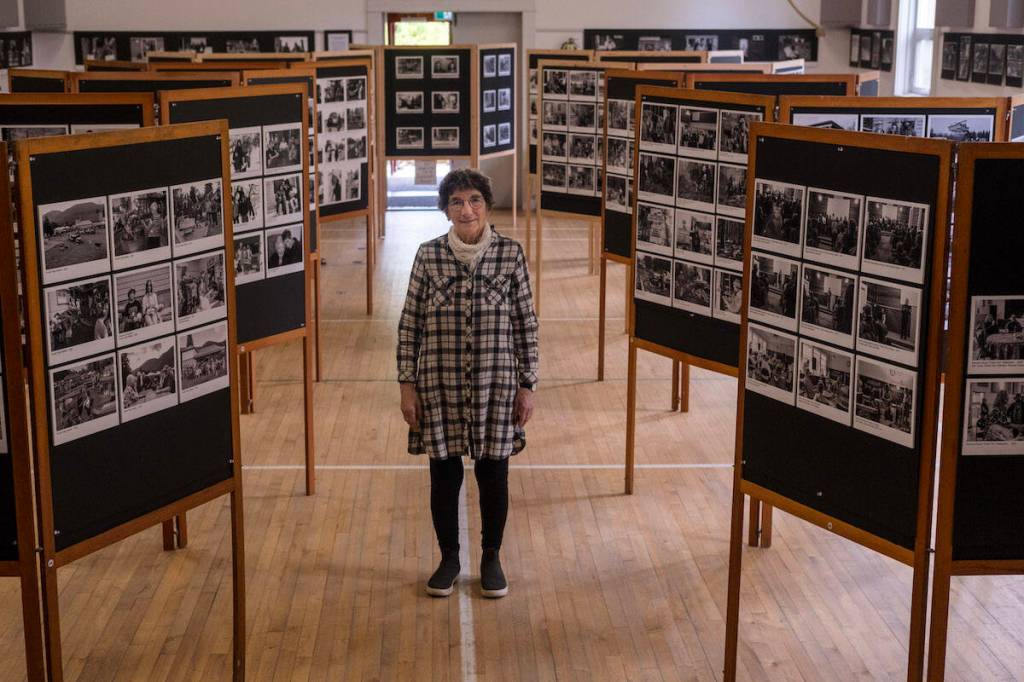
At the photographer Ursula Heller’s exhibit entitled Our Side, some viewers were moved to tears.
Others hugged each other, or hugged Heller. Some could not tear themselves away, wandering through the panels of photos, losing track of time, drawn in by the personal and community memories there.
“So many people give me hugs and thank me for doing this,” said Heller. “I’m very touched.”
The title Our Side refers the communities of Harrop and Procter, population about 700 combined, located on their own side of Kootenay Lake, across a cable ferry and at the end of the road – a community with a separate identity from the mainstream life of Nelson-Balfour-Kaslo.
Heller’s collection of 498 photos of local people taken during the 38 years she and her husband Barry Gray have lived there were mounted on dozens of standing panels at the Procter Hall from May 29 to June 2.
The exhibit attracted a steady stream of individuals and small groups, mostly locals.
People who may have lived in the community for decades discovered photos of themselves, friends, relatives and acquaintances from over the years, occasionally brought up short by an unexpected silent visit with their much younger self or with a community member no longer living.
Newcomers to Harrop-Procter saw this history and got curious about the past life of their new home.
People were moved to talk to each other and ask questions, Heller said.
“There are always these little circles of people, always people coming and going. Many people come back and they bring their friends. They tell them, ‘You have to see this.’”
Heller said the event was not a photography exhibit in the usual sense. The point was not to show off her skills (which are very high-level although she might be too modest so say so). Her purpose was to connect and reconnect people in the community.
“It is about memories, and the recognition that we care for each other. We have gone through hard times in this community and we all kind of live isolated.”
The photos, all in black and white and all the same size, mounted thematically on dozens of standing panels, showed residents working in the kitchen at the Village Bakery, or at the sawmill or the tree seedling nursery.
There are photos of people in everyday activities like playing bingo, quilting, cooking, and building.
There are people in action at a demonstration about logging or about ferries, enjoying a Christmas fair, shopping in the general store, or costumed at a Halloween party.
Others are simply portraits, taken in people’s houses, with the subjects looking comfortable and at home.
Heller never does candid shots. She prefers to take photos of people in their natural settings, like at work or at home, and she likes to get to know them first, then ask if she can photograph them.
“And then I ask people to choose their own space. ‘Where do you want to be photographed? Where do you feel comfortable?’ I think that moves people. They want to be part of this connection. I like to give them the opportunity to be themselves and to be relaxed.”
Heller never photographs landscapes, only people, and always in black and white.
“I have a much stronger soul connection in black and white than in color. For me a yellow shirt and a blue hat take away from an eye contact. I mean there is beautiful color photography – I’m just not the one who can do it.
Heller studied photography for five years in Switzerland. For her graduate project in 1971 she photographed her home village of Eglisau. In 1975 she documented the village of Brigels, where she lived at the time. Two years ago she sent the negatives to Brigels, she said, “because I’m getting old and need to get all my work back to where it belongs.”
They responded, telling her that they had digitized the photos and created an exhibition of her work that will run from June 14 through the fall.
They invited her to the opening and asked her to re-document the village, offering her and her husband a house to live in while she completes that project.
They accepted and left Canada the day after the Our Side exhibit closed.