
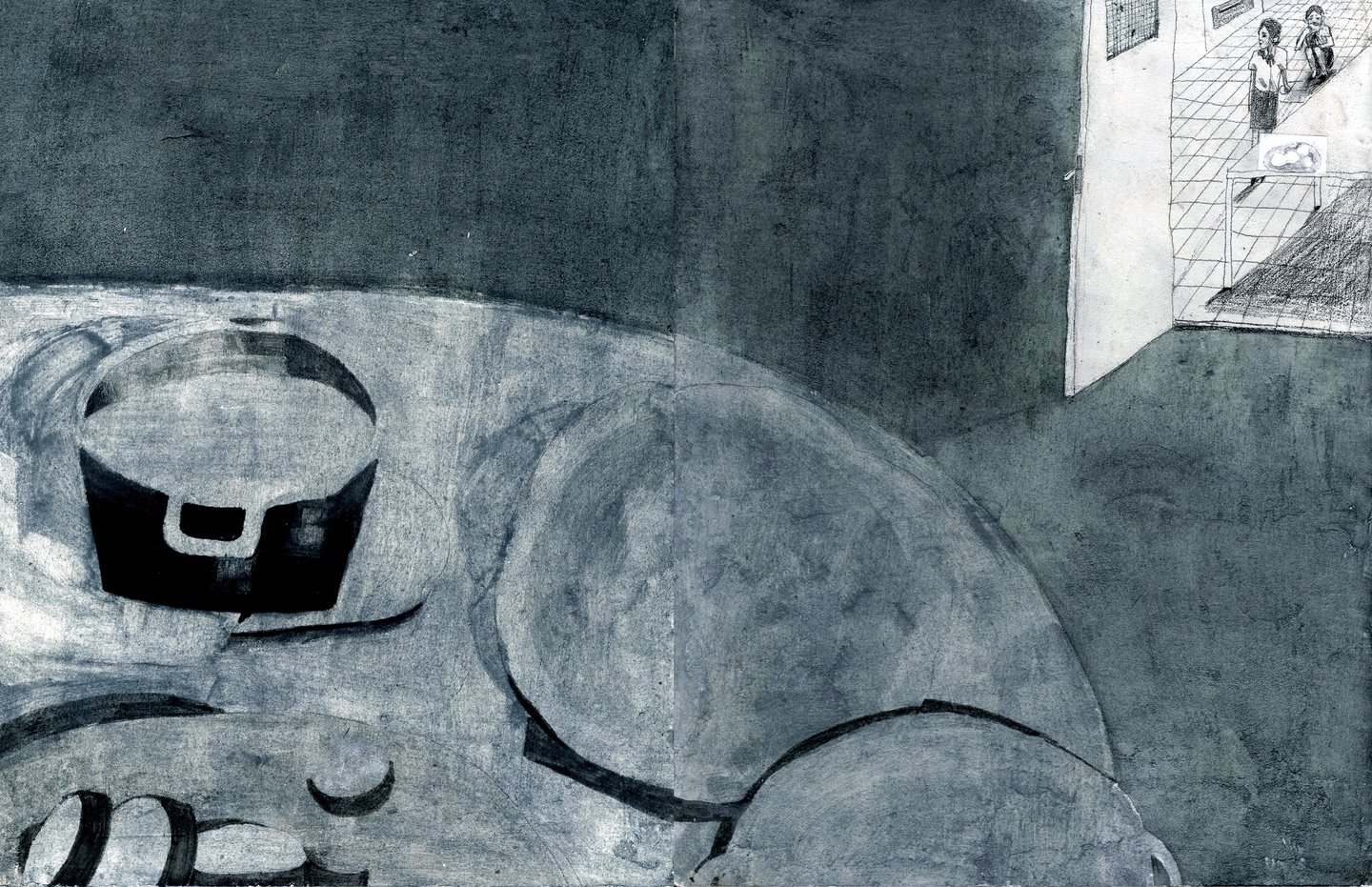
Lily began the illustrations with loose sketches and written notes to set the emotional tone before developing specific scenes, using colour and form to shape memory and reference, especially Lily’s own experience of moving between Beijing and New York as an immigrant with time limits and restrictions. To capture the mood, she used fibre gesso on wood, creating a texture that feels like paper but is in fact much colder, allowing pencil and watercolours to sit on the surface in a way that Lily describes as “like snow”. Not after long, the materials become a part of the storytelling rather than just technical choices – ephemeral, ghostly and deeply sad.
In the illustrations, the character’s faces are sometimes covered with scratchy, cold blocks of blue, whereas in other scenes, the entire character is curled up in a suitcase, which appears as a tight block, using the conventions of comic book narratives as an oppressive diegetic story-tool. The way some figures are thinly sketched, whereas others have full faces defined by black-and-white water colours or clothes speckled with muted colours brings the viewer closer to the story, directing focus subtly and effectively using mood as a character.
“I was influenced by independent filmmakers such as Hu Bo, Diao Yinan and the Coen brothers,” says Lily. “Their films often focus on ordinary people who are pushed to the margins of society and left to struggle quietly for survival. What stayed with me was not spectacle or dramatic rebellion, but the feeling of being abandoned by a system and still having to endure within it.” It’s evident in the work: small, restrained forms of persistence drive the struggle of the main characters, who speak not with words but actions – sometimes Lily obstructs the viewer from being able to see those inner feelings. Like Lilja 4-Ever, the story is cornered on all sides with building blocks, concrete and grey. There is no happy ending, nor moments of alleviation, but that’s what bakes the viewer into this desolate world so brilliantly.