
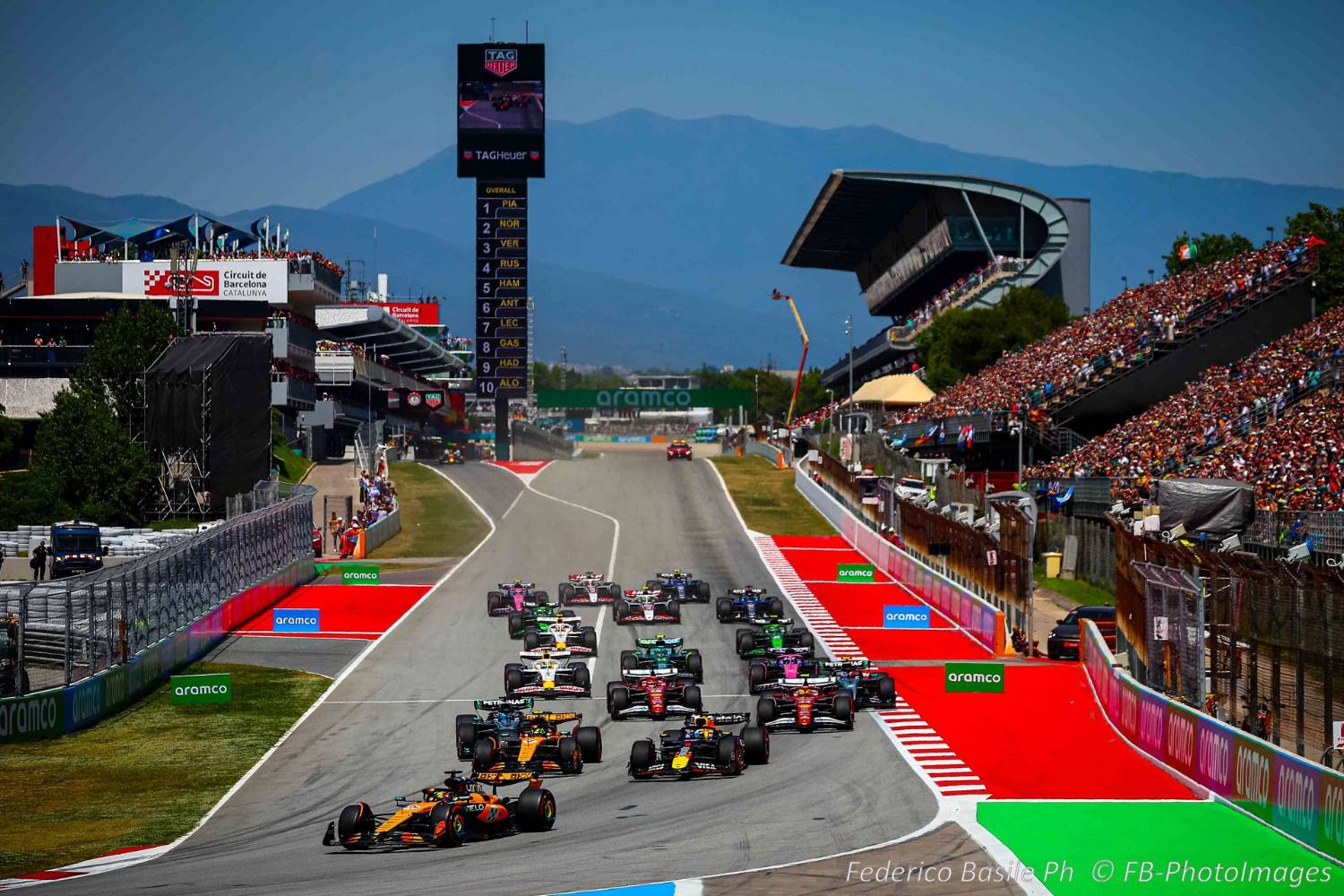
Round 10 of the 2026 FIA Formula 1 World Championship sees the grid return to one of its most complete and demanding permanent circuits as the newly renamed Barcelona-Catalunya Grand Prix hosts the first European round since the dramatic regulation reset.
–By Mark Cipolloni–
The Circuit de Barcelona-Catalunya was first used by Formula 1 in 1991 and has long been regarded as the archetypal test of aerodynamic efficiency and chassis balance. Its flowing layout, dominated by high-speed, long-radius corners, places enormous demands on downforce and stability. That challenge is most evident through the sweeping 180-degree Turn 3, the high-speed uphill Turn 9, and the technical 90-degree final corner onto the pit straight—all of which reward precision and commitment while punishing any imbalance.
With the Spanish Grand Prix now relocating to the brand-new Madring venue in Madrid for its debut in September, Barcelona takes on the fresh title of Barcelona-Catalunya Grand Prix for 2026. The race has also been shifted two weeks later on the calendar compared with previous years, bringing warmer track temperatures and a different set of strategic variables.
Six months after the revolutionary 2026 cars first turned a wheel here during five days of pre-season testing in January, the field returns to Montmeló this weekend. The circuit where the new technical era began now serves as a crucial benchmark for how far the teams have progressed — and how much work still lies ahead.
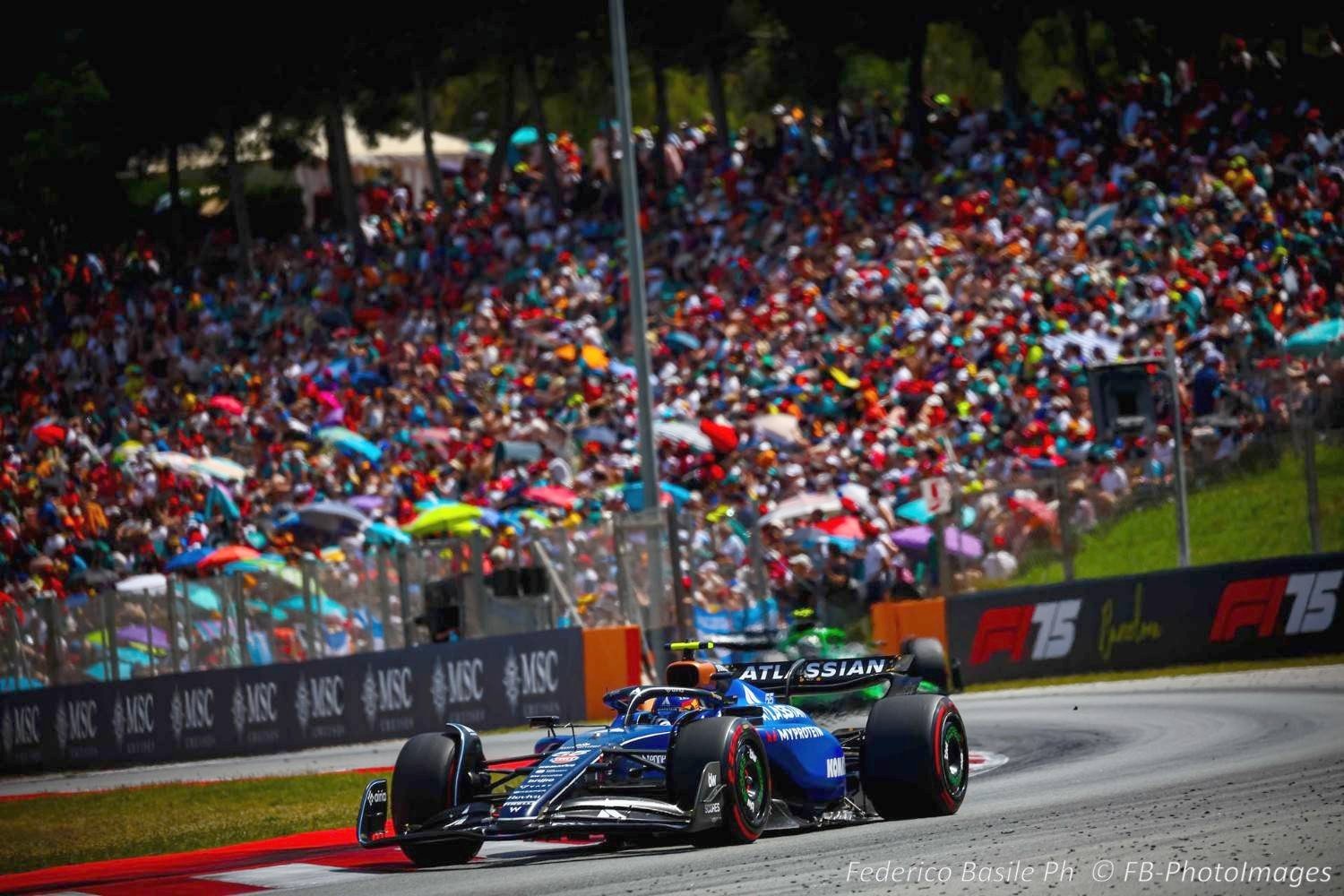 55 Carlos Sainz, (ESP) Williams Mercedes Fw47, during the Spanish GP, Barcelona 29 May-1 June 2025, Montemelò Formula 1 World championship 2025.
Circuit Overview
The 4.657-kilometer track features 14 corners, many taken at high speed, and delivers sustained high lateral loads through the tires. The layout is notably asymmetric: nine right-handers versus five left-handers place significantly greater stress on the left side of the car, particularly the front-left and rear-left tires. The reprofiled final two corners (introduced in 2023) create a smoother, faster entry onto the pit straight, while the abrasive asphalt surface—one of the oldest on the calendar—adds a mechanical wear element on top of the already demanding thermal degradation.
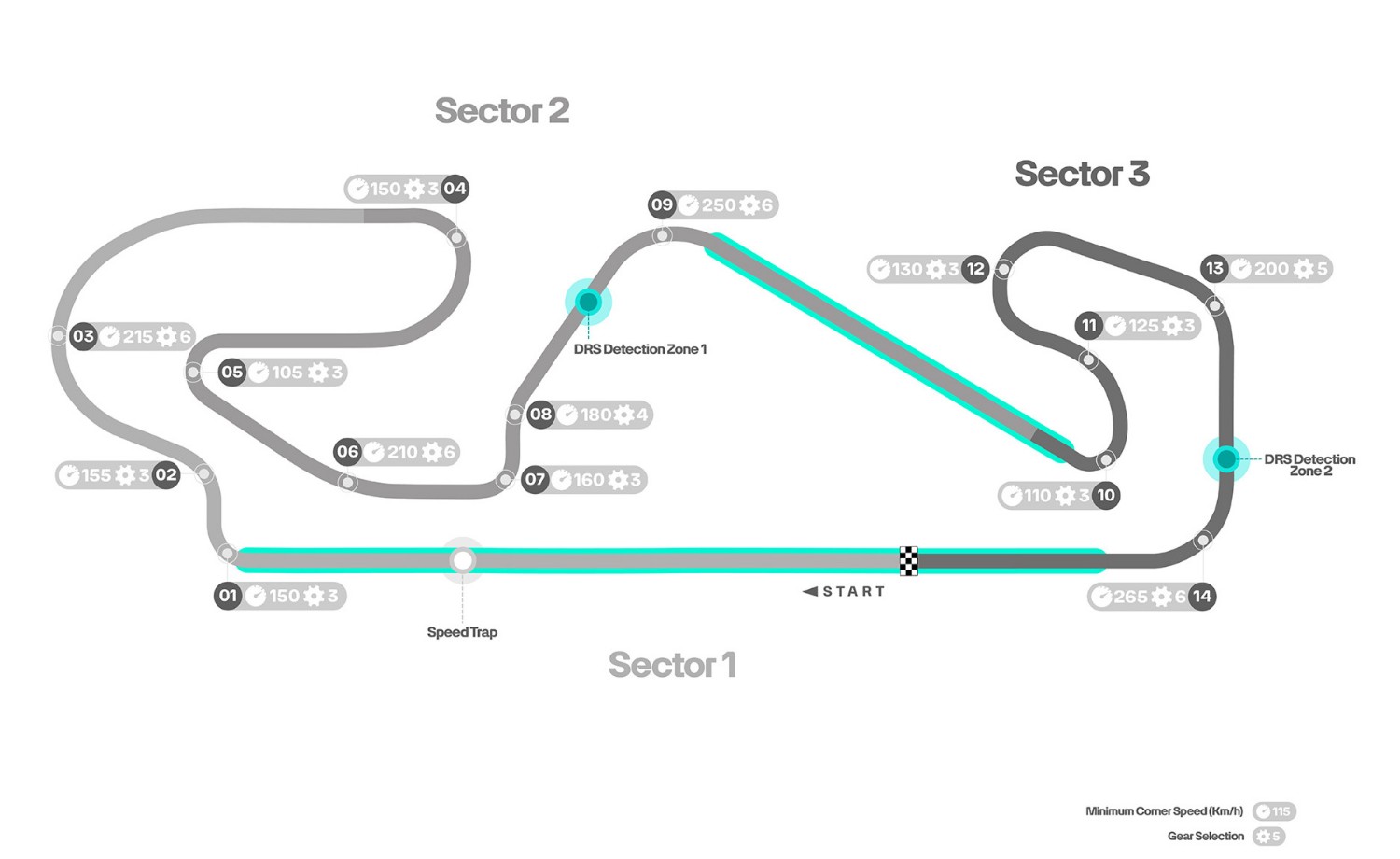 Barcelona – Track Map
Fact File: Barcelona-Catalunya Grand Prix
• The track is one of the most complete on the calendar and is known as the archetypal permanent circuit owing to its wide range of corners and technical requirements.
• Asymmetric layout – the high-speed corners are all right-handed and the slow/medium-speed corners all left-handed, creating heavily one-sided lateral demand and uneven tire degradation. This opens opportunities for an asymmetric mechanical car setup.
• Front locking under braking – a recurring issue at T5, T7 and T10 (all left-handers), requiring careful brake bias and entry speed management.
• Limited overtaking opportunities – following through T13/14 is the primary challenge, making qualifying and track position important despite the long run into T1.
• Barcelona is a complex energy management circuit with several high-speed corners followed by long straights. Whether corners are taken flat or not will significantly affect the optimal energy deployment strategy over the lap. A reasonable amount of super clip is expected in the race, and teams may use lift-and-coast to help control this.
• Tire degradation is predominantly thermal and, as with wear, the front axle is the limiting factor. The asphalt is very abrasive. Track temperatures are likely to be higher than those recorded in recent years given the later calendar date.
Pirelli Tire Selection
For this weekend Pirelli has nominated its softest-ever compound trio for Barcelona: C2 (Hard), C3 (Medium) and C4 (Soft). This is a more aggressive allocation than the circuit has traditionally seen, designed to promote multi-stop strategies and bring the Hard tire into play. Tire degradation is expected to be predominantly thermal, with the front axle the limiting factor. Higher track temperatures due to the later calendar slot will only amplify the challenge.
Pirelli will remain at Montmeló on Tuesday 16 and Wednesday 17 June for a two-day slick tire test, with Scuderia Ferrari, Aston Martin and Cadillac all taking part.
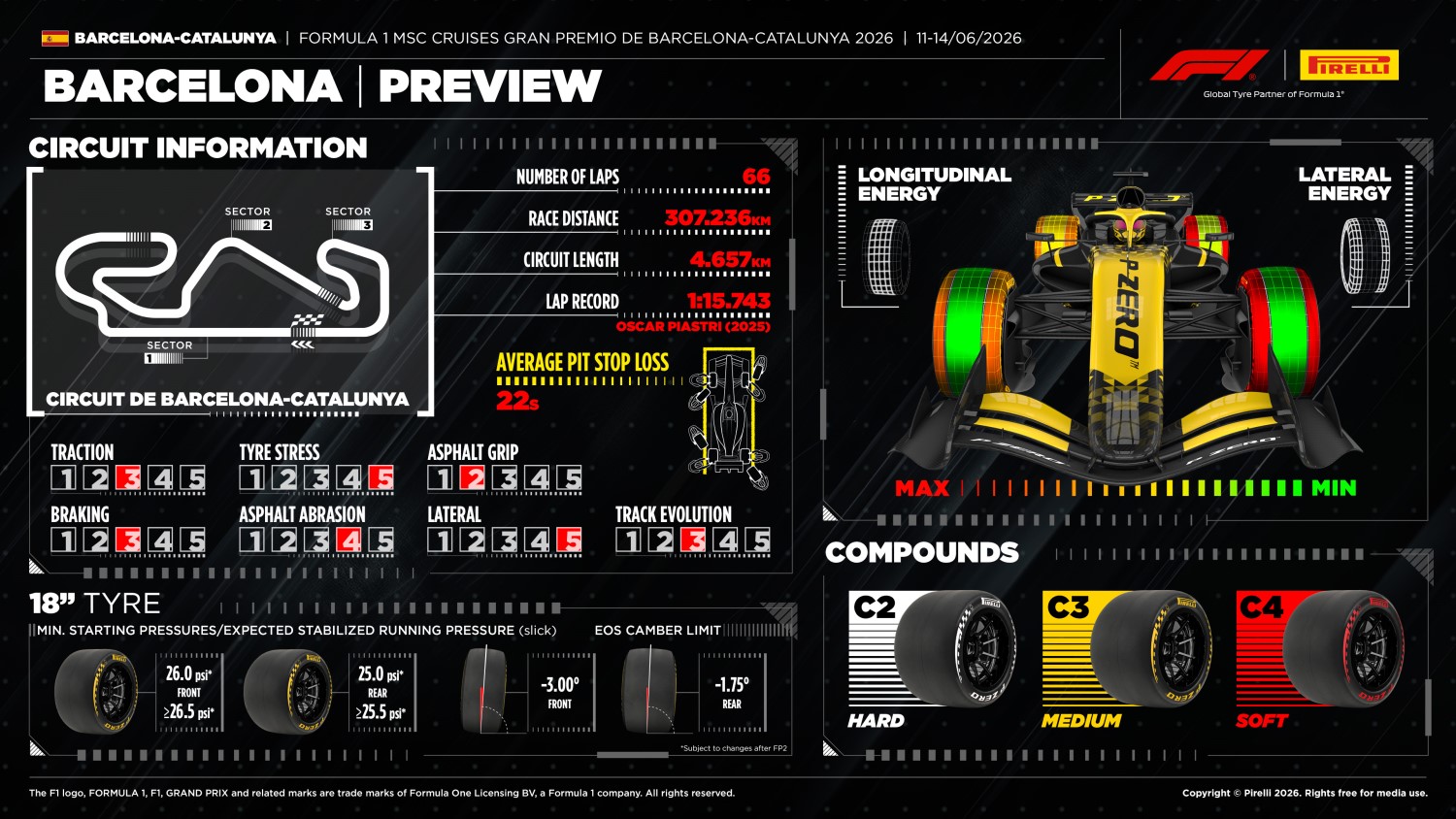
Key Technical Challenges – Paul Williams, Williams Chief Trackside Engineer
Ahead of the weekend, Williams Chief Trackside Engineer Paul Williams outlined the main factors that will shape the 2026 Barcelona-Catalunya Grand Prix:
Asymmetric layout
“The high-speed corners are all right-handed and the slow-to-medium-speed corners are all left-handed. That creates heavily one-sided lateral demand and uneven tire degradation, opening the door for asymmetric mechanical setups.”
Front locking under braking
“A recurring issue at T5, T7 and T10 (all left-handers). Teams will need careful brake bias and entry-speed management.”
Limited overtaking
“Following through the final complex (T13/14) is difficult, so qualifying and track position remain critical despite the long run into Turn 1.”
2026 regulation influence
“Barcelona is a complex energy-management circuit. Several high-speed corners are followed by long straights, so whether corners are taken flat or not will dictate the optimal energy deployment strategy. Expect a reasonable amount of super-clip in the race; lift-and-coast may be used to manage it.”
Tire challenges
“Softer compounds on a circuit that still sees high degradation. T3, T9, T13 and T14 generate very high front-left/rear-left energy, leading to significant wear and overheating. This is the roughest track surface we’ve seen since winter testing in Bahrain. In qualifying it will be a true single-lap tire.”
Race strategy
“A two-stop race is the baseline expectation. Stop windows are wide — teams must choose between aggressive early stops (at the cost of race time) or more optimal long runs that risk losing track position. Safety Car or VSC probability is moderate; a mid-race intervention could easily turn the race into a three-stopper.”
Weather Forecast
Sunny conditions and light winds are forecast for the entire weekend at the Circuit de Barcelona-Catalunya. No rain is expected from Friday through Sunday, with clear skies, bright sunshine and maximum temperatures around 27°C (81°F). The consistent, dry and warmer-than-usual conditions for this time of year should produce reliable track grip and predictable tire behaviour.
USA TV Schedule (All Times Eastern on Apple TV+)
– Thursday, June 11
Formula 1 Barcelona GP Preview: 10:30am – 11:30am
– Friday, June 12
Formula 1 Barcelona GP Practice 1: 7:10am – 8:30am
Formula 1 Barcelona GP Practice 2: 10:40am – 12:00pm
– Saturday, June 13
Formula 1 Barcelona GP Practice 3: 6:10am – 7:30am
Formula 1 Barcelona GP Qualifying: 9:25am – 11:00am
– Sunday, June 14
Formula 1 Barcelona GP Pre-Race: 7:50am – 9:00am
Formula 1 Barcelona GP Race: 9:00am – 11:00am
All sessions and additional coverage are available live on Apple TV+.