
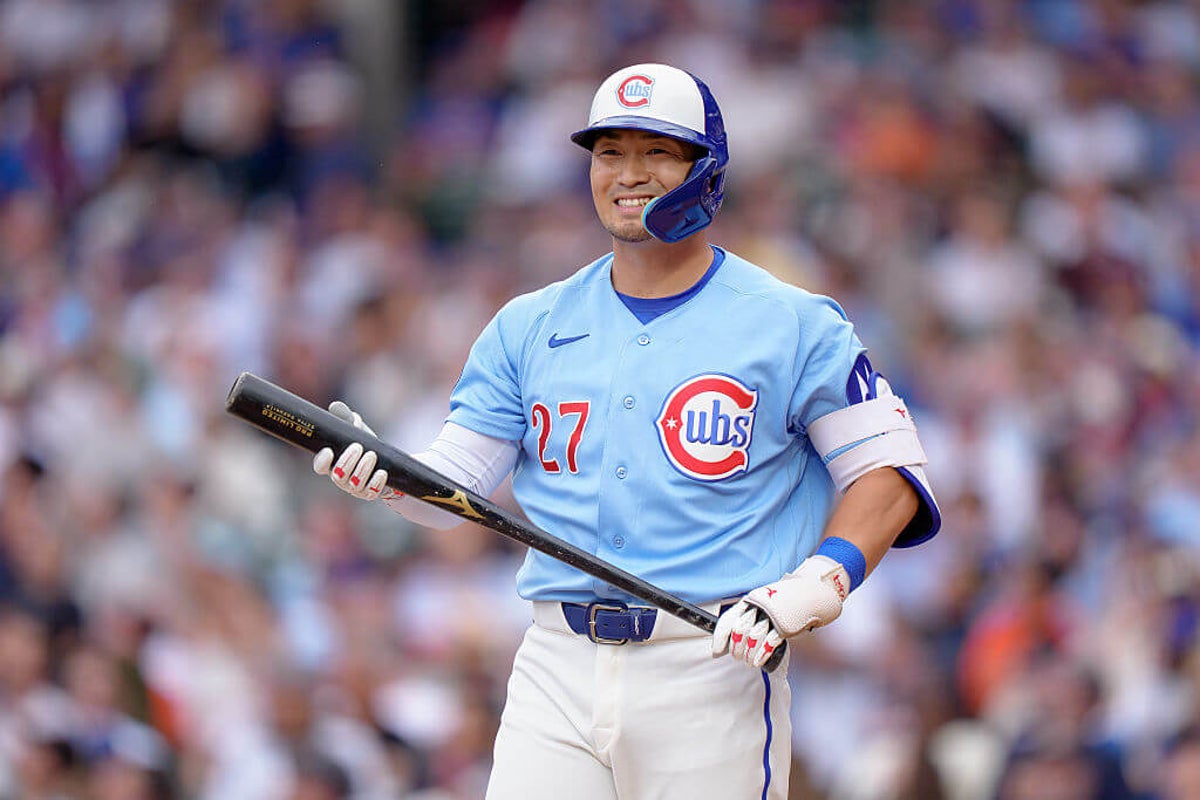
Right-handed hitters throughout Major League Baseball entered Wednesday with a .696 OPS, a figure that would be the lowest for that category of players in any season since 1992.
Know what that tells us?
Quality right-handed bats will have immense value at the trade deadline. And the Chicago Cubs, a team arguably in need of a shakeup, feature a righty hitter other teams might covet:
Right fielder Seiya Suzuki.
The Cubs drew trade interest in Suzuki last offseason, in part, because so few right-handed hitters were available. They also drew interest in second baseman Nico Hoerner, but awarded him a six-year, $141 million extension rather than move him.
The Hoerner deal left with the Cubs with five prominent players on expiring contracts — Suzuki, left fielder Ian Happ and starting pitchers Shota Imanaga, Jameson Taillon and Matthew Boyd. The Cubs won’t keep all of them in open-market bidding. They probably don’t want to keep all of them.
Their payroll commitments for 2027 amount to a modest $111 million, even after the signings of Hoerner, center fielder Pete Crow-Armstrong and third baseman Alex Bregman to nine-figure contracts. But Suzuki, who turns 32 in August, is not likely to be part of the team’s future. So, it would behoove the Cubs to explore the market for him.
Perhaps Suzuki could bring back a starting pitcher who also is a potential free agent, helping the club fill a more dire need. If the Cubs keep Suzuki and he departs as a free agent, they would receive only a draft pick as compensation, assuming they made him a qualifying offer. A trade could yield considerably more value, particularly if the Cubs included cash to pay down part of Suzuki’s remaining salary, which at the deadline will be less than $6 million.
Suzuki’s full no-trade clause would complicate matters, enabling him to effectively guide the process. However, he likely would be inclined to approve a deal, ensuring he could not receive a qualifying offer as a player traded in the middle of a season (yes, the system is likely to remain intact for at least one more year; teams make qualifying offers in November and the CBA does not expire until Dec. 1).
Like most Cubs hitters this season, Suzuki has been wildly inconsistent. His season debut was delayed until April 10 because of a sprained right knee. He then produced a wRC+ 81 percent above league average in April, dropped to 47 percent below in May but has rallied to well above again in June. His defensive metrics are by far the best of his career. Evidently, he does not want to DH.
Matt Shaw and Michael Conforto might not offer the same production as Suzuki if they replaced him as part of a right-field platoon, but the overall team could be better if the Cubs landed pitching in return.
The Cubs could use a jolt. They need to extract value from at least one of their potential free agents. And in a sport increasingly lacking in potent right-handed hitters, Suzuki figures to be in demand.
And that other team in Chicago?
The loss of first baseman Munetaka Murakami to a strained right hamstring on May 29 has yet to slow down the Chicago White Sox.
With Murakami, the White Sox averaged 4.67 runs per game, ranking ninth in the majors. Without him, they entered Wednesday averaging 5.56 runs, eighth best in the league.
Among the White Sox’s other stunning achievements: They are 30-18 since April 17, the second-best record in the AL behind only the New York Yankees’ 31-17 mark. They also have won seven straight home games and 18 of their last 21.
Not bad, considering the White Sox have had 12 players this season make their major-league debuts. And while the team’s current nine-game stretch against the Atlanta Braves, Los Angeles Dodgers and Yankees could disrupt the Sox’s momentum, the team leads the AL Central for the first time since 2021.
So, how might the Sox approach the deadline?
To remain in contention, they almost certainly will need pitching help, both starting and relief. Erick Fedde is their only starter who has pitched more than 142 2/3 innings in a major-league season (Anthony Kay worked 155 last season in Japan). Some wear and tear in the rotation is inevitable. And the White Sox, like most clubs, could stand to fortify their bullpen, too.
The Sox are the St. Louis Cardinals of the AL, reluctant to part with top prospects when they still are building toward the future. Still, Chicago’s system is deep in middle infielders, and likely will get even deeper in next month’s draft. The team, holding the No. 1 overall pick, could select either Roch Cholowsky from UCLA or Grady Emerson from Fort Worth (Tx.) Christian School.
It probably is too soon for the White Sox to capitalize on their depth, particularly when most middle infielders are capable of playing other positions and could fill other roles with the club. But at some point in the not-so-distant future, the Sox might be well-positioned to make a go-for-it type trade.
Guards poised to strike…if they choose
The team the White Sox are battling at the top of the AL Central, the Cleveland Guardians, rarely are aggressive buyers. But their system, ranked fifth in the majors by The Athletic’s Keith Law, is bursting with position players, creating at least the possibility of significant moves.
The Guardians are deep in infielders. And outfielders. And catchers. Not all will succeed. Not all will play for the Guardians in the majors. So — and apologies for breaking into GM speak — the Guards at some point might need to consolidate their assets. The question is when.
It’s not as if the Guardians are in an urgent position with any of their young players. They can see how the rest of the season plays out, gaining more information to determine which prospects they want to hold and which ones do not. But rival clubs already are calling on Triple-A catchers Bo Naylor, Cooper Ingle and Kody Huff, according to a person briefed on the Guards’ discussions. And that’s just one of Cleveland’s logjams.
Travis Bazzana and Brayan Rocchio appear entrenched at second base and shortstop, respectively. Gabriel Arias likely will be ticketed for a utility role when he returns from a strained left hamstring. Meanwhile, the Guards’ top prospect, shortstop Angel Genao, is now at Triple A, along with second baseman Juan Brito and shortstop Milan Tolentino.
The Triple A outfield includes converted infielder and former first-round pick Kahlil Watson, who was acquired from the Miami Marlins for first baseman Josh Bell at the 2023 deadline and continues to show signs of fulfilling his potential. The Guardians have so many outfielders they like at that level, they are finding it difficult to get at-bats for George Valera and Nolan Jones.
The trade for Patrick Bailey created an even more challenging dynamic at catcher, forcing Naylor to Triple A with Huff and Ingle. Huff might be the best defender of the group, but the Guardians also are playing him at first, third and DH. Here, too, the Guards might not be in a rush to act. The free-agent market for catchers next offseason is so thin, the Guardians’ youngsters might be in even greater demand then.
Royals’ Wacha, Lugo likely not in play
When the Kansas City Royals traded catcher Freddy Fermin to the San Diego Padres at last year’s deadline, they were happy to acquire right-handers Stephen Kolek and Ryan Bergert. They also knew Carter Jensen was nearly ready for the majors, making them deep enough at catcher to pull off such a move.
The Royals lack the pitching equivalents of what Jensen was, potential candidates for next year’s rotation in the upper minors. So, even if they fall out of contention, they likely will not be as comfortable moving starters such as right-handers Seth Lugo (under club control through 2027) and Michael Wacha (through 2027).
Left-hander Kris Bubic, a potential free agent, would be more likely to go, along with others on expiring contracts — outfielder Lane Thomas, lefty reliever Matt Strahm and righty reliever John Schreiber, among them.
The Royals, like all teams, are open to anything. If they could trade Wacha and/or Lugo for quality pitchers under longer club control, they would need to consider it. Any form of teardown, though, is likely not an option. The Royals want to win with shortstop Bobby Witt Jr. and third baseman Maikel Garcia, both of whom are under contract through at least 2030.
“Noot” next Cardinals vet to go?
Super utilityman Brendan Donovan was a player the Cardinals could have built around. Outfielder Lars Nootbaar is a similar type, a player whose presence and leadership enhances his value. Yet, if Nootbaar proves sufficiently recovered from surgeries on both heels, it’s hardly out of the question the Cardinals will trade him, too.
Donovan, 29, had two years of club control remaining when the Cardinals sent him to the Seattle Mariners in a three-team deal that landed them three prospects and two draft two picks. Nootbaar, 28, is under control for only one year after this one, leaving the Cardinals with three choices:
• Extend him.
• Keep him until he reaches free agency.
• Trade him, most likely for young pitching.
The latter option might make the most sense, considering the Cardinals’ need to address their pitching deficiencies. But such a deal would be easier to justify in the offseason if the team remains in playoff position with Nootbaar contributing.
The Cardinals ultimately might view Nootbaar the way they did Donovan, as a player whose age and service time puts him outside their timeline. President of baseball operations Chaim Bloom will need to decide whether the acceleration of that timeline alters the equation.
What to make of Rays’ Martinez
In his fantasy baseball mailbag on May 29, The Athletic’s Eno Sarris wrote, “. . . as much as Nick Martinez (15 percent strikeout rate), Michael McGreevy (18 percent), Eduardo Rodríguez (18 percent) and Randy Vásquez (18.9 percent) are great stories, they aren’t likely to end up in the top 15, and are almost one-in-30 shots to even be top-40 pitchers when all is said and done this season.”
Martinez’s strikeout rate since has dropped to 13.8 percent, second lowest in the majors entering Wednesday, ahead of only the Colorado Rockies’ Tomoyuki Sugano (13.6) and down from a career-high 23 percent when he was with the San Diego Padres in 2023.
So, is regression inevitable?
Perhaps. Martinez’s 2.43 ERA is the seventh lowest in the majors, yet his expected 4.41 ERA is only in the 35th percentile. On the other hand, he is adept at the art of pitching, changing speeds with command. And some of his other metrics are quite good.
Martinez’s 4.1 percent walk rate is the lowest in the majors. The average exit velocity against him (86.8 mph) is the third lowest, behind only the Philadelphia Phillies’ Jesús Luzardo (86.4) and New York Mets’ Nolan McLean (86.6).
Martinez, who turns 36 in August, never has made an All-Star team. He began his career with the Texas Rangers, then spent four seasons in Japan before returning to the majors with the Padres in 2022.
Everywhere he goes, players consider him a model teammate. His appearance on the AL All-Star team would be celebrated around the league, no matter what his strikeout rate is.
No slowdown in effect
One concern with the Automated Ball-Strike challenge system (ABS) is that it might compromise Major League Baseball’s advancements on pace of play and improvements in the length of games.
Hasn’t happened.
Through Tuesday night, the average time of a nine-inning game was two hours, 41 minutes — just four minutes longer than the average game at a comparable point last season and three minutes longer than the average at the end.
The league estimates that only about a minute of that time is attributable to ABS, viewing the rest as year-to-year variability. The average length of nine-inning games is still down nearly a half-hour from the all-time high of 3:10 in 2021.
The league introduced the pitch clock in 2023.