

Listen to this article
Estimated 4 minutes
The audio version of this article is generated by AI-based technology. Mispronunciations can occur. We are working with our partners to continually review and improve the results.
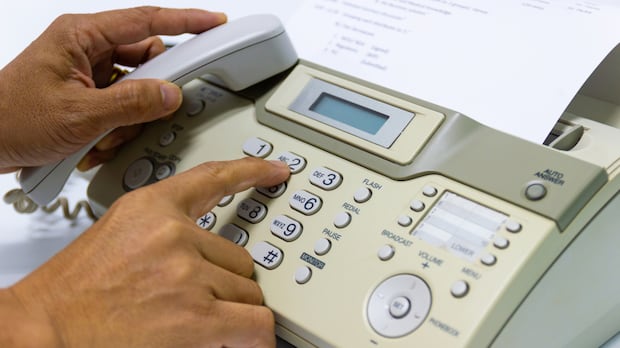
Fax machines are old. They’re susceptible to privacy breaches. But the N.W.T. health-care system still relies on them, and the health minister says that’s not about to change.
An early version of the fax (short for “facsimile”) was invented in 1843, and the technology would later become widespread in offices in the 1980s and ’90s — before email came along.
Now, as much as the N.W.T. government might want to move away from the aging technology, doing so isn’t so simple.
Health Minister Lesa Semmler was asked earlier this month in the legislative assembly about when the territory might be ready to say goodbye to fax machines.
She replied that faxes are still commonly used across Canada for sharing information across jurisdictions.
“Faxing is expected to continue to play a role for the foreseeable future, particularly where connectivity and limitation exists,” she said.
Faxes are a ‘bridge’ in the N.W.T.
The territorial Department of Health and Social Services says health care in the N.W.T. and across the country is decentralized.
“Hospitals, clinics, pharmacies, and partner organizations often use different electronic medical record systems that don’t always communicate with each other,” a department spokesperson told CBC News in an email.
“Faxing acts as a universal backup or ‘bridge’ that ensures important information, such as referrals, lab results, or prescriptions, can still be sent and received regardless of the technology in use.”
Even still, the territory says it’s trying to cut down on the reliance on faxes, and switch to modern, secure digital solutions.
“Faxing persists not because it is preferred, but because it is still practical, interoperable, and widely accepted across the health-care sector,” the spokesperson wrote.
Machines ‘a big source of privacy breaches’ expert says
Historically, fax machines have been involved in some privacy breaches in the N.W.T., with medical records getting faxed to the wrong building.
In 2019, a man from Paulatuk, N.W.T., had his privacy breached when a third-party faxed his private health information to the wrong government department.
Some N.W.T. residents’ personal information has also been faxed to CBC North.
In 2012, the health centre in Fort Providence sent personal medical information to the CBC newsroom fax machine. In May 2010, health officials in Norman Wells sent pages of blood test and Pap test results to the same fax machine.
Albina Magomedova is a privacy specialist with Toronto-based Bamboo Data Consulting. She says that province’s health-care system also relies on fax machines and while they can be a liability, they’re also prevalent.
“They are a big source of privacy breaches. But the use of faxes unfortunately is so commonplace,” she said.
Moving on from fax machines is by no means easy, Magomedova says. Switching to an online portal, for example, can take time, be costly, and comes with its own set of potential problems around cyber security.
It would also have to be a universal switch across various organizations, as a person’s medical records or case notes might be kept across different systems.
“It’s very hard to find a unified system or unified approach to send referrals or case notes or what have you to other recipients, other clinicians,” she said. “Everybody has a fax machine, for the most part.”
The N.W.T.’s health department says there are rules in place to protect patient privacy when faxing.
Safeguards include:
Using a standard cover sheet with a confidentiality notice and clear identification of the sender and recipient.Verifying the fax number before sending to prevent errors.Confirming receipt with the intended recipient to ensure the information arrived securely.
Staff also take part in mandatory privacy training, which includes how to handle faxes.