

Listen to this article
Estimated 5 minutes
The audio version of this article is generated by AI-based technology. Mispronunciations can occur. We are working with our partners to continually review and improve the results.
It used to be easy for Marcel Gahbauer to find a seat during his commute.
Numerous double-decker buses were in the mix along Carling Avenue, but over the past few weeks he’s noticed that those high-capacity models became rarer and rarer, and he found himself standing much more often — if he managed to squeeze aboard at all.
“If you take a bus that seats 86, and you replace it with a bus that seats 36, you’re going to notice a difference,” he said.
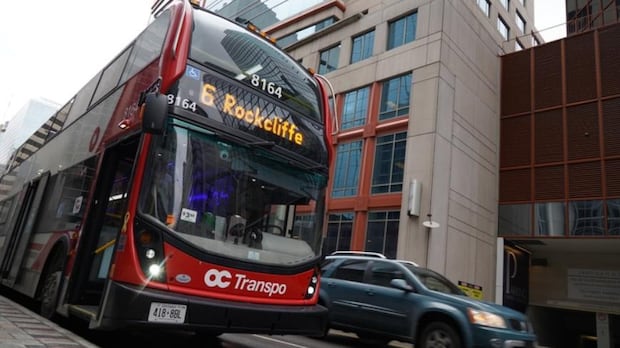
Gahbauer isn’t imagining the change. OC Transpo has gotten rid of almost all of its double-decker buses as it looks to replace its most unreliable vehicles with brand new electric buses.
It recently retired 67 of the 77 double-deckers in its fleet, leaving just 10 on the roads.
But not everyone is sorry to see them go.
 Noah Vineberg, president of ATU 279, says he’s not sorry to see the double-deckers go. (Mathieu Deroy/CBC)
“I won’t long for the double-deckers, I will tell you that,” said Noah Vineberg, president of Amalgamated Transit Union 279, which represents drivers and mechanics. “They were duds.”
As long-delayed shipments of electric buses finally start to roll in, OC Transpo has retired 100 vehicles. That includes aging workhorse models that were well past their best-before date.
But the double-deckers were comparatively youthful at just eight to 10 years old, far short of their 15-year life expectancy.
“How can they be in such rough shape?” Gahbauer asked.
Frequent breakdowns, costly maintenance
OC Transpo statistics presented to transit committee on Thursday show that the double-deckers are reaching a mean distance of 2,500 kilometres of service before a breakdown. That’s well below the 13,000-14,000 kilometres for the newest buses in the fleet, and it’s expected to get worse.
Rami El Feghali, OC Transpo’s director of transit bus operations and maintenance, said the double-deckers have suffered from a wide range of defects including issues with the chassis.
“Retiring them frees up a substantial amount of our team’s capacity,” he said.
Vineberg said they were never the right purchase for Ottawa.
“I know how much work goes into those in our garages,” he said.
But the head of OC Transpo doesn’t think it was a mistake to buy the double-deckers in the first place.
“If they had been properly maintained, we could have looked at them and kept them a longer period of time,” said transit services general manager Rick Leary. “So it is about maintainability. Not that it’s a bad vehicle.”
 Ottawa’s transit general manager Rick Leary at the news conference announcing his hiring on March 27. ( Tristan Strasbourg/CBC)
El Feghali explained that the double-deckers required more maintenance than other vehicles, and OC Transpo was unable to put in the investment to keep up “from a resource perspective.”
“So they degraded over time,” he said. “With so much pressure and so little capacity, we had to skip basically the mid-life refurbishment, which got us to a point where they’re too costly to maintain.
“So the right decision was to move away from refurbishing them and put our resources where it matters — to put reliable buses on the road,” El Feghali added.
‘A pretty sad indictment’
Ottawa saw its first double-decker bus in 2006 as part of a trial run, and OC Transpo soon brought on a few more for a pilot project. In 2011, the city’s transit committee approved a large order of 75 double-deckers at a cost of about $80 million.
They were in service by the following year. The transit union soon expressed concern after one toppled over in windy conditions.
In the years to come, the double-deckers would be involved in two of OC Transpo’s worst tragedies: a September 2013 collision with a train near Fallowfield Station that killed six people, and a 2019 crash at Westboro station that left three passengers dead.
Gahbauer called OC Transpo’s decision to skip refurbishment “a pretty sad indictment about their approach to managing their fleet.”
He said it’s hard to defend getting half the life expectancy from a vehicle that cost more than $1 million each.
OC Transpo says it’s taking measures to preserve some of its high-capacity fleet, including by refurbishing 30 articulated buses that are past their normal lifespan so they can stay on the road for at least three more years.
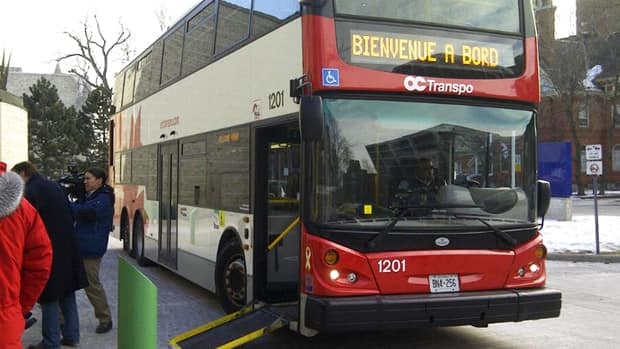 One of OC Transpo’s earliest double-decker buses is seen parked outside Ottawa city hall in a file photo. (Giacomo Panico/CBC)
Gahbauer said he defers to OC Transpo on the economics of keeping the double-deckers in service, but he said it would have been nice to let passengers know in advance.
He noted that Leary recently promised better communication as part of his 10-point action plan to turn around OC Transpo.
“OC Transpo has eroded a lot of trust in recent years,” he said. “This seems like another example of making a change that is negatively impacting riders, and then coming out after the fact with an explanation that isn’t really satisfactory.”