
A new Jewish high school is opening in Ottawa almost a decade after the last one closed due to low enrollment.
Capital Jewish High School (CJHS) is a not-for-profit that will open with Grade 9 classes this fall. It will be the first Jewish secondary school in the capital since Ottawa Jewish Community School (OJCS) phased out its high school program in 2017.
Tuition is set at $7,200 for parents who enroll their children in CJHS this year, but those students must stay at CJHS until they graduate to maintain that price for every year, says Myriam Auclair, secretary of the school’s board of governors.
Auclair says they were able to keep tuition this low because of the support of local philanthropists whose names she could not share. She says the school’s cost of operation in the first year is under $500,000. Their main expenses include teacher salaries and rent for their campus.
“It is a very normal thing that we’re going to be running at a deficit for a few years,” she says. “We’re hoping that by year seven or eight, that the school is going to become financially viable.”
The board expects to charge $20,500 for tuition in 2028. Over the next two years, tuition will increase by $615 and $635, respectively, and it will reach $22,500 at “optimal capacity,” Auclair says. The school will also help lower income families who can’t afford full tuition.
“We offer a ‘tuition assistance grid,’ which provides lower tuition to families of household incomes lower than $300,000 per year,” says Dan Pfeffer, chair of the school’s board. “If the tuition assistance grid does not work for the family, then we would have individualized tuition assistance based on their full situation.”
Pfeffer says CJHS would ideally reach “critical mass” for their high school by enrolling around 60 to 80 students across all four grades. Even if that made them financially stable, he says they would “still need to thread the needle” when it comes to tuition support.
CJHS’s plan for success post-Yitzhak Rabin
A group of Ottawa parents came up with the idea to found CJHS in late 2024 because, Pfeffer says, Jewish families were leaving the city due to a lack of Jewish community high schools. The OJCS secondary school that closed in 2017, Yitzhak Rabin High School, was founded in 1995 for similar reasons.
In a 2015 letter to the parents of Yitzhak Rabin students, OJCS’S then-board president, Aaron Smith, said the school was “not financially viable.” Yitzhak Rabin needed “a minimum of 50 students to be sustainable” annually, but had only 24 students enrolled that year.
“Put simply, not enough families are choosing to send their children to grades 9 through 12. This has been a challenge in the high school over [its] 20-year existence,” Smith wrote.
Pfeffer believes the benefit of having a Jewish community high school as an alternative to public school is greater than the burden of financial challenges. He says people are now “much more hostile towards Jews,” so it’s become more important than ever to create institutions like CJHS that will “equip our children for that world.”
Auclair says that process involves cultivating leadership among young Jews, which they hope to accomplish with smaller class sizes and volunteering opportunities at local organizations of the student’s choosing.
The school will offer 10 classes every week across its basic high school curriculum and a Judaics curriculum approved by Ontario’s Ministry of Education, says Auclair. CJHS’s courses on Hebrew language, the Tanakh, and Jewish history and studies are based on the curriculum developed by the Tanenbaum Community Hebrew Academy of Toronto (CHAT), which enrols more than 1,200 students annually.
“We’re not looking to reinvent the wheel here,” Auclair says. “If we can base our curriculum off of something that’s accredited and successful, we’re absolutely going to take that opportunity.”
CJHS classes will be integrated, Pfeffer says, because Yeshiva High School is already an option for Ottawa’s Orthodox families who want boys and girls to learn separately.
“They do excellent work, and I think a lot of people in the community have mistaken us as potential competitors, whereas the way I like to think of it is: if you’re going to open a car dealership, where’s the best place to put it? Very frequently, it turns out the best answer is to be next to another car dealership,” he says.
Pfeffer and Auclair couldn’t share the school’s address because they’re still in discussions with the landlord, but they expect to rent a building close to the Soloway Jewish Community Centre campus, which is home to the OJCS day school.
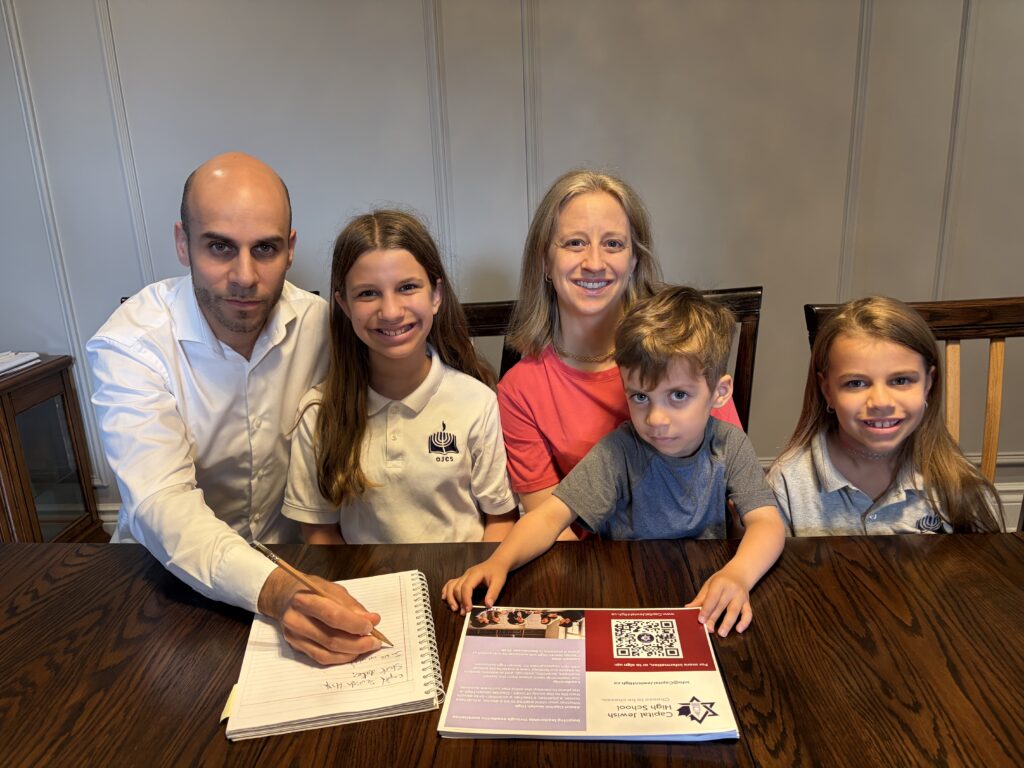 Dan Pfeffer (far left) is chair of the school’s board of governors. Pfeffer and Hayley Adler (middle) intend to send their children Kayla, David and Leila (left to right) to CJHS once they get old enough. (Photo by Ellen Adler)
CJHS principal Walter Piovesan has worked with the Ottawa-Carleton District School Board (OCDSB) for more than 35 years, including as a principal, superintendent, and eventually the associate director of OCDSB’s more than 140 schools. He’s also directed schools in China and Egypt, and worked with Torah High, which allows students in Ottawa to earn individual credits for Jewish high school courses.
He says building CJHS “from the ground up” has required him to be “more hands on” than ever, especially when it comes to learning about Jewish educational standards.
“As a principal in the public system, you walk in with things ready to go,” Piovesan says, adding that he’s not as familiar with the private school or Jewish school systems. “The role of a rabbi in this, that’s new to me — it’s really the spiritual advising.”
Piovesan expects to hire two full-time equivalents per grade if CJHS succeeds. He says hiring for smaller classrooms requires educators to teach multiple subjects, which gets more complicated for grades 11 and 12 because of their diverse subjects.
Ideally, the Grade 9 staff he hires this year will teach higher grades in the future, so there’s “a consistency in staff.”
“You really want to make sure that kids are familiar with teachers and they build a relationship with them, so you want people there for long-term,” Piovesan says.
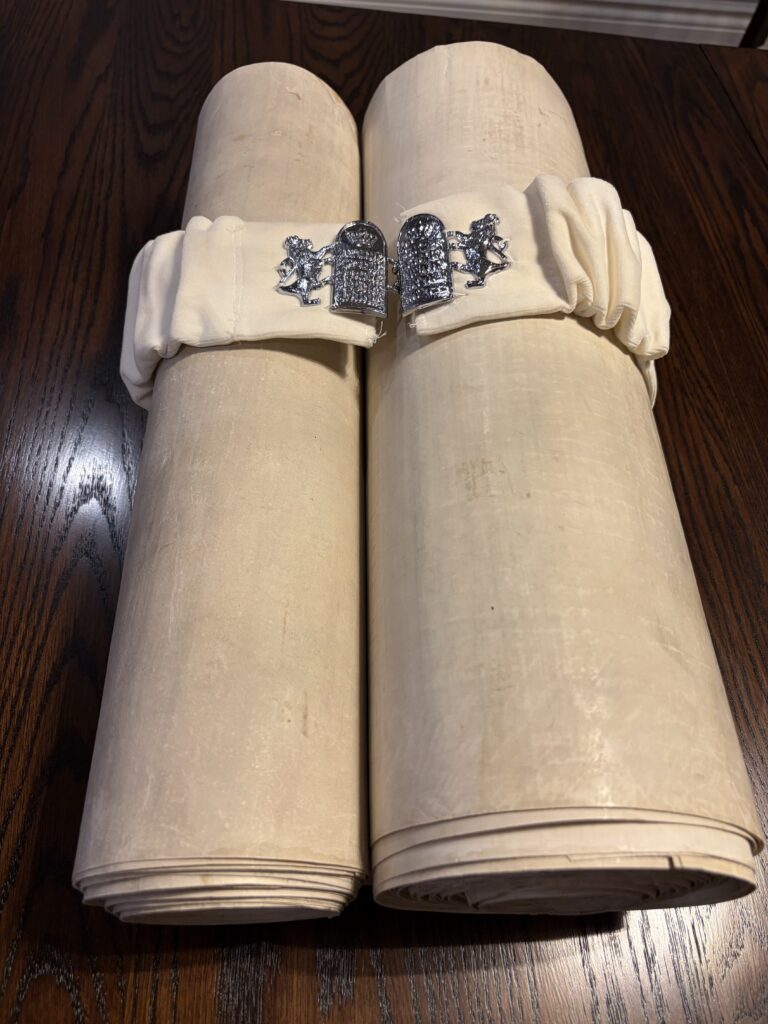 CJHS’s Sefer Torah was written in Germany around 110 years ago and eventually brought to a congregation in Virginia. Hayley Adler and Dan Pfeffer purchased and restored the Torah for the new high school. (Photo by Dan Pfeffer)
Ottawa parents, former Yitzhak Rabin students support CJHS
Former Yitzhak Rabin student Ella Sabourin launched a fundraising campaign in 2015 to keep her high school open. In a statement to The CJN, she writes that she’s excited to hear CJHS is opening. She hopes teachers will encourage the same kinds of “expansive discussions” she had about Judaism at Yitzhak Rabin “rather than limiting what it means to be Jewish into a specific set of criteria.”
“As the old expression goes, if you have two Jews you’ll get at least three opinions,” she writes. “It is crucial for a Jewish high school to be a place welcoming of discussion and diversity of opinions with empathy for all living beings at its core.”
Ella’s brother, Ethan Sabourin, was part of Yitzhak Rabin’s last graduating year. He hopes CJHS will give students similar extracurricular opportunities, such as annual plays and band practice that built his confidence in public speaking and performance.
But he says there were several gaps in his education that he hopes CJHS will correct, including a lack of “secular” options when it came to Jewish history and philosophy. Since his 2017 graduation, he’s learned about Eastern European Jewish history and speaking Yiddish, which have both deepened his love of Judaism.
“I think it would have been interesting to think about the ideas of you know, Gershon Scholem and Albert Einstein, and the bi-nationalist movement, or to hear about the Bund and Jewish socialism and diasporism,” Ethan says. “There’s so much breadth in Judaism, and if the major engagements with it are a bit of mushy Torah and Zionism, you don’t really get enough.”
He says modelling the courses after TanenbaumCHAT is a good step because it seemed to have a “more robust” curriculum, based on what he heard from friends who attended the Toronto school. Ethan adds that small class sizes and dedicated teachers at Yitzhak Rabin “made for a great learning experience,” but he worries about students having “insular” social lives.
Mordechai Brodt enrolled his son, Noah, in classes at CJHS for the upcoming school year. Brodt says Noah has had several experiences with antisemitism at public school, such as witnessing Nazi salutes and overhearing conversations about Hitler, so it will be a relief not to expect these negative interactions in high school.
“It gives me that comfort. I know some parents are concerned about the isolation, being in a sheltered environment, but my son goes and participates in other activities that are outside the Jewish community also,” says Brodt, adding that Noah practices martial arts and will continue to see his friends outside CJHS.
Brodt says he would have still considered enrolling Noah in CJHS at their projected 2028 tuition price.
Auclair, who plans to eventually enroll her 8- and 11-year-old children at CJHS, says the school’s “first few cohorts” will mould the new institution in their image.
“They’re really going to be building this school into what it will be,” she says. “That’s an opportunity that very few students can have.”
Zenith Wolfe is an Ottawa-based reporter who specializes in arts reporting and compassionate, person-first storytelling. He’s also written for the Globe and Mail, CBC, Cottage Life magazine, and La Converse. His website is zenithwolfe.com.