

Listen to this article
Estimated 4 minutes
The audio version of this article is generated by AI-based technology. Mispronunciations can occur. We are working with our partners to continually review and improve the results.
Caldwell First Nation is urging Ottawa to pass legislation that would, among other things, extend status entitlement under the Indian Act to any person with a parent who has it and end what is known as the second-generation cut-off.
The cut-off makes children ineligible for status if only one of their parents had it, and if that parent also had only one parent with status.
Caldwell Chief Nikki van Oirschot told a news conference on Parliament Hill Thursday the Indian Act was designed to control First Nations people, and much has changed since then. But the legacy of those policies remains.
“Some will say that First Nations can simply determine their own membership,” van Oirschot said.
“But community recognition does not replace federal recognition. It does not restore access to health benefits. It does not restore access to post-secondary supports. It does not restore access to programs and services tied to status, and it does not remove the discrimination that created these divisions in the first place.”
The First Nation was on Parliament Hill as the government considers Bill S2, which would, among other things, end the second-generation cut-off and legislate the right of people with a family history of enfranchisement to obtain status and pass on that entitlement to their descendants in the same way as those without that history.
‘Do not ask First Nation families to wait another generation’
Enfranchisement refers to the removal of status from Indigenous people that was carried out under a number of circumstances, including when an Indigenous woman married a non-Indigenous man; when an Indigenous person became a doctor, lawyer or priest; or when an Indigenous person gave up their status, typically in exchange for land and citizenship rights such as the right to vote.
Previous legislation had restored status entitlement to women who married non-Indigenous men but not to those enfranchised for other reasons.
The Senate passed Bill S2 in December, and it is currently before a House of Commons committee.
“Do not ask First Nation families to wait another generation,” van Oirschot said.
“Reconciliation is not measured by speeches; it’s measured by action.”
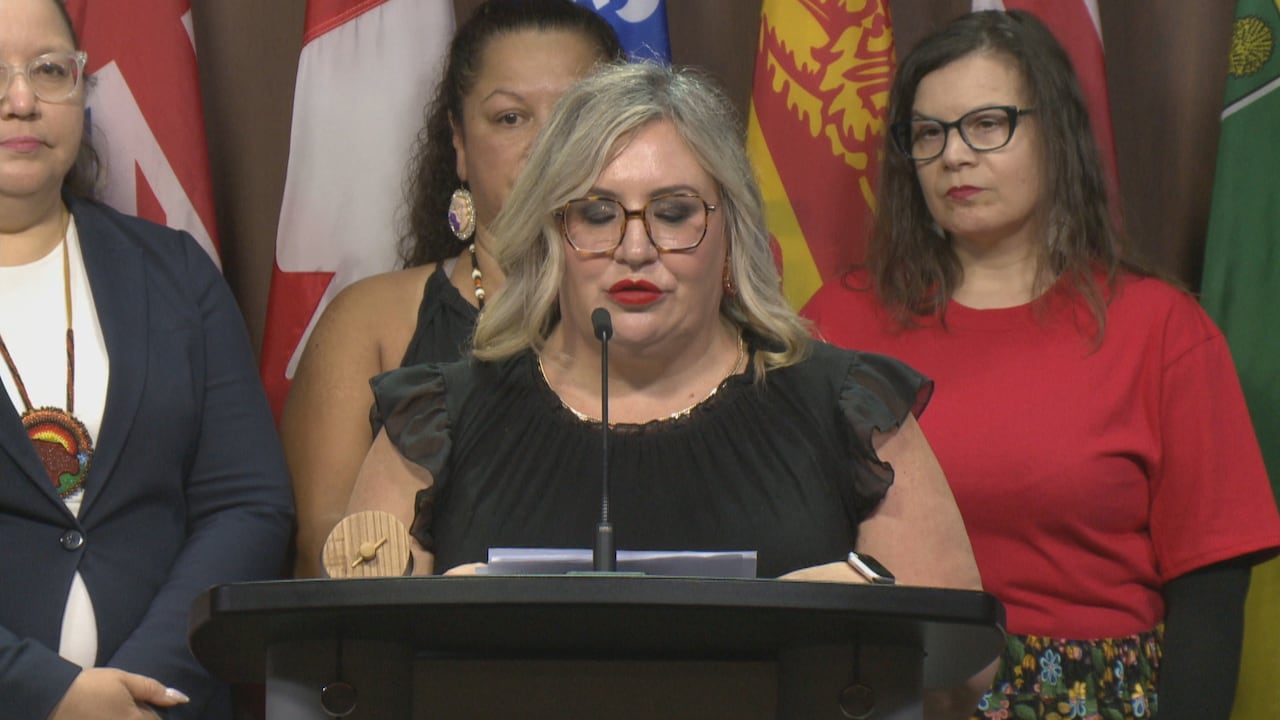 Caldwell First Nation Chief Nikki van Oirschot speaks at a news conference in Ottawa June 11, 2026. (CBC)
Van Oirschot was joined at the news conference by Senator Paul Prosper, Assembly of First Nations National Chief Cindy Woodhouse Nepinak and two members of the Caldwell community who have been impacted by enfranchisement.
Sixties Scoop survivor Theresa Lewis said the promises made to her grandfather in connection with enfranchisement went unfulfilled.
But her disconnection from her culture led her to battle addiction and face incarceration.
“As an Indigenous mother, I work hard at healing to break into intergenerational cycles so I can be a good mom to my children,” she said.
“I can raise them in their culture and in their community, but they know they are not equal to others because they don’t have status.”
Lori Kittelberg said her grandmother lost her status when she married a German immigrant because of policies at the time that stripped status from Indigenous women who married non-Indigenous men.
Kittelberg was able to apply for status after laws were changed to allow the descendants of those women to regain it.
“I can say that my child and I — we lost years,” Kittelberg said.
“We lost decades of connection through family, through culture and through community.”
Kittleberg said she appreciates how disconnection feels because she now knows what it feels like to be connected to her community and culture.
“Over the spring, I was really fortunate I was able to attend a ceremony over a weekend in community,” she said.
“And that weekend we all received our spirit names. … It’s really hard to describe the significance of that experience if you haven’t gone through it.”