
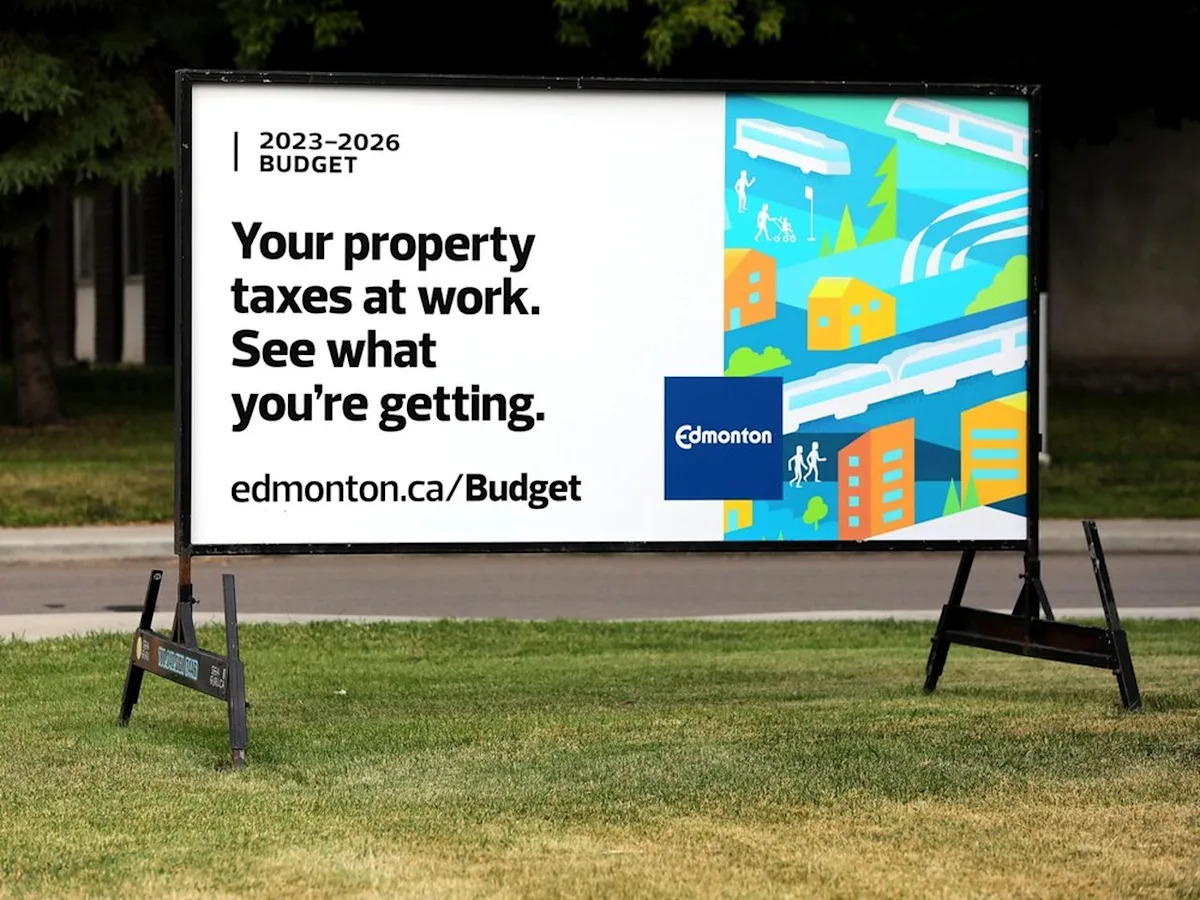
Property taxes have long been Edmonton’s main revenue source.
If you wonder why property taxes keep setting new records in Edmonton, don’t just blame inflation for the 6.9 per cent tax increase in 2026.
User fees — from free zoo parking to cheap pool memberships — are pumping up your property taxes. A key municipal revenue tool, they have fallen ever further behind the cost of delivery in Edmonton.
Over the past 25 years, the cost of city services and attractions has increasingly shifted from user fees to property taxpayers. Stacey Padbury told council’s executive committee a corporate user fee policy is needed to help close the city’s fiscal gap ahead of the 2027-2030 budget cycle.
Padbury noted property tax revenue grew by 60 per cent from 2016 to 2025, while Edmonton Transit revenue fell 18 per cent over the same period. Recreation and attraction user fees rose just 22 per cent.
“Because these two revenue streams have not grown in line with service delivery costs, and because the city is required to balance its operating budget, this has meant that the tax levy has offset the difference resulting in higher tax increases over the entire period,” Padbury said.
Of course, saying “taxes versus fees” is like saying “Alien versus Predator” — who is rooting for either one?
Show us the numbers
According to data presented, the city’s revenue mix has steadily shifted over 25 years: from 54 per cent non-tax and 46 per cent property tax in 2000 to 37 and 63 per cent in 2025. The last even split was in 2007.
The tax base is doing more of the heavy lifting in an apparent effort to keep things affordable for everyone to use.
“Non-tax revenues for items such as user fees have not grown in line with expenditures, and therefore has placed an additional burden on the amount needed to be collected through property taxes,” said Milap Petigara, the city’s principal policy advisor.
“When non-tax revenues, which include user fees, do not grow in line with expenditures, tax increases need to be higher to ensure the budget is balanced.”
Who pays, who subsidizes?
Questions about who pays and who subsidizes what are increasingly in focus at Edmonton city council.
User fees aren’t intended to generate profit, but to recover all or part of the cost of delivering a public service. The challenge, Padbury cautioned, is balancing financial sustainability with affordability.
“(Subsidies) also support affordability, as we know that target subsidies will be required to ensure that all Edmontonians are included and have access to city services, so that income barriers don’t limit the accessibility of those services,” she said.
A user fee policy accompanying the budget would set out key principles. Padbury said user fees are central to financial sustainability, ensuring services can be delivered reliably over the long term. She also said services should remain accessible to all Edmontonians regardless of income.
Other principles include “beneficiary pays,” meaning users should cover the cost of services they benefit from, and “equitability,” where costs are shared between the broader community through property taxes and direct users through fees.
Full cost recovery is not required for services. Instead, partial recovery targets would guide budgeting, Padbury said.
In addition to general taxpayer subsidies, targeted support could be offered to low-income users so access is maintained on a “beneficiary pays” basis.
“We would not set a target that required a price that would reduce the overall consumer volume at any of our facilities or attractions,” Padbury said.
Residents shouldn’t expect a flat increase in user fees. Decisions must balance service expansion with pressure on the tax levy, Padbury said.
“I think we need a starting point to keep us from growing services to the point they’re applying too much pressure, potentially, on the tax levy,” Padbury said.
Revenue death spiral
Ward O-day’min Coun. Anne Stevenson raised concerns about a potential “death spiral” tied to the elasticity of demand.
“Do we get to a point where we are increasing prices, which drives down usership, which then drives down revenues further?” Stevenson asked.
City officials responded that pricing would be structured to avoid that outcome.
“We would not set a target that caused the requirement for the prices to be so high that they would push away users and reduce demand. So it’s part of the design, get that balance between pricing and demand correct,” Padbury said, adding that the goal is to balance pricing with expected demand. Noting that setting property taxes and user fees involves ongoing trade-offs that are revisited with each four-year budget cycle. “These are the tensions that will exist forever.”
Edmonton Transit is still working through the scenarios for what user fee increases might be; a better picture will be available this summer.
But don’t expect final numbers on fee hikes without a budget to frame them around.
“We want to bring you some information to test things like these principles, but we don’t want to get such specific direction that we can’t do the work. We don’t want to surprise you at budget, but we can’t bring you a fully-baked user fee analysis until we do the budget,” Padbury said.
Mayor Andrew Knack was hoping for some cost-benefit calculations such as cost of transit service versus wear and tear on city roads.
“I think my worry is that suddenly cost recovery will become the indicator and everything else will become secondary. And I want to be very clear that I would not want to see a policy that has cost recovery as the primary indicator,” Knack said.
Related
Bookmark our website and support our journalism: Don’t miss the news you need to know — add EdmontonJournal.com and EdmontonSun.com to your bookmarks and sign up for our newsletters here.
You can also support our journalism by becoming a digital subscriber. Subscribers gain unlimited access to The Edmonton Journal, Edmonton Sun, National Post and 13 other Canadian news sites. Support us by subscribing today: The Edmonton Journal | The Edmonton Sun.