
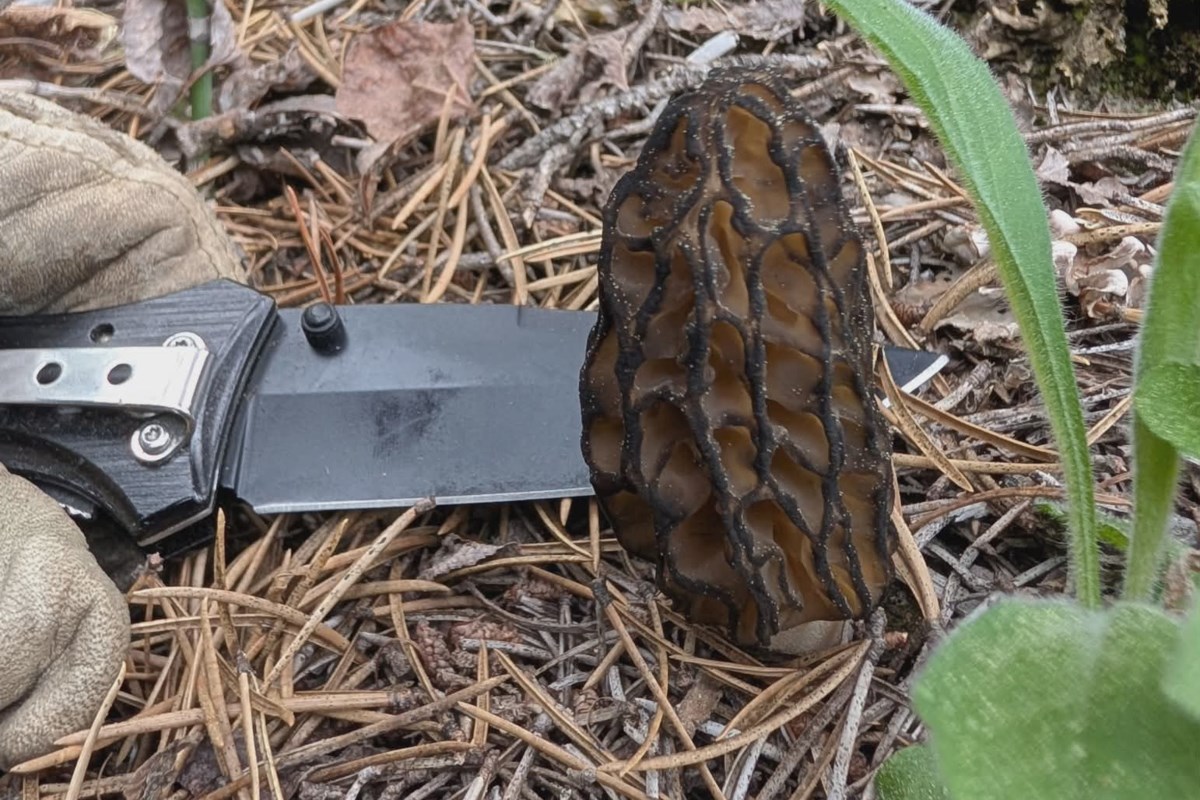
Back Roads Bill set out looking for sources on heritage wooden boats and ended up on Wabatongushi Lake, learning the basics of black morel hunting, from disturbed ground and spring rains to safe, careful harvesting
Look down, not up. Went morel pickin’ by chance. But it is more like hunting.
Unlike the gold panning story.
Black morel mushrooms are among the most prized forages. In northern Ontario, they emerge in late spring – following sustained warm temperatures and spring rains. We’ve had sort of weather recently; the wildland fires have begun. They thrive in areas with disturbed soil, particularly around logging sites in the transitional boreal forest.
Fortuitous.
Why?
There will be a story about the five-generation cedar strip boat-building family. Giesler Boats – AI says – is the last of its kind in the world. Could be, but certainly in Canada. So, started looking for testimonials about this heritage business, certainly a thriving legend in the north. More to come on that.
But I found a wilderness fishing lodge that has a flotilla of the beautiful wooden Giesler Boats.
Bingo. They would furnish a quote.
So, I surfed around Loch Island Lodge, located on the border of the Chapleau Game Preserve, and then inadvertently clicked on the Game Preserve tab – Morel Hunting.
What?
This seems a bit out of place for a fishing lodge, owned by an American and that caters primarily to our neighbours.
I am not really a fisher; some might think so. More curious about what is on and around the lakes and rivers of the back roads. An explorer.
There was even an invitation on the website. “If you have any questions or would like to book a trip, please don’t hesitate to contact us.” I didn’t.
I reached out to the owners, Andy and Amy Wilson of Soo Michigan, through the usual media query.
There was no hesitation from Andy; an invitation to “come up and go morel hunting.” I’m in another avocation activity.
Mycology
Mycology is the branch of biology devoted to the scientific study of fungi, including mushrooms, moulds, and yeasts. It explores their vital ecological roles as decomposers, as well as their practical applications in medicine, food production, and agriculture.
Monika Fischer (PH. D) one of Canada’s leading mycologists, is a professor at the University of British Columbia. Monika is passionate about understanding the biological mechanisms that drive ecological processes.
“My first passion was food, and I worked in kitchens for several years before landing an internship at a farm-to-table restaurant (The Herbfarm) just outside Seattle, where I learned from the farmers all about the soil microbiome and mycorrhizal fungi” she said. “We also collaborated with local mushroom foragers, and I got very involved with the local mycological society. Simply put, I got bit by the fungal bug, and there was no turning back.”
I asked about disturbed areas regarding morels.
“Some mushrooms are triggered to grow by disturbance (e.g. oyster mushrooms – if you have a kit that’s not fruiting, just kick it around a little bit and it will start to fruit)… but not all mushrooms. In my experience, the fire-following morels seem to be exceptionally picky about having exactly the right combination of time-since-fire, moisture, temperature, soil type, etc…
“Burn morels are one of my favourite mushrooms to eat, though I must confess I’ve never been very good at hunting for them because I get so distracted by all the other cute fungi that often co-occur with morels.
“I’m really passionate about understanding the molecular mechanisms that enable fungi to interact with each other and their environment. Some of those other fungi (e.g. Pyronema and Neurospora) that also fruit at the same time as morels are fabulous molecular model systems that are easy to work with in the lab so we can better understand their specific adaptations to post-fire environments, like heat-triggered spore germination, or the ability to eat charcoal. We grow morel mycelia in the lab, but it grows pretty slowly and isn’t a major focus of our research.”
And do you pick and consume wild mushrooms?
“Yes! Though I always make sure I know exactly what I’m picking and eating – especially making sure I know how to differentiate mushrooms I’ve collected from possible poisonous look-alikes. I’m not super adventurous, and I’m not too keen to risk gastrointestinal upset for a foraged meal, though I love to at least taste any well-established edible mushroom!
“I’ll also add that I make sure to only pick mushrooms in areas where it’s legal to forage – it’s important to respect protected areas.”
Mushroom guide
You need a mushroom resource.
One of the Loch Island employees was so passionate about going morel hunting with Back Roads Bill. There was an unattributed remark about one’s “morel compass.” (I think it was Andy.)
Georgina Atkins is a younger Back Roads’ follower, especially a fan of the BRBill podcast. She had a very detailed guidebook I had not seen before, Edible Mushrooms: Safe to Pick, Good to Eat, that she won as a door prize at one of her forest ecology courses. The two featured authors used the fact-checking of Michael Krikorev of Ljugarn, Sweden.
Like looking for elusive morels, I had to find this aficionado, and I did. I found out he was a mushroom professional like no other. Ljugarn is a coastal community on the island of Gotland, south of Stockholm on the Baltic Sea.
He is a member of the Swedish Mushroom Consultants Association and the Swedish Mycological Association. He currently works as a mycologist at the Swedish Species Information Centre (Swedish University of Agricultural Sciences data bank) and regularly gives lectures and mushroom courses
Go on to his website; it is truly exemplary. By northern latitude, the Nordic countries have very similar forests and mushroom species.
Svampguiden is the largest website about mushrooms, with around 10,000 visitors per day and around 250,000 visitors per month during the Nordic hunting mushroom seasons. It was started by Michael in 1997.
He said, “I have long been fascinated by fungi, strange organisms that always manage to puzzle me.”
He has published the books Our 20 Best Food Mushrooms (2013) and The Best Food Mushrooms (2008), which, in addition to Swedish, have also been translated into Norwegian, Finnish, Danish and Estonian. In the Nordic countries, the black morel is referred to as the top morel for its distinctive shape.
And for some clarification. Fun-guy (FUN-gye) is the most common pronunciation in North American English. Fun-gee (FUN-gee) is widely preferred in British English and is also frequently used worldwide, particularly among mycologists.
Mushroom diet
Jeremy St. Onge, a biology professor at Canadore College, went to the extreme limits when it comes to wild edibles. He is more than a keen morel hunter and mushroom picker.
He did something unique when it comes to wild edibles – taking what we say to another level.
He “slowly wrapped up the Big Wild Year by eventually completing my MSc Kinesiology at Nipissing University.”
The Wild Big Year includes staying on a wild edible diet for an entire year while assessing the physiological and biochemical changes occurring with two healthy adults. The thesis and the results of this experiment are accessible here.
One branch of his research investigated aspects of hunter-gatherer lifestyles “as these groups typically exhibit lower incidence of overweight and metabolic diseases.”
“One of the keys to mushroom hunting is knowing one’s trees and basic habitat types. Many species grow in close association with a host. Morels are known to grow in a variety of habitats, but most of my personal success has been picking them where chip mulch has been used in landscaping and targeting large white ash trees in loamy hardwood forests. They are also prolific in pine forests in the year following a forest fire.”
Some tips. He said, “I think for folks who want to pick mushrooms, there are a few basic guidelines to follow. Importantly, to learn from someone who knows. Additionally, not pick them unless you plan to use them. I still see a lot of social media posts of baskets of mushrooms with the question: can I eat these? There are lots of good paper guides out there, and the phone apps are good but not reliable.”
Sage advice.
Fungi eyes
And another unique find.
A Loch Island employee was working on the island’s waterfront – dock duty – when we departed early evening on Wabatongushi (Wah-batong-gush -ee) Lake. Rowan Gallican presented us with Fungi Eyes glasses as we were leaving the docks in a wooden wonder – the Giesler 22’ Georgian model.
Not only do you need scissors or a knife, a mesh net satchel but special eyeglasses help!
Fungeyes have been engineered to enhance the contrast between mushrooms and their surrounding landscape. They make morels easier to spot on the forest floor because of the unique lenses.
Justin Fowler is the inventor of fungi glasses. He is an entrepreneur and outdoorsman from Finleyville, Pennsylvania (a Pittsburgh suburb).
Another what moment?
So, Justin, the obvious question: how did Fungeyes get started?
“I get asked this question all the time. To put everything in context, I will start from the beginning when I would go hunting morels when I was a kid.
“The first time I saw a morel was at the age of seven. I remember my Uncle Dan emerging from the woods with a five-gallon bucket full of ‘brains’ as I called them. I was bursting with questions and begged to be taken along on his next trip.
“He agreed, but the next time, his bounty wasn’t nearly as fruitful. We didn’t find a single mushroom. I couldn’t understand. Why didn’t we just go back to the same place and fill up the bucket again, I thought? This frustration only intensified my early obsession with these elusive mushrooms.
“Over thirty years later, I’m still an avid hunter of morels. To me, hunting morels is both challenging and rewarding. It is an escape from the busy monotony of daily life. I cherish the opportunity to step back from my hectic life and enjoy peaceful time in nature. I’ve found happiness in the beautiful woods and the close-knit community of morel hunters like myself.”
What about the glasses?
“People have always asked me how I find so many mushrooms while they continue to struggle. I tell them all the same thing: look down, not up. Once you have proper soil temperature in the spring, keep your eyes down and find other mushrooms first. Morels grow where other mushrooms grow. Look for moss. Moss signals an area with lots of moisture. It doesn’t matter how perfect the tree is.”
As his harvests increased, so did the number of people who asked for Justin’s help.
“At first, I was hesitant since most morel hunters are so secretive about their spots.” He began to share his knowledge with others.
“Hundreds of people found their first morel by following my advice. This led me to challenge myself. Rather than preserving my secret spots, I show everyone where I have found morels.”
He said morels are easiest to spot in the early morning and the late evening, as opposed to sunny midday conditions.
“Although sunglasses can help block the light, they will not aid in making mushrooms appear more vivid against the green and brown backdrop. I knew colored-lens technology was the key. I have spent years perfecting a lens to enhance the appearance of a mushroom compared to its lush forest surroundings. After a long journey of research and development.”
Fungeyes finally took shape.
“People think I am lying when I tell them of my massive hauls during Morel season. Cheating a little, maybe, but lying, no.
“As I began showing fellow mushroom hunters the lenses we had created, I got the same amazed response every time. Their excited requests for a pair of my glasses led me to the decision to bring the glasses to market and share my secret with mushroom hunters worldwide.“
He wasn’t fibbing; it works.
Setting
Maybe it is a little like fishin’ – you have to try.
In this case, you are going to wander around the Jack pine forest in disturbed areas like sand pits and logging roads, especially the ones that have become somewhat overgrown.
The bugs are really bad. From a past story, I am prepared with my Original Bug Shirt Company attire. You can’t give up when wandering and wondering.
Morels have specific needs. Trees are the food for morels, but two other things come first. Without proper soil temperature, hunting morels is hopeless.
Loch Island owner Andy Wilson says,
“You’ll almost never find morels when it’s too hot or too cold,” said Loch Island owner Andy Wilson.
Morels need moisture. It had been a little dry in this area. If the microclimate surrounding it is dry with hard soil, you will never find a morel.
Treasure finally – the first morels are spotted, and then others. You cut them off with scissors or a knife or use the ‘pinch’ technique. You don’t pull them out of the ground. Unlike blueberry picking, you need to be careful.
You carry your bounty in a mesh bag. As you walk, a net bag allows millions of microscopic spores to be released from the mushrooms and to be dispersed for future hunts.
You are on your hands and knees.
It is fun. But the morel season is short enough because of the needed microclimate requirements.
The bugs are swarming; I said that. DEET helps as well.
Back at the island, we cut the finds lengthwise and then fry up the morels in butter, with a little salt and pepper, in a traditional cast iron pan. A colourful culinary mosaic in a stir fry.
How do I describe it? Mouthwatering, delicious with that wilderness taste. Slicing lengthwise, in half, is key to preparation. You can dehydrate and freeze morels.
This activity is different from blueberry picking. Listen to the CBC Morning North interview with Back Roads Bill.
Enriched again on the back roads. What is the ‘morel’ of the story? A couple of notes from the field.
The most important thing is to focus on the ground, and it is more like hunting. And this is a northern Ontario sort of precept.
“When the black flies are at their worst, the morels are at their best!”