
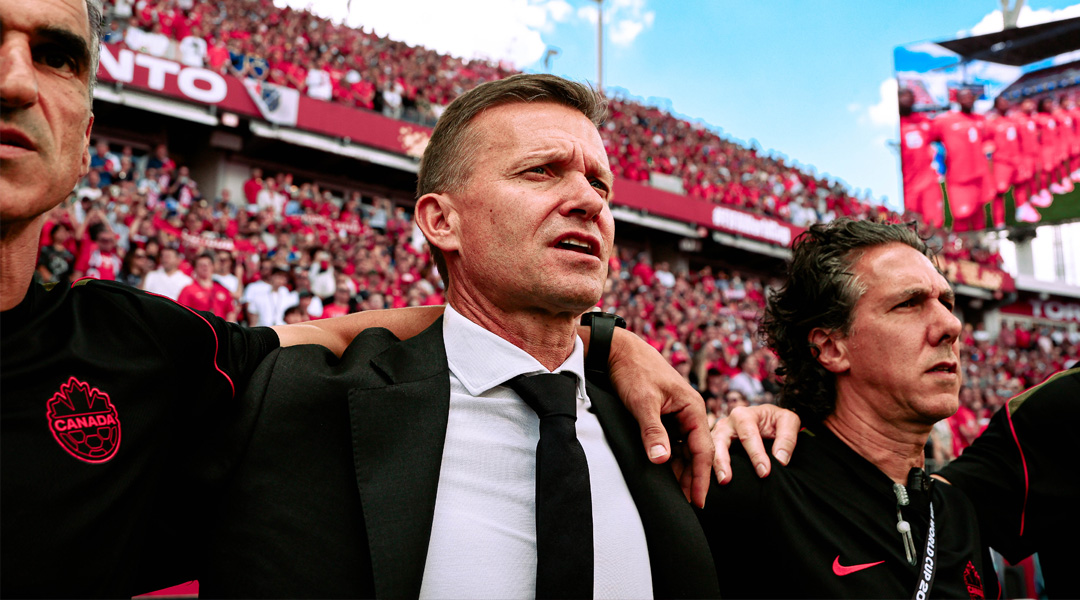
Canada’s opening match of the 2026 FIFA World Cup against Bosnia and Herzegovina was, perhaps, the most dangerous of the lot.
All the nerves and emotions of playing the first match of a home men’s World Cup, the desperate quest to earn the country’s first point at the quadrennial competition, and the uncertainty about how Canada would match up with a dangerous side that had knocked both Wales and Italy out of the UEFA Playoffs.
Even then, it seems odd to call that first half a slow start. Canada was all over Bosnia. The only stat they trailed in at halftime was the most important one: the scoreline.
Jesse Marsch made three changes in the 61st minute and then the crucial one that saw Cyle Larin introduced 15 minutes later. Jonathan Osorio came on for Stephen Eustáquio in stoppage-time.
“On one level, you can say the subs made a big impact,” observed the coach post-match. “But I’ve got to figure out how to get a little bit more out of some of the starters and make sure that we have a better performance from the start.”
“I told them after the match that if we play like that second half the whole match we win,” Marsch underlined. “We’ve got to find a way to have a bit more confidence, a bit more self belief, and go after the game. The good part was, in a difficult moment, we responded.”
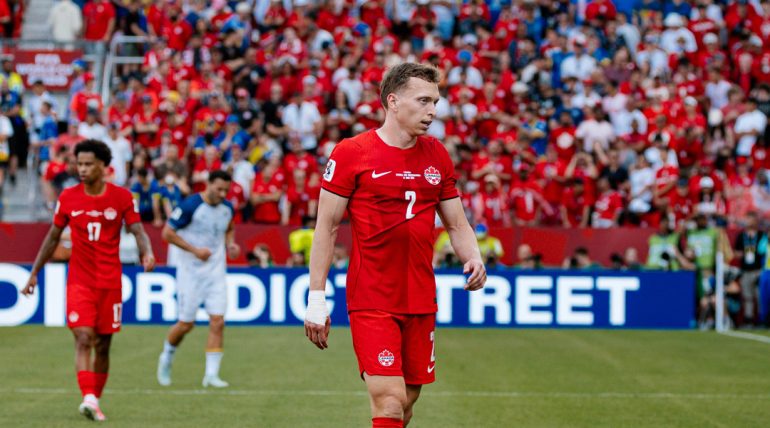 Photo Credit: John Jacques
The late equalizer from Larin was a moment of pure, unadulterated joy, that stadium has never been louder. But there was a hint of relief in it as well.
“It was,” agreed Alistair Johnston. “It’s been something for us this past year, sometimes the ball won’t go in the back of the net. When you see the one that gets saved off the line, hits the crossbar, and somehow doesn’t go in, you do have that sense of it’s just not going to be our day.”
“But Cyle took a great touch, turns – I think those were his first two touches of the game. It was a great finish and then you could see it, the weight off of our shoulders, the weight off of the fans’ shoulders, and we were really pushing for it there in that last 10 minutes,” he continued. “It was a bummer that we just couldn’t get [another] one.”
 Photo Credit: John Jacques
Canada will dive into the details, take the lessons from the day.
“There are some set-piece things that we can do better, for sure, but for me it’s the mentality and the bravery,” emphasized Marsch, referencing both the defensive and offensive aspects of corner kicks – Canada rarely threatened on their nine attempts, Bosnia needed just one to score.
“We want to make sure that the team is equipped from the start, for all these matches, to understand the plan, to understand the set-piece plan and the opponent and what their plan might be, but to really go after the game and represent exactly what we wanted to be,” he stressed. “We did that in the second half and not in the first half, and that was the difference for us on the day.”
“We’ll learn from this,” Marsch added. “If you look at World Cups historically, teams can start a little bit tense in the beginning matches and then the games come more to life and you see truer versions of teams. It will be really important that we use this experience to be better and stronger and more prepared for exactly what we want the game to look like.”
Bosnia too, as the thousands of fans in the stadium and the many more watching elsewhere in Toronto, were playing for their nation’s pride. There were times, when Jovo Lukic scored the goal, when a Bosnian song was played during the prematch festivities, that they were louder than the Canadians despite being outnumbered.
They and their side showed up.
“We knew that Bosnia has experience, that they’re aggressive and that they’re savvy and confident – they showed that in the qualifiers to get into the World Cup,” said Marsch. “They were exactly what we thought they would would be.”
“You have to give Bosnia a lot of credit,” he continued. “To come here in a first home World Cup match for Canada, not an easy situation, and for them to deliver that kind of performance and hang on for a point. It could have gone either way – they had chances to make it 2-0, we had chances to find the win. In the end, I think that a draw is a fair result.”
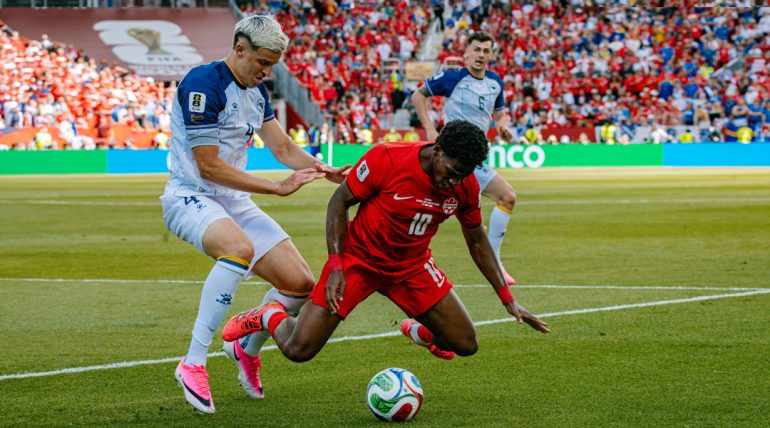 Photo Credit: John Jacques
Aside from the goals and the occasion, perhaps the biggest talking point was Jonathan David coming off. Especially with some of their biggest stars – like Alphonse Davies and Moïse Bombito – sidelined. Canada need the others to have big performances.
Ismaël Koné had himself a game, Eustáquio too was solid, Maxime Crépeau came up big when called upon. David was relatively quiet, sending his best look of the game straight at the goalkeeper.
“Given performances from some of our front players and given the weapons that we had on the bench I wanted to make some changes,” explained Marsch. “I wanted to bring guys in that I thought could bring a little bit more energy. As much as the start of the [second] half was better, we needed to really push the game and find some ways to be sharper.”
“Johnny didn’t have his best day,” he admitted. “It’s normal that a player doesn’t always play at his peak, but he’s an incredibly important player for us. Make no mistake, he scored and set up more goals than anyone since we’ve been here and we’ll need him in this tournament to be at his best and find a way to use this experience to be better for the next one.”
“Without him in top form,” Marsch said plainly. “We’re not the same team that we have the potential to be.”
Friday was history: Canada’s first point at the World Cup.
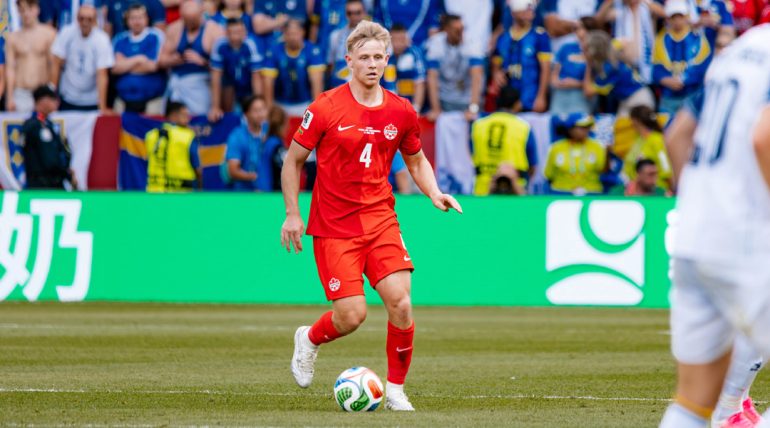 Photo Credit: John Jacques
“That’s our third World Cup and it took us that long to get one,” said Johnston. “We can’t turn our noses up at the fact that we are making history.”
“Our goals are loftier than that, but at the same time you do need to check off those boxes,” he continued. “First point out of the way, now it’s about getting that first win, that’s going to be important if you want to get out of this group.”
With Qatar scoring a late equalizer of their own against Switzerland, at the conclusion of the first round of games in Group B its ones all the way down.
Marsch and every single player who spoke mentioned the crowd.
“The first time it felt like a home game,” said Larin. Laryea called it, “a brilliant atmosphere.” Luc de Fougerolles, “one of the best moments of my life,”
Said Koné, en français: “The stadium was full, but it wasn’t just full.”
“There was passion, there was emotion, there was support, there was heart,” he continued. “I never would have imagined it when I was little.”
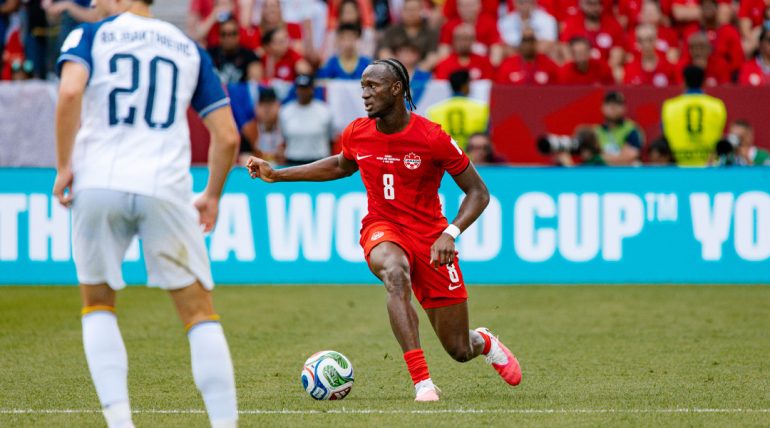 Photo Credit: John Jacques
Every team needs to feel that, especially at home.
Marsch said it drove the team on.
“As [the fans] started to feel that the team was growing into the game, specifically in the second half, you could feel them cheering louder and being more anticipatory and pushing the group, whether it was a corner or a free kick or being hard on the referee when maybe he gives a soft foul for Bosnia or whatever,” he listed. “That’s what we need.”
“We need the home crowd to push the team, to put pressure on referees, to create a hostile environment for the opposing teams,” Marsch urged. “And we’ll need that in Vancouver too,”
With the next two group stages games switching to the Pacific Coast, it’s your turn now Vancouver.
“We’re trying to pave the way for the future, but also capture the now,” said the head coach. “Vancouver, I know that it’s a football city, I know they love their Whitecaps, I know they love their national team, so I expect a full stadium again, red jerseys – how awesome was that to look around and see all those red jerseys, the sea of red in the stadium – and to do the same.”
“To push the team from the start of the match, make them feel love, make them feel confidence, and really make them feel the home crowd,” Marsch closed. “That was a big factor in why we were able to get the point.”