
The clients of À Coeur d’homme, a network of nearly three dozen Quebec community organizations that help men to address violent, controlling or threatening behaviour in their intimate relationships, must be made to understand that “violence does not stem from a loss of control,” said network executive director Sabrina Nadeau.
Rather, violence is a deliberate act of domination through coercive means — and for it to end, its perpetrators must be held accountable, she said.
Helping violent men is not excusing or downplaying their actions, Nadeau said: It is providing the means to reduce recidivism and to prevent femicides.
The organizations in À Coeur d’homme offer individual counselling and support groups that generally meet weekly for 18 to 20 weeks. Montreal has three À Coeur d’homme organizations: Avant Coup, Option and Service d’aide aux conjoints.
About 60 per cent of participants are there voluntarily — of their own free will or referred by relatives, the health-care system or former participants. The rest participate on the recommendation of a lawyer, parole officer or correctional services — or, in about a quarter of cases, on the order of a judge.
Most men don’t present saying: “I am a violent man,” Nadeau said. “They will speak of couple conflicts, a sudden loss of control or communication problems, sometimes of mental health difficulties or problems with alcohol or drugs. They will often minimize their actions or focus on the behaviour of their spouse — especially at the beginning.
“Our work is to get them beyond this vision to recognize that their actions are acts of violence, with concrete impacts on their partner and their children. It can’t be done in one meeting,” she said. “It’s only when awareness kicks in that the work of change becomes possible.”
The message is that “your behaviours are violent, you are responsible for them and, if you want to stop destroying your life and the lives of others, there is help. But no one will change for you,” Nadeau said.
It’s only when awareness kicks in that the work of change becomes possible.
Sabrina Nadeau
Network executive director, À Coeur d’homme
“The man has to do the work. If he is not willing, we tell the judge or probation officer that he doesn’t recognize what he has done.” Men sometimes return a few months later, she said.
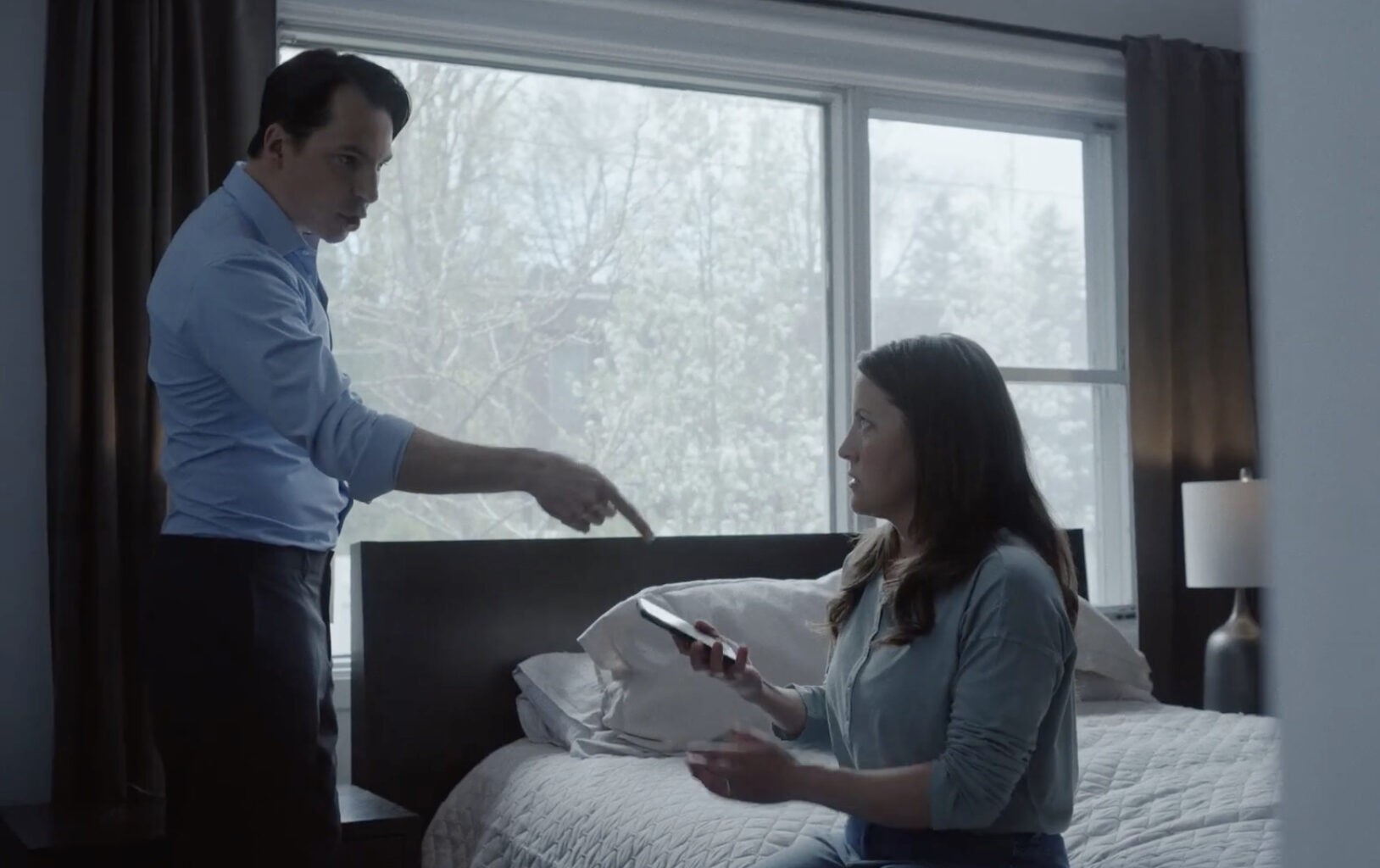
David described his violent behaviour with his girlfriend to Ingrid Falaise in the final episode of a three-part documentary on intimate partner violence she hosted on ICI Radio-Canada Télé in 2022: “It started with verbal violence, always, to take away her confidence, psychologically,” he said. “It gives you a sense of control — as if you are a giant and they are just mini-ants: ‘I am strong. You have nothing to say.’”
Whenever his girlfriend threatened to leave, he would show her his vulnerable side — and each time she agreed to come back, “it would be worse, because I realized that I could manipulate her,” he told Falaise.
The violence was never physical — until she returned home late from a night out. “Enraged, I carried her to the living room — and I nearly strangled her. It destroyed me. In that moment, I saw who I was,” he said.
“Of course she left. And the next day I entered therapy.”
 David described his violent behaviour with his girlfriend to author and interviewer Ingrid Falaise in the final episode of a three-part documentary she hosted on ICI Radio-Canada Télé in 2022. Credit: Pixcom Productions
The documentary, Face aux monstres: l’origine des M, followed a 2019 dramatic miniseries, Le monstre, based on Falaise’s own experience in an abusive marriage. The actor and author, who wrote two memoirs about that experience, has long been campaigning against intimate partner violence.
And men are part of the solution to the problem, said Isabelle Lecours, MNA for Lotbinière-Frontenac and herself a survivor of intimate partner violence, at a May 13 press conference in which Premier Christine Fréchette’s government tabled a bill that would allow someone to find out from police if a current or former intimate partner has a documented history of violent or abusive behaviour.
News on the femicide front has been grim of late: 10 suspected femicides in Quebec since the start of the year — five of them in January alone. According to Statistique Québec, 28,500 police-reported victims of intimate partner violence were identified in Quebec in 2024, 76 per cent of them women.
Also at the May 13 press conference, Minister of Domestic Security Ian Lafrenière described a collaboration between the Régie intermunicipale de police Richelieu-Saint-Laurent (RSL), which covers 75 municipalities in the Montérégie, and Entraide pour hommes, a South Shore member of the À Coeur d’homme network.
 Most men don’t present saying: “I am a violent man,” says Sabrina Nadeau of À Coeur d’homme. “They will often minimize their actions or focus on the behaviour of their spouse — especially at the beginning.” Courtesy of Sabrina Nadeau
The collaboration, which started as a pilot project in 2022, meant that a man arrested by RSL police for intimate partner violence could be referred, without his consent, to Entraide pour hommes.
The Proximité project, as it is known, was developed by Geneviève Landry, executive director of Entraide pour hommes, and Francis Lepage, now chief inspector of the force’s Gendarmerie Division. They came up with the idea of having a civilian, a community worker with Entraide pour hommes, at the station — and having that person intervene.
A partnership between the two had long been in place, but the offer for help by Entraide pour hommes had been coming from police — and barely one per cent of men accepted it. In contrast, 70 per cent of men contacted by a community worker accept the referral.
“These men were not coming to us, so it was about us reaching out to them,” said Landry. Between March 31, 2025, and April 1, 2026, 490 men were reached. The hope is to be able to expand the service, she said.
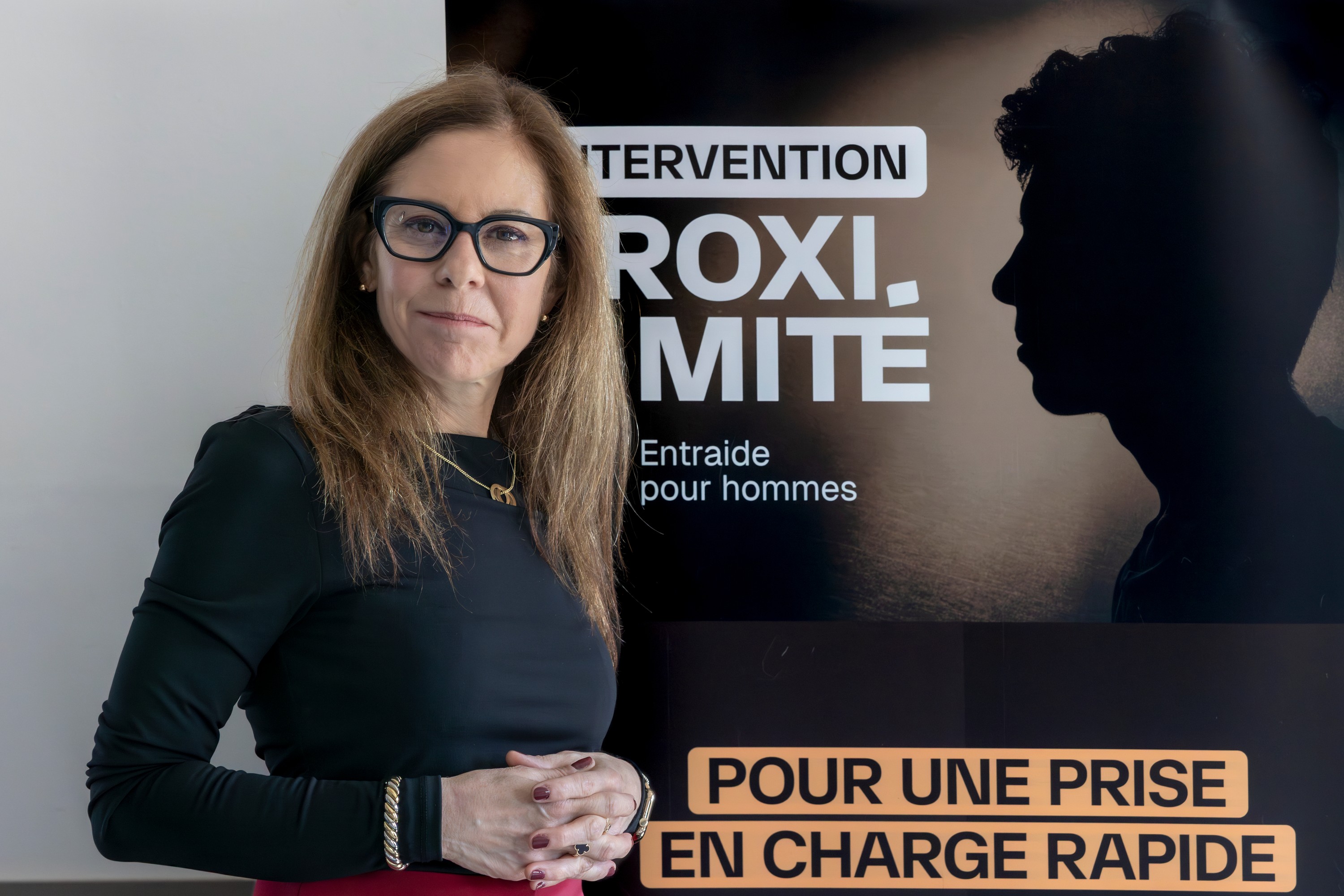 Geneviève Landry, executive director of Entraide pour hommes, an organization on the South Shore that provides counselling and support groups for men who are perpetrators of intimate partner violence. Dave Sidaway / Montreal Gazette
An arrest is difficult and that is how we open the door.
Geneviève Landry
Executive director, Entraide pour hommes
“An arrest is difficult and that is how we open the door,” she said. “We wait for him to be released and we call.”
The idea is to act within 48 to 72 hours of an arrest, when men are still experiencing shock and distress following their arrest — few are detained — but when there is a possible opening to change.
“They call — and they are reassuring,” said Lepage. “They say, ‘I am here to offer you help. Are you willing to have a conversation?’ And the majority of men say, ‘It’s the first time someone is asking me how I am doing.’ … And they open up: They say, ‘I have a violence problem’ or ‘I am impulsive.’”
It’s the fact that it is not a police officer making the offer that has affected the outcome, he said.
It also serves as a kind of safety net, by ensuring a psychosocial presence in the hours following an arrest — a time when, without support, the risk of recidivism is high. In the majority of femicides, the perpetrators are already known to police, Landry said.
Often the men say when they are contacted that they were unaware of the existence of programs like Entraide pour hommes.
Many professionals are more at ease helping the victims of intimate partner violence than its perpetrators, Nadeau said. But she said training to intervene with perpetrators must be included in the education of professionals — including doctors, social workers and psychologists — to provide the tools to spot red flags of abuse and coercive control, know the risk factors for femicide and what questions to ask.
Awareness-raising campaigns specifically directed at men are needed and messages should be circulated where men are — their workplaces, on sports and social media and at health clinics, Nadeau said: The goal is for them to recognize themselves before the situation deteriorates.
“We need messages that say clearly: ‘If you recognize yourself, you’re not ‘just jealous’ or ‘too much in love.’ You are committing acts of violence — and there is help to make you stop.’”
The messages must be aligned with those about preventing intimate partner violence so the message that “men can and must change” is as clear as the one that “victims have the right to safety.”
“It means naming the violence for what it is — but also opening a door and showing that specialized services exist and that to ask for help is not to lose your masculinity: It is to take responsibility for not destroying your family,” Nadeau said. “The more intolerant a society is of violence, the less there will be.”
Men wishing to put an end to the violence in their intimate relationships can contact any of the 32 organizations across Quebec in the À Coeur d’homme network (acoeurdhomme.com).
People facing intimate partner violence can contact SOS Violence Conjugale 24 hours a day at 1-800-363-9010.
We used typewriters when I started at The Gazette, and heavy black rotary phones. Today’s newsroom looks different but the work – reporting and informing my readers – remains constant and rewarding. I am grateful to my academic adviser at McGill, where I was a neurobiology major, for steering me to journalism. Evidently he realized I wasn’t cut out for neurobiology.
sschwartz@postmedia.com