
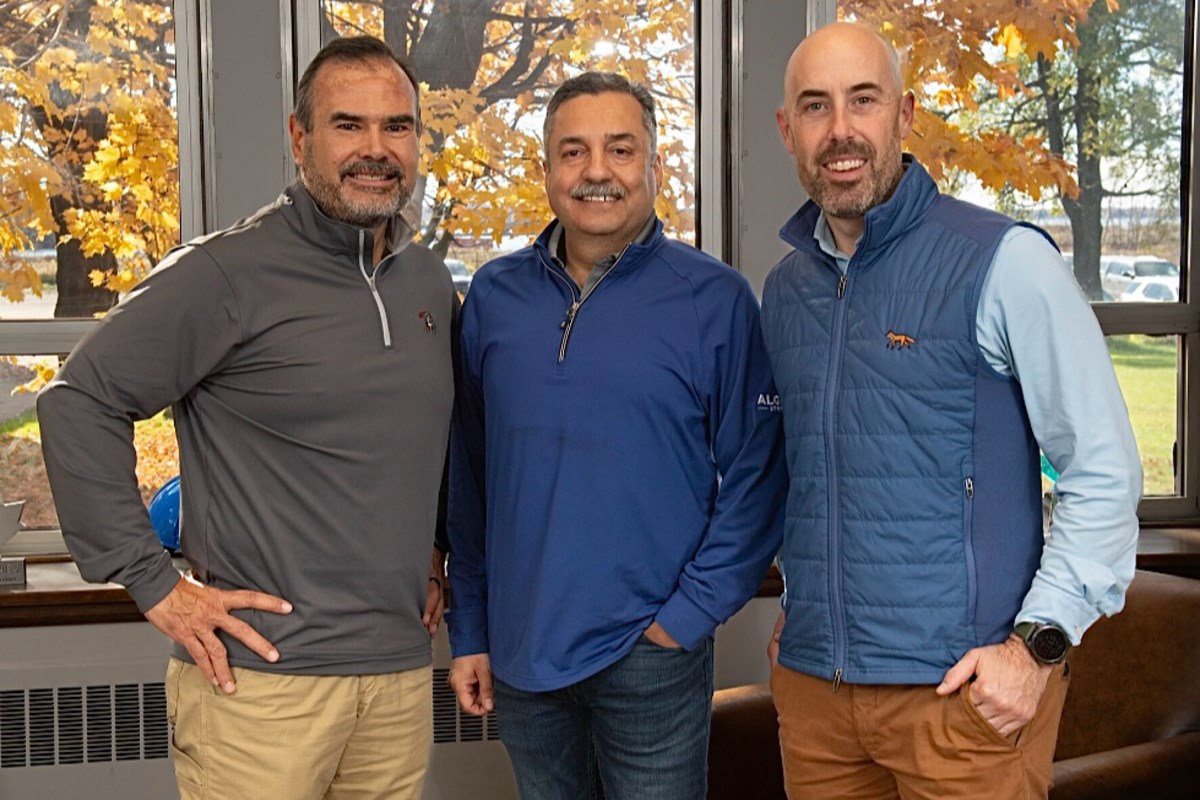
Michael Garcia, who retired Dec. 31 as Algoma’s CEO, was paid a total of $6.82 million last year. His base salary was $1.07 million
Algoma Steel lost just short of a billion dollars last year.
Most of us have difficulty comprehending numbers bigger than our mortgage, but if you make $45,000 a year, it would take you more than 22,000 years to make $1 billion.
Despite that huge and unprecedented shortfall, our Sault steelmaker still paid its senior executives millions of dollars in bonuses, incentives and other forms of compensation in 2025, according to a management information circular prepared for its annual meeting later this month.
Michael Garcia, who retired Dec. 31 as Algoma’s chief executive officer, was paid a base salary of $1.07 million, but collected a total of $6.82 million compensation for his efforts to turn the company around. That compared to $5.58 million total compensation in 2024 and $2.96 million in 2023.
Rajat Marwah, who took over from Garcia on Jan. 1 as CEO, was president and chief financial officer last year. Marwah earned a total of $1.47 million in 2025, considerably more than his 2025 salary of $543,762.
Other top-earning Algoma brass in 2025:
John Naccarato, vice president of strategy and chief legal officer, $1.39 million including base salary of $504,900
Mark Nogalo, then vice president for strategic transformation, $827,088 including $425,000 base salary
Michael Panzeri, senior vice president of production, $1.69 million including base salary of $596,700
Not all of this compensation was paid in cash or paid immediately.
The big payouts to Algoma Steel’s top brass include a mixture of short-term incentives and long-term incentives including options, restricted stock units and performance share equity units.
The long-term incentives tend to be non-cash, share-based, vesting in three years to encourage employees to stay with the company and take a longer-term mindset.
How compensation is determined
Algoma’s executive compensation is calculated using a complex matrix of factors including:
meeting electric arc furnace goals
total plate shipments
environmental spills
cash flow from operations
workplace safety (lost time injury ratio)
EBITDA (a key measure of profitability)
operating cash flow
“Our human resources and compensation committee oversees executive compensation to attract, retain, and motivate top talent while aligning executive incentives with Algoma’s long‑term business objectives,” the company said in a sustainability report issued last week.
That committee paid a consultant $112,042 over the past year to benchmark the paycheques of Algoma Steel executives against those at comparable companies including:
Algoma Central Corp.
Allegheny Technologies Inc.
Arch Resources, Inc.
Canfor Pulp Products Inc.
Carpenter Technology Corp.
Century Aluminum Co.
Commercial Metals Co.
GrafTech International Ltd.,
Haynes International Inc.
Olympic Steel, Inc.
Peabody Energy Corp.
Russel Metals Inc.
Schnitzer Steel Industries, Inc.
Mattr Corp. (formerly Shawcor)
Stelco Holdings Inc.
Mettalus (formerly Timken Steel)
Warrior Met Coal, Inc.
Western Forest Products Inc
A challenging year
Last year’s billion-dollar loss resulted from many factors outside the control of Algoma Steel brass.
“Fiscal 2025 presented an extraordinarily challenging operating environment for the North American steel industry, shaped by a confluence of trade disruption, import pressure, and weak demand,” the company said in its recent management information circular.
“U.S. trade measures – unprecedented in scope – were designed to eliminate Canadian steel imports into the United States, including through the imposition of 50 per cent tariffs on imported steel products and derivative steel products,” the circular said.
“These measures fundamentally decoupled previously integrated North American supply chains. Compounding this, as the United States moved to curtail global steel imports, displaced tons sought alternative markets, with a significant volume finding their way into Canada and further depressing domestic Canadian pricing.”
On Sept. 28, 2025, Algoma concluded that its integrated ironmaking operations were no longer viable, and its planned transition to electric arc furnace (EAF) steelmaking was speeded up.
Blast furnace production was halted shortly after year’s end and the company is now exclusively an EAF steel producer.
‘Say on pay’ vote
Later this month, Algoma Steel shareholders will get an opportunity to speak out on the bonuses and other compensation paid to senior company executives.
In a ‘say on pay’ vote to be taken at Algoma’s annual general meeting on June 23, shareholders will be asked whether they approve of the company’s compensation approach.
In a similar vote last year, 96 per cent of shareholders expressed support for Algoma’s executive compensation.
Such votes are conducted on an advisory basis that’s not binding on the company’s board of directors.
“We understand the importance of providing our shareholders with an opportunity to express their support for our compensation design and decisions,” the company says.
In 2022, Algoma’s then-CEO earned as much as $25 million
There were even larger executive compensation packages during Algoma’s 2022 fiscal year, when the company merged with Legato Merger Corp.
Former CEO Mike McQuade earned as much as $25 million that year for his role in refinancing and realigning the company
Rajat Marwah was paid $8.9 million that year.
John Naccarato received $8.8 million.
Mark Nogalo got $7.6 million.
Federal government puts restrictions on Algoma’s compensation
In March of this year, the company disclosed that the Canadian government had placed restrictions on salaries, bonuses and other compensation paid to top executives at Algoma Steel.
Documentation filed with regulatory agencies showed limitations on executive compensation were included in the fine print of $500 million in federal and provincial tariff liquidity support loans made last year to the Sault Ste. Marie steelmaker.
So long as there is outstanding balance on a $400-million Large Enterprise Tariff Loan facility, the top five executives of Algoma are subject to unspecified restrictions on executive compensation.
As of March 31, 2026, there was unused availability of $292.5 million available to draw under its LETL facility.
Details of the restrictions aren’t being released because they’re considered commercially confidential, but they’re known to include limits on total compensation for key executives inclusive of base salary, any cash bonuses, share- or option-based compensation and other forms of compensation.
Targets not met for electric arc furnaces
Algoma’s executive bonuses were heavily weighted (35 per cent) on meeting goals related to the new electric arc furnaces.
But during the final nine months of 2025, no bonuses were paid for EAF performance.
“The human resources and compensation committee placed a 35 per cent weightage on EAF goals given the importance of the EAF to the future strategy of the company as a green steel producer,” Algoma said in its management information circular.
No specifics were provided on the failure to meet EAF targets, which Algoma described as “competitively sensitive information.”
The EAF targets were said to be related to construction timeline and production goals.
“These goals were viewed by the committee at the time of setting these goals as rigorous and challenging to achieve, resulting in a payout of zero per cent for the nine months ending Dec. 31, 2025,” the management circular reported.