
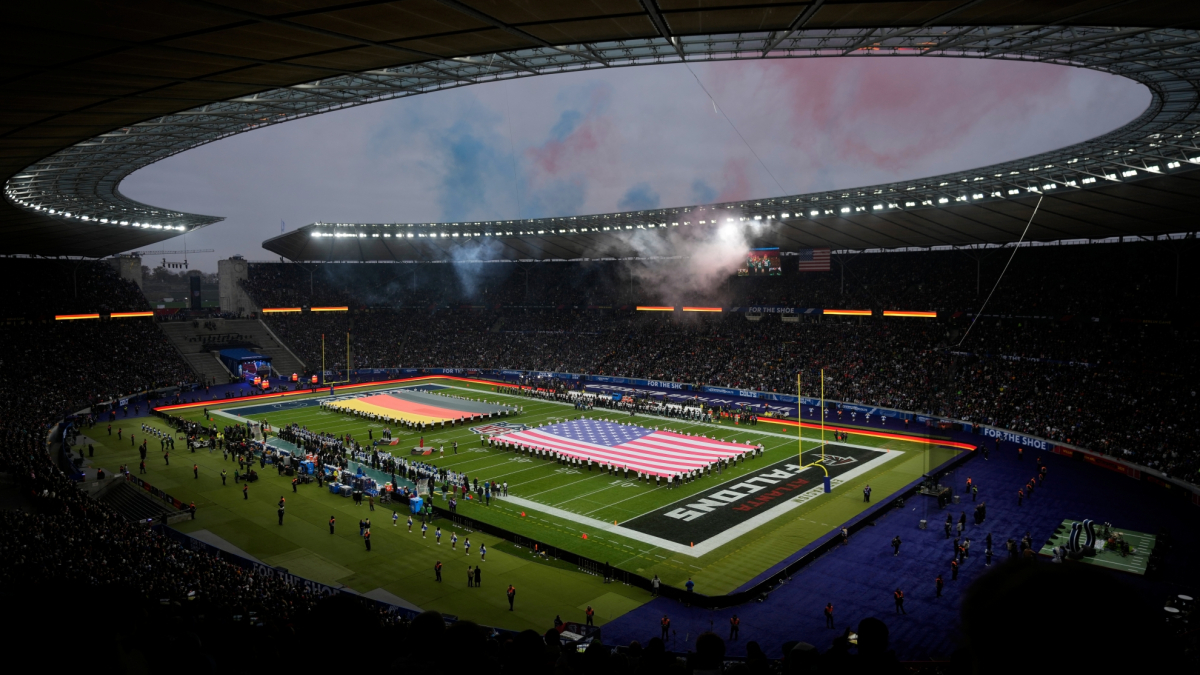
The NFL has spent years proving that it can grow without changing the number of teams. It’s taken regular-season games to new countries, built a more valuable media machine and kept pushing toward a bigger global footprint.
Now, one comment from Mike Repole has raised the possibility that the next step could be more direct: a 34-team league.
The many looks of Travis Kelce throughout his NFL career
Repole, the UFL co-owner and business figure connected to Tom Brady, appeared to reveal more than intended while discussing why spring football doesn’t need to fight the NFL or college game for attention.
“I think that, that just shows you how much people love football,” Repole said. “I think the NFL is doing eight or nine or 10 international games this year, like crazy.
“They’re adding an extra week, talking about two more expansion teams, you know. It’s great for football, it’s great for the NFL, it’s great for college football, and it’s great for the United Football League.”
The NFL hasn’t announced expansion plans, nor publicly committed to moving beyond 32 teams. Repole’s remark, then, should be treated as a hint rather than confirmation.
The revenue math behind two new teams
Roger Goodell once set a $25 billion annual revenue target for the NFL by 2027. That number looked ambitious when he said it. It now looks entirely realistic after the league reportedly cleared $23 billion in the most recent fiscal year.
A 34-team NFL would make the next revenue leap easier to imagine. Using a simple projection, a league making $25 billion with 32 teams could reach roughly $26.5 billion if two expansion franchises generated average team-level revenue.
That estimate doesn’t include expansion fees, increased media value, new stadium income, sponsorship inventory or international rights.
Those extras could matter more than the baseline math. Modern NFL franchises are selling at record valuations, and expansion fees would likely run into the billions before either new team played a game.
Possible cities would become their own debate. St. Louis and San Diego would be obvious domestic names because both lost NFL teams.
International markets would create a more complicated, but potentially more lucrative, conversation. Goodell has already left that door open.
“I don’t take international expansion off the table,” Goodell has said. “I think it’s very possible someday.”
International growth remains the clearest clue
The league’s global schedule shows where Goodell’s thinking is headed. NFL owners have approved up to 10 international games for 2027, and Goodell has repeatedly discussed a long-term goal of 16 international games per season.
NFL executive Peter O’Reilly has framed the strategy as a sustained presence, not a one-off tour.
“Our strategy is not one and done, so our goal is to go back to those markets that we’re establishing,” O’Reilly said.
He also made clear that Asia remains part of the league’s thinking.
“There are parts of the world that we are looking at for future years, maybe not ’27, beyond,” O’Reilly added. “Asia would be an example of that. Japan would be a good example within Asia of a market that has complexity.”
Repole’s remark resonated. Expansion hasn’t been announced, but the NFL’s direction is obvious. More games, more markets and possibly, eventually, more teams.