

Listen to this article
Estimated 4 minutes
The audio version of this article is generated by AI-based technology. Mispronunciations can occur. We are working with our partners to continually review and improve the results.
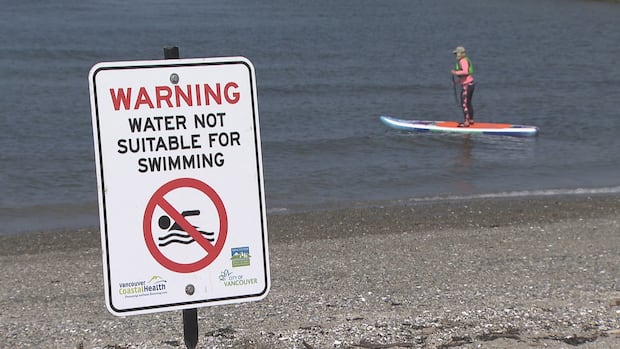
With the heat blazing and the visitors in town for the FIFA World Cup, one of Vancouver’s most picturesque beaches remains closed to swimmers.
Vancouver Coastal Health (VCH) implemented the no-swimming advisory at Sunset Beach on Friday, after testing revealed E. coli levels of up to twice the recommended limit.
Health officials were also investigating four other beaches due to higher-than-usual E. coli sample results.
However, none of those beaches — English Bay in the West End, Third Beach in Stanley Park, Locarno Beach in Point Grey and Trout Lake in East Vancouver — were formally closed to swimming.
E. coli is a bacteria that’s commonly found in the intestinal tract of animals and humans, but it can also be found in swimming water that has been polluted with untreated waste.
“Some of the typical causes that we see are discharged from boats, from combined sewer overflows, in particular after heavy rains, we can also have contamination from animal sources that could be geese, dogs or other animals,” VCH medical health officer Michael Schwandt told CBC News.
“Oftentimes we don’t end up knowing exactly what it is because all of these different influences can be at play and it can be very hard to pinpoint exactly what’s causing something.”
Schwandt said recent heavy rains triggering combined storm drain-sewer overflows and the presence of a large number of boats in the western half of False Creek could be contributing factors.
“Unfortunately, some boats likely do dump waste into the waters,” he said, adding that boaters are legally required to use pump-out services, which the city offers for free.
The swimming restrictions come as southwestern B.C. bakes in a bout of pre-summer heat.
Environment Canada said 26 daily high temperature records fell on Sunday, with highs in Vancouver reaching 26.8 C.
Sunny skies and temperatures in the 20s are forecast throughout the week.
“Nobody wants to be swimming in a situation where it’s going to be gross and people might get sick,” said Christine Baker, a board member with the Vancouver Open Water Swim Association.
“People swim at all of Vancouver’s beaches and the E. coli situation affects all of Vancouver’s beaches — Sunset is the most affected right now, but it’s not the only beach that happens to.”
WATCH | Nine Vancouver beaches closed to swimming in 2025: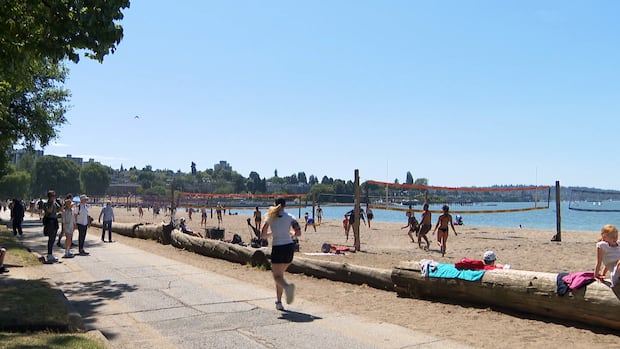
E. coli contamination closes 9 Vancouver beaches for swimming
Nine public beaches in Metro Vancouver are closed for swimming because of high E. coli levels in the water. Vancouver Coastal Health says some possible sources of contamination include animal waste, stormwater runoff and discharge from boats.
A number of the region’s beaches have been closed to swimming at various points throughout the summer in recent years due to high E. coli levels.
Baker said swimmers want to see more enforcement around sewage discharge from boats in local waters along with stronger efforts to control the region’s goose population.
“It’s also one of those things that makes it important for Vancouver to have good pools that people can access,” she said.
She pointed to the impending June 28 closure of the Vancouver Aquatic Centre, and ongoing concerns about the integrity and lifespan of Kitsilano Pool as concerns.
Schwandt said swimming advisories can last from a few days to a few weeks. He stressed that an advisory does not mean a beach is fully closed to the public.
People are free to sit on and enjoy the sand, but should avoid the water and wash well with soap if they do get wet.
He added that investigations at the other four beaches remain ongoing and that VCH will update the public if a no-swimming advisory is required.
You can find updates and information about Vancouver beach water quality at Vancouver Coastal Health’s website.