
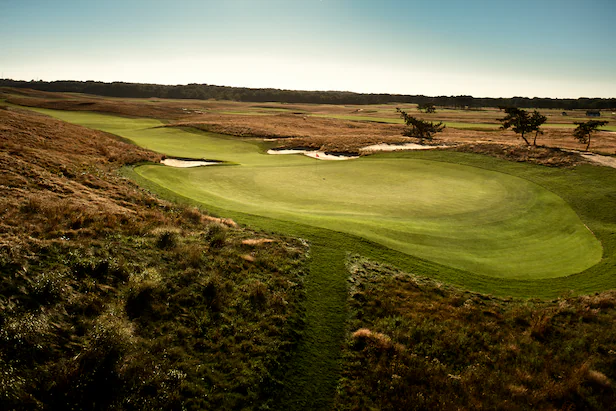
In the pantheon of the great American golf course architects, you have names most golfers know like A.W. Tillinghast or Donald Ross. Most golfers are also familiar with Shinnecock Hills Golf Club, site of this year’s U.S. Open. You know it as one of golf’s great championship venues. But in all likelihood, the majority of casual golfers couldn’t name its designer.
William Flynn is one of the best American architects of the Golden Era, but consistently is underrated. The reason? Flynn didn’t work on nearly as many designs. Architects like Tillinghast, Ross and Robert Trent Jones Sr. have hundreds of courses to their names. Flynn did not, but among the key principles in the Golden Age of American golf course architecture, he was as influential as anyone else. And Flynn’s work was stellar: “His style could perhaps best be summed up as ‘apparent simplicity, but actual complexity,’ ” says Wayne S. Morrison, co-author of “The Nature Faker,” the most comprehensive study of Flynn. “He would mimic nature in truly brilliant ways.”
Flynn played major roles in the designs of three courses ranked within the top 20 of Golf Digest’s most recent America’s 100 Greatest rankings: Shinnecock Hills (No. 4), Merion’s East Course (No. 6) and The Country Club at Brookline (No. 17), matching only the contributions of Alister MacKenzie (Augusta National, Cypress Point and Crystal Downs) and C.B. Macdonald/Seth Raynor (National Golf Links, Fishers Island Club and Chicago Golf Club) for most courses inside our top 20. That’s an impressive fact, and it speaks to how underappreciated Flynn is.
Hugh Wilson, one of the most prominent amateur players of his time, would lean on Flynn to assist him in completing the famed East Course at Merion Golf Club. Flynn, a Massachusetts kid who competed against Francis Ouimet in high school, was hired by his brother-in-law to help him with construction there. Wilson and Flynn would continue to revise the course up until Wilson’s death in 1925, according to Morrison. Merion purchased seven-and-a-half acres of land in 1922, leading to a significant renovation of the East Course, and with Wilson ill at the time, most of the work was likely done by Flynn, Morrison says. “Much of the conceptual stuff was likely Wilson, but Flynn’s originations are in the dirt,” Morrison told Golf Digest. Flynn’s work at Merion, where he’d become their superintendent for some time, led him to get the breakthrough job of his career—redesigning Macdonald’s layout at Shinnecock Hills, one of the world’s best championship venues.
Golden Age architects such as Tillinghast, George C. Thomas and Perry Maxwell usually get their due. Perhaps with yet another U.S. Open coming back to Shinnecock, Flynn will resume his place as one of the most heralded designers in American history.
Explore our brand-new course reviews experience with individual course pages for bonus photography, drone footage and expanded reviews of top international courses and all 17,000-plus courses in the United States. Post your own ratings for courses you’ve played … and tell us where it should be ranked.