
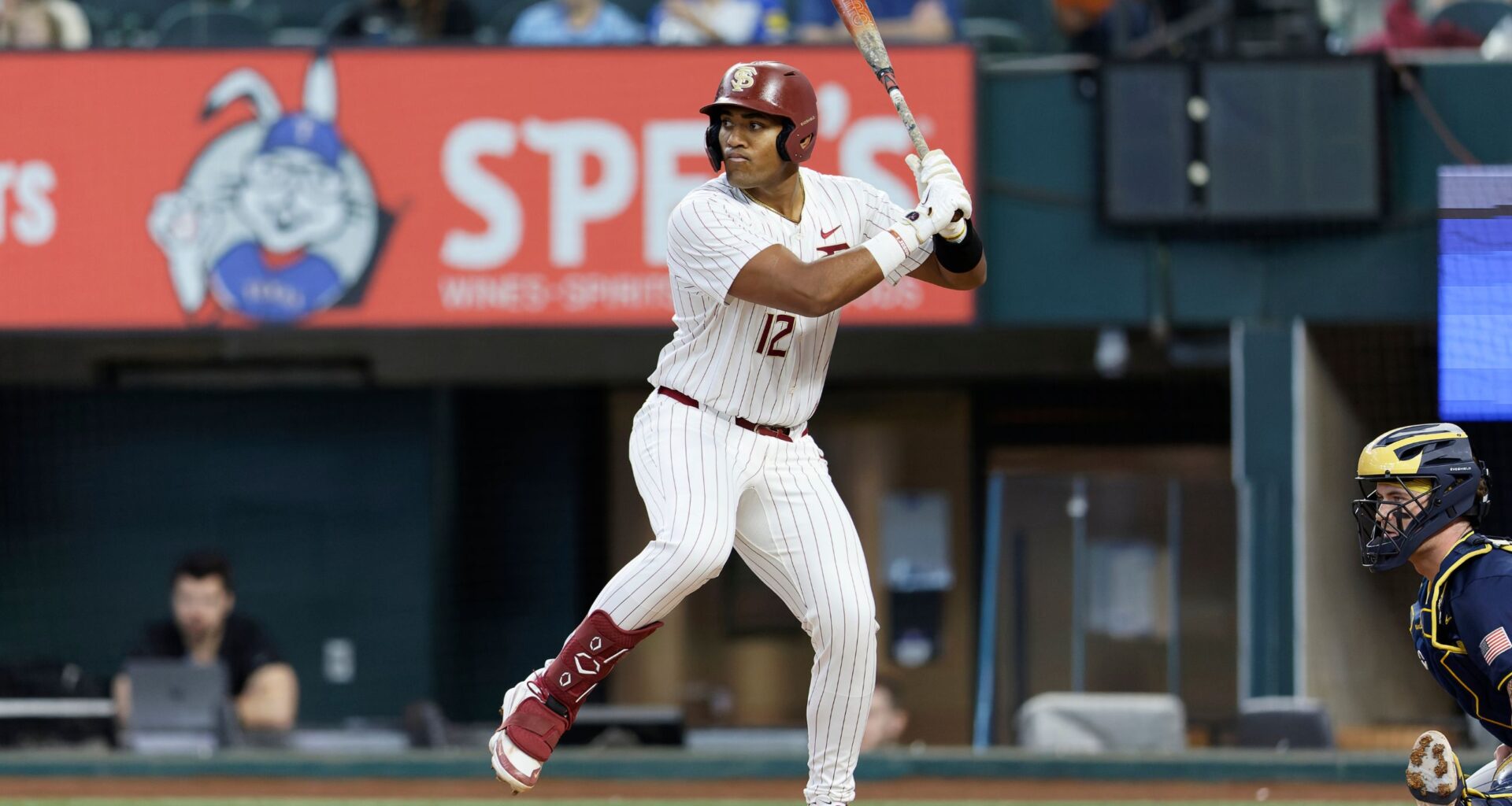
There are few players in the country who can rival Bailey’s prodigious displays of power, and that’s been true dating back to his high school days with Lincoln High in Tallahassee, Fla. He ranked as a top 200 prospect in the prep class of 2024, but made his way to campus at FSU, where he hit .327 with 19 home runs in 56 games and 245 plate appearances—a 7.8% home run rate—in his freshman season.
He was well on his way to shattering that home run total in 2026, with 13 home runs in his first 26 games and 122 plate appearances—a 10.7% home run rate—before the first real injury of his career brought things to a sudden halt.
In the bottom of the eighth inning of a March 28 game against Duke, Bailey was intentionally walked for the 10th time of the season. After a pickoff attempt sailed wide, he took off for second base and slid into the second base bag. He felt his ankle pop, but didn’t think it was a huge deal initially.
“And then I went to go move my foot to get up on top of the bag and stand up and I saw it pointing to the right,” Bailey said. “I was like ‘I know that’s not supposed to be happening.’
After Bailey saw the unnatural angle of his foot, he put his hands over his head. He knew this wasn’t a minor injury.
“I was like ‘My season’s over. I can’t help our team anymore,’” Bailey said. “I knew it was over immediately, and so it sucked. The first couple seconds, it didn’t really feel like anything. Then when everyone got out there, the pain started to hit. It was probably the most painful moment of my life.”
The first week after his surgery, Bailey couldn’t do much of anything except sit on the couch, barely moving, and attempt to deal with the pain. He watched the Seminoles on TV. A few weeks later, once the incisions of his surgery were healed, he started physical therapy.
He had conversations with former FSU quarterback Jordan Travis, the 2023 ACC player of the year, who had a similar leg injury that wound up ending his playing career. Travis encouraged him to figure out more about himself away from the field—what matters, getting closer to God and figuring out who you are outside of the sport.
“I think it just showed and proved my love for the game and how much baseball means to me,” Bailey said. “The last two and a half months without it have been miserable.”
Now, several months away from his injury, Bailey can see his path back to the field. He was recently cleared to get out of a walking boot and is working to redevelop his natural walking mechanics and ankle mobility. He should be cleared to run soon, and then in a few more months he hopes to get cleared to return to normal baseball activities.
And even with his injury and shortened season, Bailey’s unique offensive profile should have plenty of big league clubs interested. The power is his obvious carrying tool. A highlight reel of Bailey’s home runs—or a brief look at any of his batting practice sessions—would be enough to confidently put an 80-grade evaluation on his power.
But he’s also got the numbers to back it up.
In the Trackman era of college baseball, Bailey is in rarefied air. No hitter has been able to match his 97.6 mph career average exit velocity, and the 99.6 mph average exit velocity he had in the 2026 season was shaping up to blow any individual season mark out of the water, as well.
Baseball America has comprehensive college batted-ball data going back to the 2022 season. There have been just 39 hitting seasons in that span with either a 96 mph average exit velocity or a 112 mph 90th percentile exit velocity.
Bailey tops the list and is one of only three players to appear on the list twice.
YEARPLAYERAVG EV90TH EV2026Myles Bailey99.61122024Jared Jones98.2111.52024Braden Montgomery98.1111.12023Alejandro Figueredo97.6107.62026Jake Bennett97.5112.32023Kavares Tears97.5110.42024Mason Neville97.5108.92026Quinton Coats97.4111.42024Charlie Condon97.31122024Nolan Schubart97.1111.62024Kyle West97.11112026Lorenzo Carrier96.9112.92025Myles Bailey96.9112.12024Grant Knipp96.8109.82024Dakota Jordan96.7111.42026Brendan Lawson96.6111.22025Luke Stevenson96.51072026Ryan Zuckerman96.4112.82024Robert Moya96.3110.32024Daniel Cuvet96.3108.12026Jack Natili96.2108.72026Diego Cardenas96.21082024Mason White96.2107.82024Christian Moore96.1111.82026Crew McChesney96.1106.82025Aaron Graeber96113.92024Travis Bazzana96108.92024Jimmy Obertop96108.52023Kemp Alderman94.7114.62026Carson Tinney94.4112.32024Jacob Krieg94113.52023Dakota Jordan93.9112.62023Jac Caglianone93.7113.32024Joe Delossantos93.7112.42026Caden Bogenpohl931122024Aaron Graeber91.7112.62023William Sullivan91.6112.32023Joe Vetrano90.1112.42024Trey Truitt86.2112.3Minimum 120 plate appearances and 30 batted ball events
Among college hitters with at least 350 plate appearances in the last two seasons, Bailey is first in OPS (1.222), fifth in on-base percentage (.488), fourth in slugging percentage (.734) and fifth in isolated slugging (.397).
He has real contact questions—he has a career 28.9% strikeout rate and 60% overall contact rate with FSU—but could have enough raw power and the savvy batting eye—with a 23% chase rate and 18.3% career walk rate—to make up for it.
Bailey understands power is the focal point of his game, but he was also trying to prove he’s more than just a slugger before his injury.
“Obviously big power, everyone knows that and that’s kind of my identity,” Bailey said. “But I think my hit tool and my impact to the game … the way I approach an at-bat, just my presence in the lineup and within the at-bat, it also plays into my power and my hittability.”
Bailey found a mechanical adjustment late in the 2025 season that helped him hold his backside in his swing, which he credits to helping him see the ball deeper and make sharper swing decisions.
That mechanical adjustment, plus reps with FSU’s new iPitch pitching machine or simply having his dad set up two normal pitching machines—one throwing fastballs and one throwing breaking balls and then forcing Bailey to react and make decisions—all helped him sharpen his swing decisions and level up offensively for his draft-eligible sophomore season.
In his first 26 games of the 2026 season before the ankle injury, Bailey cut his strikeout rate from 31% to 24.6%. He improved his walk rate from 13.1% to 28.7%. Yes, a spike in intentional walks (1 in 2025 to 10 in 2026) certainly helps, but there was also a real shift in the pitches Bailey was choosing to swing at.
He expanded the zone 27% of the time in 2025 and in 2026 dialed that chase rate down to 17%. That led to better quality contact when he did choose to swing and a HR/FB rate of 50%.
Coming off a serious injury, Bailey’s draft stock is more volatile than it might otherwise have been. But his exceptional power and vastly improved swing decisions give him some of the most exciting offensive upside in the class. Seeing him come off the board in the second round wouldn’t be a huge surprise.
As a draft-eligible sophomore who turns 21 just a few days before the draft begins, he also has more options—and leverage—in front of him than many college players and will be one of the most interesting names to follow on draft day because of that.
“For me, pro ball was obviously the goal at the beginning of the year,” Bailey said. “The injury didn’t help. The way I was going, it would have done a lot for me. But at the same time, Florida State’s a great place and there are some things I didn’t get to do this year because of the injury that I wouldn’t be opposed to getting to do those things again.
“But pro ball has always been a dream of mine. If the opportunity presents itself, I obviously wouldn’t be opposed to that. But staying at home, because I’m from here, and playing at FSU is a great option. For me, whatever (situation) God puts me in is what I’m going to do and what I’m supposed to do.”