

SOUTHAMPTON, N.Y. — A sprawling piece of exposed land sits between Long Island’s Great Peconic Bay and the Atlantic Ocean, where coastal gusts are ever-present, even if the water isn’t always visible.
This is the site of the 135-year-old Shinnecock Hills Golf Club, the 2026 U.S. Open venue admired by experts as a timeless masterpiece. The national championship has been contested on Shinnecock’s sweeping terrain and canted greens in each of the last three centuries.
The last two times the U.S. Open was brought to Shinnecock, the course has been the story. Only two players finished under par across both tournaments. A six-time major champion committed a shocking penalty more fit for a charity scramble. Pros howled at the USGA, the organizing body that governs this major championship. They had a point — those tasked with determining green speeds and fairway width failed to give proper weight to the inherent toughness of architect William Flynn’s layout.
Why? Perhaps because understanding the true brilliance behind Flynn’s design first requires a step back.
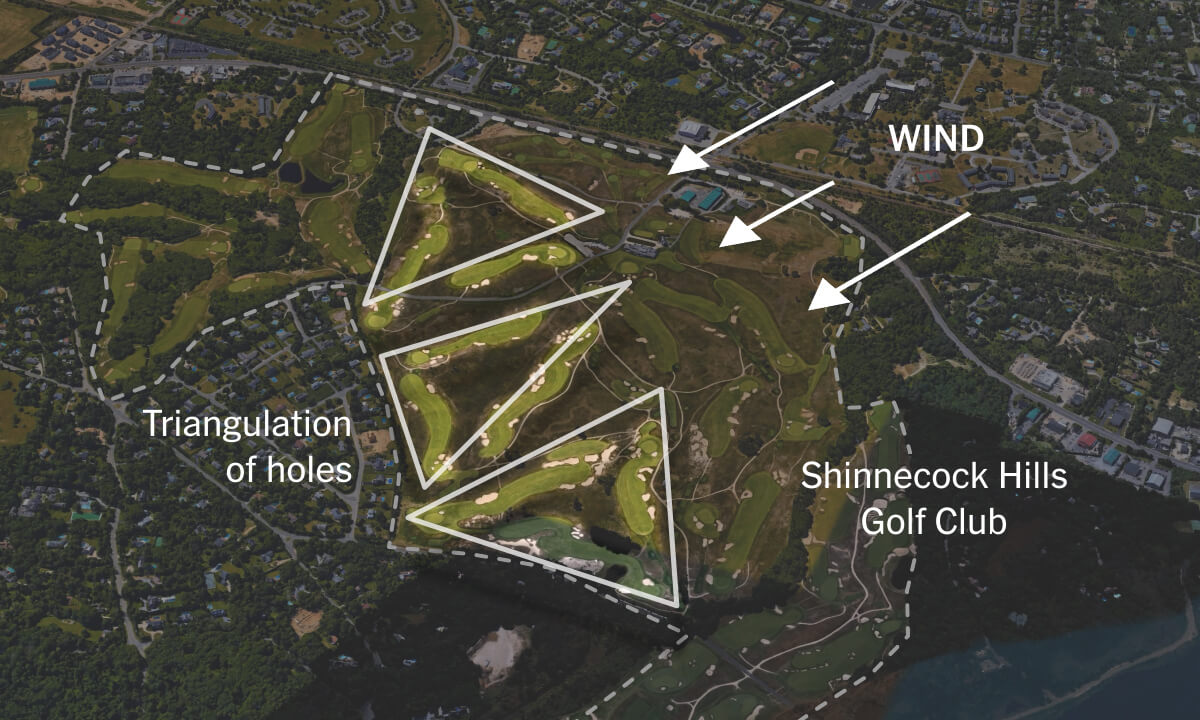
Shinnecock Hills is full of triangles — sneaky but massive, and always torturous triangles. You may not be able to see them as you plot your way around the course on foot. But from a bird’s-eye view? They are there, and they will haunt you. Shinnecock deliberately forces you to confront nature everywhere you turn.
Whereas traditional coastal courses often route out and back — forcing players to face one wind direction on the front nine, and the other most prevalently on the back — Shinnecock is built geometrically, atop a large ridge. Rather than sitting on a long and narrow piece of land, Shinnecock’s 260 acres of property are shaped more like an oval, allowing for these hole formations.
Holes No. 4-6 form the first triangle, holes No. 10-13 form the second and holes No. 14-16 complete the final triangle. This configuration of holes was chosen specifically by Flynn in 1931 to pit the golfer against the prevailing southwest wind from all angles. The shape of Shinnecock spins you in a vortex, with crosswinds galore. With each new hole, the wind direction changes, demanding a heightened level of focus.
“The triangulation is one of the key features of the course in that it really keeps you on your toes,” says Wayne Morrison, a historian of Flynn’s work and author of “The Nature Faker”, an extensive Flynn biography. “You can’t settle into a predictable pattern.”
This all came about when Flynn — the mastermind behind Merion East in Philadelphia and The Country Club at Brookline in Boston — was tasked with redesigning the 1916 C.B. Macdonald and Seth Raynor layout at Shinnecock. The original 1891 layout of Shinnecock was only 12 holes and was built with the help of more than 100 members of the local Shinnecock Indian Nation.
By 1927, however, club leadership deemed another new design a necessity because the state planned to build a highway that would cut through the course. So Shinnecock purchased 108 additional acres of land and gave Flynn the reins. According to Morrison, Flynn pulled inspiration from his experience at Merion because that property was also known for its unpredictable and persistent wind.
Having seen the shift from hickory to metal shafts, Flynn was also ahead of his time in his ability to foresee a distance problem in golf, an issue the professional game plans to address with a ball rollback in 2028.
In 1927, in an article Flynn wrote for The Bulletin of the United States Golf Association Green Section, he advised architects to use natural tools like wind and elevation when considering hole length. He warned that one day, courses might need to be lengthened to 8,000 yards. This week’s U.S. Open will play at 7,440 yards, and Flynn’s original layout was approximately 6,755 yards, according to original scorecards collected by Morrison.
(Drew Jordan / The Athletic)
“It should be the aim of the architect to lay out his course in such a way as to get the proper length holes at the proper places,” Flynn wrote. “Actual yardage, however, is not the determining factor in this or that type of hole for a 430-yard hole downhill may very easily be a drive and mashie niblic while a hole reversed on similar ground might be two full wood shots.”
That is why elevated tee boxes and greens are so prevalent at Shinnecock. There are longer par-4s that are intentionally downwind, starting with No. 3, and other par-4s that are shorter, but set into the wind, like No. 8. Flynn also crafted many of Shinnecock’s par-4’s and par-5’s into doglegs, so players might even face multiple wind directions on the same hole — the kind of challenge that does not discriminate, whether you are a long or short hitter.
“Flynn thought golf should not only be a physical test but a test of strategic thinking as well,” says Morrison.
All of these choices only add to the challenge that Flynn built out on the ground. Shinnecock’s fairways create optical illusions off the tee, the bunkering is treacherous and the greens are, in some places, designed to repel the ball from the putting surfaces. The margins for error are slim, even without the added factor of 30-mile-per-hour switching gusts.
Holes Nos. 9 to No. 11 stand out as the toughest stretch on the property.
Players will finish their front nine with a daunting uphill approach to one of the most canted greens on the property, the iconic Shinnecock clubhouse perched as the backdrop. Then, they’ll head to the blind tee-shot 10th, which rolls like an amusement park ride down a massive dip in the middle of the fairway and back up to another steep approach. And the 11th is one of the most terrifying par-3s in the world, despite being the shortest hole on the course at 157 yards.
The climb up the dune is so severe that players cannot see the minuscule green from the tee box, which is surrounded by an intimidating set of bunkers that catch wayward shots. At the 2004 U.S. Open, the par-3 ranked as the fourth-hardest hole on the course with a scoring average of 3.332.
“You’re exposed to nature at Shinnecock, both in terms of the contours on the ground and the contours coming at you through the air,” says Bill Coore, the renowned golf course architect who assisted with Shinnecock’s 2013 restoration. “Flynn went out and sought out the most interesting landforms that just felt like golf in a natural state, and then he laid holes out upon those, in what they thought was an interesting fashion.”
Flynn’s use of the innate movement of the land and the location’s natural weather patterns is why Shinnecock has uniquely stood the test of time. But that does not mean modernity hasn’t placed its demands on the venue. Tee boxes have been lengthened and championship setups have pushed the course to its limit.
“I don’t think William Flynn or anyone associated with Shinnecock Hills would have thought of the green speeds that they expect today,” says Coore. “The greens are so beautifully done, and you don’t want to change them just to accommodate green speeds. But it’s a fine, fine line, between what’s acceptable and what’s over the edge. With the tilt of the greens, the speed of the greens, and then you throw in the other big element — the winds.”
The USGA will host its sixth U.S. Open at Shinnecock this year. A U.S. Open has been held at the course in each of the last three centuries, beginning with the 1896 championship, and it is set to host two more in 2036 — the men’s and women’s Opens. But every time the tournament comes back to the revered venue, the USGA faces a taller task.
With all the challenges that Shinnecock naturally offers, how do you set up a U.S. Open-caliber championship without crossing the line?

Cameron Young and his caddie try to make a game plan during a Monday practice round. (Warren Little / Getty Images)
Brooks Koepka won in 2018, but the week’s drama came to a head on Saturday afternoon. Shortly after the conclusion of the third round, Zach Johnson spoke into a Sky Sports microphone with a declaration: “They’ve lost the golf course … when you have a championship that comes down to sheer luck, that’s not right.”
That Saturday, the morning wave went about business as usual, with multiple players posting scores several shots under par. But the leaders, teeing off in the afternoon, faced a different beast: The wind picked up, the sun kept shining, and Shinnecock’s Poa annua greens firmed up to a level that the USGA admittedly did not expect.
Putts cascaded off greens and players walked off the course in shambles. Phil Mickelson famously hit a moving putt. Several holes, including the 13th, the site of Mickelson’s bizarre ruling, teetered on the edge of unplayable, according to players.
It reminded players of the disaster at the previous Shinnecock U.S. Open, in 2004, when USGA CEO Mike Davis instructed the maintenance team to syringe moisture back into the greens and hose down the putting surfaces in between groups. Davis once called the final day of the tournament a “double bogey” in the USGA’s history. Shinnecock sits on a truly unpredictable piece of property, built on a sand foundation. The technology available today to increase green speeds was not part of Flynn’s vision when he designed table-top-sized nooks for pin positions. Testing that limit is a dangerous game.
Since 2018, however, the USGA has focused less on the goal of the winner finishing their championship over par and more on promoting the course architect’s original intent for how the host venue plays.
That mindset was shared with Shinnecock members at a meeting back in November, who care deeply about how their course is presented to the world, and has continued to be the narrative leading into this year’s U.S. Open. John Bodenhamer, the USGA’s Chief Championships Officer, said in May that the USGA plans to maintain Shinnecock’s traditional fairway widths and “ease into” the green speeds over the course of the week.
“We’ve seen what’s happened here the last two U.S. Opens. It doesn’t need to get that fast to play incredibly difficult and challenging,” said Rory McIlroy on Tuesday.
If the USGA acts according to plan and the coastal gusts don’t shake things up yet again, golf will see something beautiful at this year’s U.S. Open. A renowned architect will test the best players in the world — as he originally intended — nearly a century after first crafting his masterpiece. And Shinnecock will be Shinnecock.