
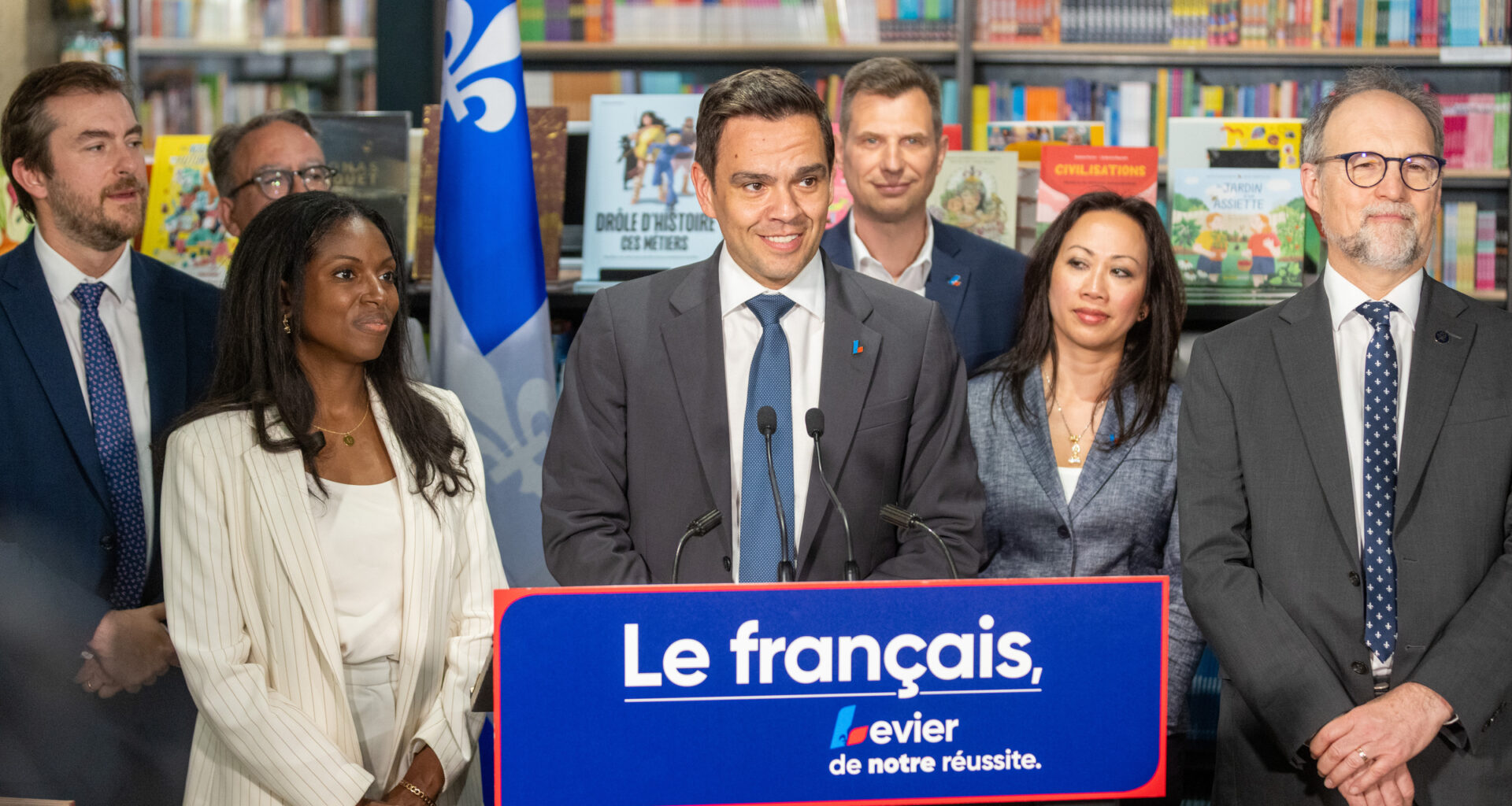
Charles Milliard has made his move in Quebec’s language debate.
After years in which Quebec’s political conversation around French has been dominated by restrictions and the expanding reach of the province’s language watchdog, the Quebec Liberal leader on Tuesday unveiled a $380-million plan built around a different idea: strengthen French through schools, francization and economic opportunity.
Speaking at a Verdun bookstore, Milliard promised major investments in reading, immigration services and French-language promotion and a “change of tone” at the Office québécois de la langue française.
“I think we should all agree that a change of tone is necessary,” Milliard said when asked about the OQLF, which came under renewed scrutiny last week after targeting a popular St-Henri brunch restaurant over the use of the word “nosh” in a window sign.
The Quebec Liberals have long been accused by rivals of being weak on French and too closely tied to anglophone and minority voters. But ahead of the fall election, Milliard, who took over the party in February after winning the Liberal leadership following Pablo Rodriguez’s resignation, is trying to prove his party can defend French without adopting the more coercive nationalism of the ruling Coalition Avenir Québec or the Parti Québécois.
It comes weeks after Quebec French Language Commissioner, Benoît Dubreuil — a watchdog post created by the CAQ’s Bill 96 — warned that the French Charter, in its current form, would not be enough to stabilize the decline of French in Quebec. Milliard had seized on those remarks as evidence that the CAQ government’s language policies had fallen short.
‘Making reading a national priority’
Milliard’s plan is organized around seven themes: read, integrate, prosper, learn, protect, shine and unite.
One of the largest commitments — roughly $110 million — is “making reading a national priority.”
This would see every elementary student receive a Quebec-published French children’s book each year. It would also go towards protecting school library budgets and creating a fund for municipal literacy projects.
More than $130 million would go toward francization — French-language integration services for newcomers — a policy area Milliard said the government has mismanaged by asking newcomers to integrate in French while making them wait months to access courses.
As such, the Liberals promise to reduce wait times for francization courses to six weeks. They would also extend from six months to two years the period before newcomers are required to communicate only in French with the state.
The plan would target areas where French is considered fragile, including downtown Montreal, through initiatives tailored to local realities and partnerships with businesses and community groups. However, the Liberals provided few details on how those measures would work.
Milliard was careful not to blame the OQLF itself. He said the agency is simply enforcing rules set by the government.
A Liberal government would review the regulatory burden imposed on small businesses, job postings and municipalities, and also revisit the OQLF’s inspection process to ensure its interventions actually strengthen French.
Milliard pointed to recent language controversies and municipal paperwork requirements as examples of rules that, in his view, generate bureaucracy without advancing French.
“When we think about ‘Go Habs Go’ or the burgundy controversy, it just doesn’t make sense for anyone who is serious about protecting French,” he said, referring to two episodes in which the OQLF pushed to strip the “Go” from Montreal transit displays cheering the Canadiens, and told the Burgundy Lion pub in Little Burgundy that the word “Burgundy” on its sign wasn’t French enough. The agency walked both back after public backlash.
Premier Christine Fréchette struck a similar tone Monday.
“Maybe we can improve the tone used by the OQLF,” Fréchette said in an interview with CJAD.
The plan also includes maintaining current enrolment levels in English-language CEGEPs while strengthening French instruction; seeking a resolution to legal disputes involving English school boards; and expanding trade and cultural ties with francophone markets abroad.
French is “a cultural gem, but it’s also a very interesting business opportunity,” Milliard said.
Milliard had recently said he would be willing to use the notwithstanding clause to protect a revised version of the French-language charter and reiterated Tuesday that position if legal advice deemed it necessary.
Jean-François Roberge, Quebec’s minister responsible for the French language, dismissed the proposal and accused the Liberals of proposing “the rollback of French.”
In a post on X, Roberge argued the party was weakening protections by opposing measures that expand the Charter of the French Language and by seeking to reverse restrictions on English-language CEGEP enrolment.
“No one is fooled by their ‘plan,’” he wrote. “Once again, the Liberals are resigned to the rollback of French.”
He also accused the party of repackaging existing government initiatives aimed at improving access to books and promoting French-language content online.
Recent polling suggests what appeared to be a two-way race between the Parti Québécois and the Liberals is becoming a three-way contest, with the CAQ gaining ground.
But more worrying for the Liberals, support among non-francophone voters has fallen, while the party continues to trail the PQ and CAQ among francophones.
Still, Milliard hopes to reposition his party.
“No political party in Quebec has a monopoly on the defence of French,” he said.
Do you have a story tip? Write to me at hnorth@postmedia.com.

I’ve been writing for the Montreal Gazette since 2023. My favourite stories are ones that make you think and I’m always looking for new ways to tell them. At McGill, I studied economics and computer science. Now I live in the city’s Plateau, where I wear Doc Martens to try and blend in among the hipsters. Got a story? Email me.
hnorth@postmedia.com