
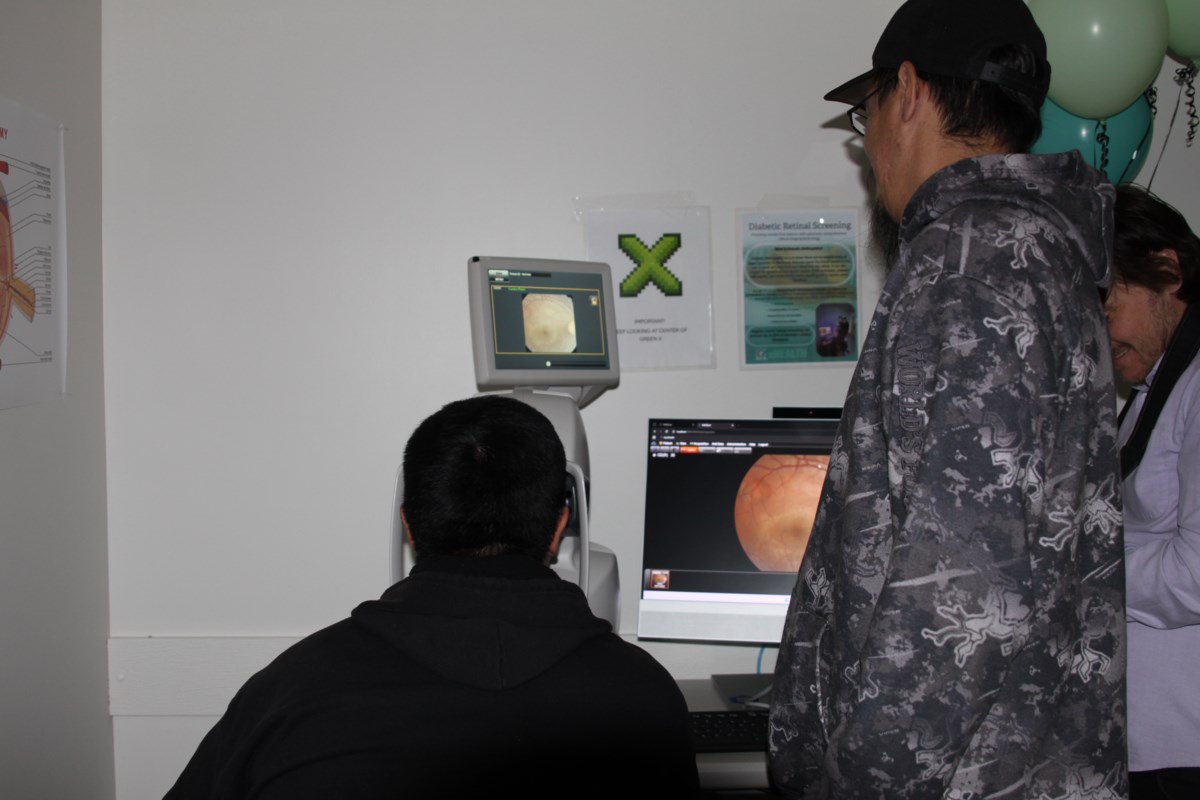
Twenty-seven Northern communities will now be able to screen residents for diabetic retinopathy, removing barriers that can delay both diagnosis and treatment.
THUNDER BAY – Twenty-seven Northern communities will now be able to screen residents for diabetic retinopathy, removing barriers that can delay both diagnosis and treatment.
Keewaytinook Okimakanak (KO) eHealth held their official launch of the TeleOphthalmology program on Thursday. The program will allow for four portable screening cameras to rotate among the 27 First Nations that KO eHealth serves.
“This program combines advanced retinal imaging technology, artificial intelligence-assisted screening, and virtual care pathways to support the early detection of diabetic retinopathy, a complication of diabetes,” said project lead Allison Palmer.
A trained community member will administer retinal screening to patients, saving them from having to travel out of the community, lowering costs to the health-care system, and saving time for physicians.
“The importance of this work cannot be overstated,” said Palmer.
“Diabetes continues to affect Indigenous populations at disproportionately high rates, and regular retinal screening is critical for detecting changes in the eye before symptoms appear,” she said.
Erickson Owen is the community telemedicine coordinator for Poplar Hill, and volunteered for the demonstration of the screening camera during the ribbon-cutting ceremony. Poplar Hill is scheduled to receive one of the cameras in late August.
“It eliminates the need to go to a place like Thunder Bay or Winnipeg, especially when Non-Insured Health Benefits is cutting back on a lot of their funding and a lot of people are missing out on their medical appointments because (…) their travel is not coming in on time,” Owen said.
He also said that community members will feel more comfortable to be able to rely on, and have the program administered by someone that they know.
David Fagan is a vision rehabilitation specialist for Vision Loss Rehabilitation Canada, and said that they have already screened 4,000 people in Ontario. In 12 per cent of the screenings, a positive diagnosis was made.
Fagan explained that the camera, with its AI-supported screening software, takes a picture of the macula and optic disc that are located at the back of the eye.
“The screening is not a diagnosis, but it is a way to detect possible diabetic eye disease earlier, and connect people to follow-up care when its needed,” he said.
Patients have their results after just five minutes using the camera. If the results are positive, KO eHealth sends the results to an ophthalmologist at Vision Loss Rehabilitation Canada, and they can develop a plan.
Palmer added that previously, every scan had to be sent to an ophthalmologist to determine if it was negative or positive. “We’re saving our healthcare dollars there too, by not having an ophthalmologist have to read thousands of scans,” she said.
The $75,000 cameras are capable of screening for other conditions according to Palmer, but they will begin with using it for diabetic retinopathy at this stage.
Currently, the cameras are in Thunder Bay and Sandy Lake, Deer Lake, and Lac Seul First Nations, to be rotated regularly.
Diabetic Retinopathy is a complication where the retina’s small blood vessels are damaged by prolonged high blood sugar. The damaged vessels swell and leak fluid if left untreated, causing irreversible loss of vision or blindness, as described by Fagan.