
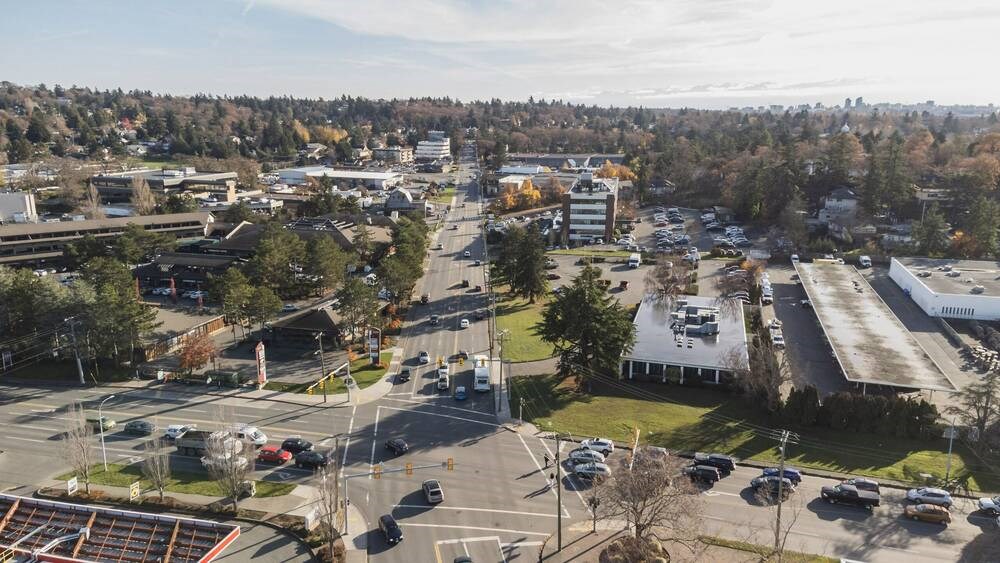
After a five-and-a-half-hour public hearing Tuesday night, council voted 6-2 in favour of adopting the Quadra-McKenzie Plan, which has been more than three years in the making.
A controversial neighbourhood plan that will guide the future growth of Quadra Street and McKenzie Avenue in Saanich is now a reality.
After a five-and-a-half-hour public hearing Tuesday night, council voted 6-2 in favour of adopting the Quadra-McKenzie Plan, which has been more than three years in the making.
The plan, which will be folded into the district’s official community plan, is meant to focus future growth in Saanich’s centres, corridors and villages where there is transit and infrastructure to handle the increased density.
It was revised several times since the process began in February 2023, and each time the community came out in force to laud the changes, claim they didn’t go far enough, argue they went too far, or suggest the plan should be scrapped altogether.
Over the last three years, the district received more than 17,000 pieces of feedback.
It got more of that again on Tuesday night.
Over three hours, council heard from dozens of residents complaining about the increased density envisioned in the document, arguing more density should have been included in some areas, bemoaning a lack of environmental protections in the document, or expressing fear of increased traffic congestion and a lack of amenities and updated infrastructure to handle future growth.
Mayor Dean Murdock said the plan will not please everyone, but it’s one he is still proud of.
Murdock cautioned that “nothing changes overnight” as a result of the plan’s approval, and not everything in it will come to fruition. “This is a long-term plan, and it will guide Saanich over the next five, 10, 15, and maybe 20 years in these corridors.”
Over the last two years, the draft document was revised several times after public feedback. Plans to reduce vehicle lanes on both McKenzie Avenue and Quadra Street in favour of more space for buses and bikes were scrapped in favour of more transit-friendly designs.
The potential for buildings as tall as 24 storeys in some centres was cut to 12 or 18 storeys, while buildings on corridors were capped at six storeys. No more than three- or four-storey buildings will be considered in areas that transition toward single-family neighbourhoods.
In areas of south Quadra near Tattersall Drive, several streets that had been earmarked for six-storey apartments are now down to allowing townhouses.
Potential building heights were also capped at four storeys along Quadra Street north of Saanich Road on the west side of the street and Tuxedo Drive and Ian Street on the east side. Those parcels will now only allow redevelopment for townhouses or three-storey buildings.
Murdock stressed that all the plan does is indicate which areas are suitable for potential rezoning, adding that the fact that it does not change land use has been a difficult message to get across during public engagement sessions.
“I regret that it’s created a lot of anxiety and frustration for people who potentially misunderstood the intention of the plan or were misled about what the plan was going to achieve.”
Coun. Zac De Vries said keeping the status quo won’t help those who can’t afford to live or stay in Saanich.
“Doing nothing doesn’t preserve affordability or opportunity. It simply limits who can live here,” he said.
Growth will happen, he said, so the question is not whether people will need homes, but where and how those homes will be provided.
Coun. Karen Harper called the plan a living document that will be revised as needed.
“Is it perfect? Of course, it’s not perfect. If I waited for perfection or if any of us waited for perfection, nothing would ever get done.”
She said she hopes having more housing options will improve affordability, especially for the 20-40-year-olds who are not sticking around after university.
Councillors Nathalie Chambers and Judy Brownoff both voted against adopting the plan.
Brownoff said residents have expressed concerns about the plan leading to too much density that could creep into single-family-home neighbourhoods.
Chambers, meanwhile, said the process should have included more engagement, in particular with the Songhees First Nation.
The Songhees had requested that Saanich postpone adoption of the plan pending meaningful consultation over the Garry oak ecosystem.
On Tuesday, council amended the plan to include a new goal of restoring and stewarding ecosystems, and added a policy of working with Indigenous communities to incorporate their knowledge into Garry oak restoration approaches.
Murdock said the additional language makes it clear the plan will be updated to respond to the concerns raised by the Songhees.
“While this policy language does not resolve all of the issues that were raised, what it commits to is an ongoing relationship and discussion to ensure that is respected and that we can remain responsive to the issues and concern the Songhees have very thoughtfully articulated.”
Final adoption of the plan will come later this summer.