
“It’s not personal… It’s strictly business.”
That’s the self-deception Michael Corleone coolly lays on his brother when he declares, in a pivotal moment in The Godfather, that he wants to be the one to retaliate for the attempt on his father’s life. I’ve tried to sell myself on the same deception over the past few years, as antisemitic attacks and betrayals rained down; so many under the false premise that they’re anything but personal.
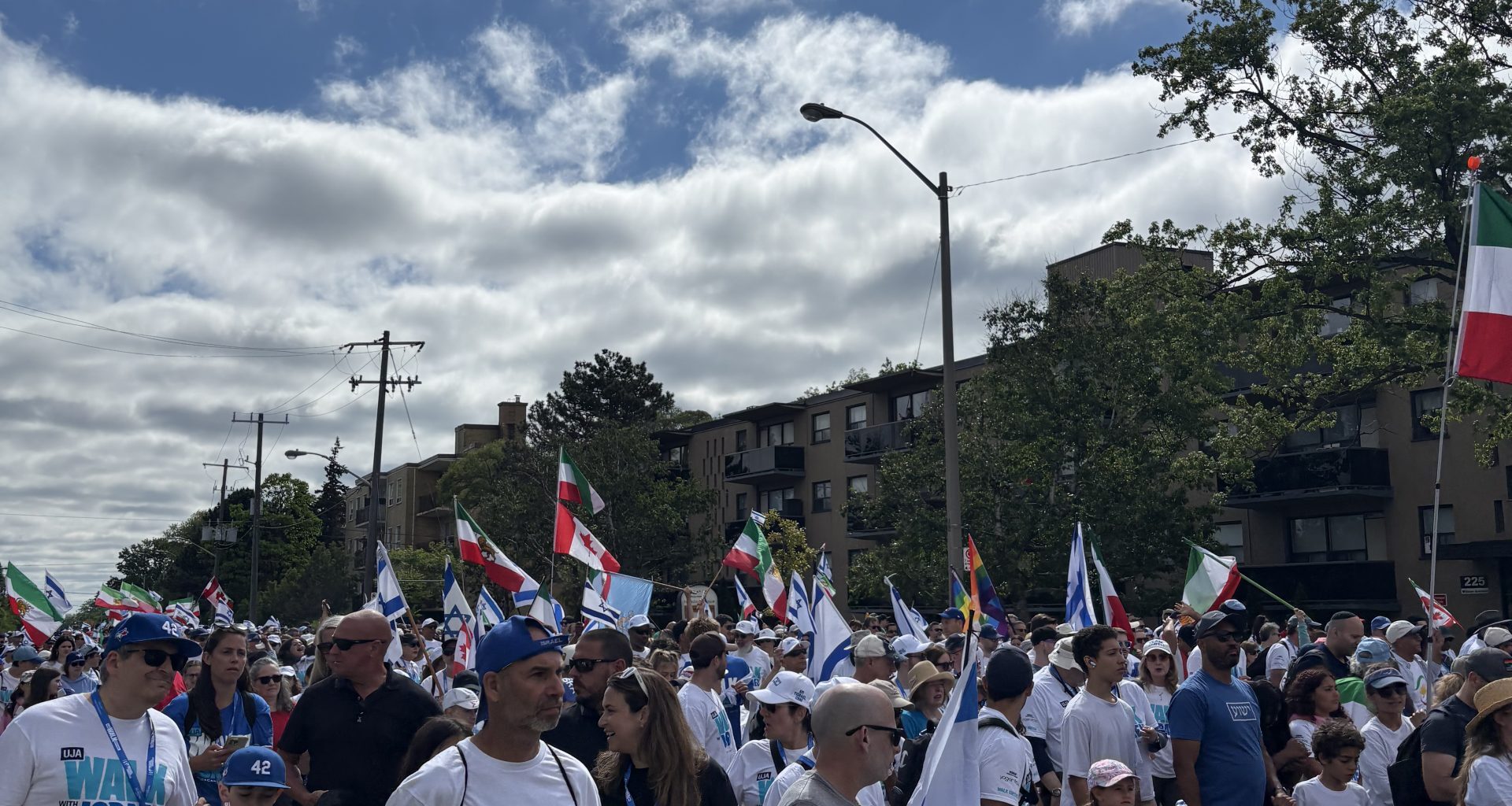
A progressive social media pal recently let me know that if I were to attend the Walk with Israel, it wouldn’t matter if I vehemently opposed Netanyahu or supported peace; simply showing up was emboldening violence and it should weigh on my conscience. I argued that actually I get to define my own relationships with Israel and Judaism but was scolded that “some people here matter and some don’t.” I took it to mean that the symbology of the Israeli flag is contested and because Zionists are privileged and powerful, it’s the other 99% of the Canadian population who get to tell us what it means. And what it means to them isn’t good.
It’s a big change from the Walk I did as a kid, which no one openly protested or politicized. Of course, over the past generation—and especially over the past 2 years—everything that was once taken for granted has shifted and the Walk has become a key flashpoint for discussions of what is OK for Zionist Jews to do and say in public. Accordingly, the route has been drastically shortened and cordoned off, secured by aerial drones and uniformed and plainclothes police, so the families who attend can do so securely. Whether having all those police around makes us actually feel safer, I’m not so sure.
Well, I attended the Walk anyway. I went because of stuff like this. I flashed back to my friend’s description of the event (which he’s never attended) as a borderline anti-Palestinian hate crime while I munched on a kosher hot dog and watched a group of shinshinim sing their own lyrics to ABBA’s “Mamma Mia,” while kids played in bouncy castles and Chabadniks coaxed people into wrapping tefillin as I caught up with an old friend. I guess I’m saying I see a gap between reality and what others are projecting onto us.
After watching Mark Carney’s recent antisemitism speech fall short, an empathetic not-Jewish friend asked me for my take and after summarizing a litany of dashed hopes, I said I was tempted to make a list of every person and organization that has let me down since Oct. 7. She helpfully suggested no good would come from that.
She’s probably right but I know it’s not just me. I don’t know if anyone in my social circle hasn’t lost friends (or had friends lose them), hasn’t seen colleagues post upsetting material on social media or otherwise had some relationships permanently changed for the worse over the past couple of years.
One of my lifelong friends—someone with whom I played in a band, attended synagogue services and day school, and rabble-roused on shabbatons—evolved in a matter of months from a critic of Israel to a virulent anti-Zionist activist with a vast social media following. He penned an article explaining why everything from bomb threats to vandalism of shuls to arrests for terrorist activities do nothing but prove Canadian Jews are as safe as ever. Hundreds of Facebook followers loved it and thanked him for bravely speaking out.
He repeatedly offered lessons from selected “Jewish values” he learned in Hebrew school, while simultaneously saying everything he learned there about Israel was an exaggeration or lie. He seems to take a masochistic pride in losing friends and being disowned by family for The Cause, but for me and many others, it’s been a brutal gut-punch. Many fled and unfollowed. I tried to stick around but ultimately, despite more than 40 years of friendship, the gaslighting about how Canadian Jews are just narcissists imagining antisemitic attacks was something to which I could no longer subject myself.
Coincidentally, I was just reading about Montreal’s Temple Emanu-El-Beth Sholom narrowly averting being severely damaged in a firebombing last week and noted the rabbi had also grown up within our circle. Two people from the same youth minyan: one enduring an attack on her congregation and the other making excuses for it.
The sheer quantity of attacks has made it inevitable that they keep hitting closer to home. I’ve had riot police and assaults on Jews in my neighbourhood. Pretty much every GTA synagogue that has been hit is a place in which I’ve spent time; my own wedding here, my daughter’s bat mitzvah there, a friend’s simcha, my childhood shul. And it seems like no one else cares very much.
For years, as technology and social media shifted the nature of discourse, I stayed on the sidelines, an impetuous age of writing letters to the editor and other futile protests in the distant past. I made a conscious decision not to engage with any of “this stuff” on social media; I didn’t put flags in my bios or put ((())) around my name when Pepe the Frog and his ilk were making the rounds. Being Jewish and/or Zionist was such a core part of my identity. I didn’t feel the need to assert it any more than I’d announce my shoe size. It’s what I live, every day. I’m fairly certain I never even said or typed the phrase “I am a Zionist” before 2023. But I realized that while I hadn’t been paying attention, “Zionism” had become a misappropriated slur and, whether I liked it or not, this new age demanded that I say something. My friend vacating a space of engagement and dialogue for bully pulpit lecturing was the final straw.
It’s been bad enough from people I know but of course the random denizens of the internet are even more pointed, lecturing me on my identity and the state of my soul. I’ve been called a Khazar and a pedo Nazi and accused of antisemitism more times than I can count. It turns out that a surprising number people have a lot of thoughts about who I’m allowed to be.
None of it is nearly as shocking as it used to be but I won’t pretend the personal attacks aren’t upsetting. It’s not business as usual anymore and there’s no benefit to pretending it doesn’t feel personal or that my views of Canada haven’t been fundamentally altered. I could try to dispassionately analyze and understand the socio-historical factors at play. I could try to offer academic assessments of antisemitism and anti-Zionism as they’ve manifested here or propose policy solution bromides that might or might not work. Perhaps a Council!
My old friend expressed disappointment that we could no longer connect because of a difference of “politics,” as if he wasn’t fully aware he was attacking a core part of his friends’ and community’s identity, often using antisemitic tropes. But simply doing nothing or continuing to pretend this was really just a debate about politics or differing views was no longer an option. Because it’s not business. It’s personal.
David Fleischer’s writing has appeared in publications including The Globe and Mail, National Post, Toronto Life and Spacing. He was founding co-editor Afterword, a national, Canadian Jewish student magazine and his Reel Toronto column ran at Torontoist for 10 years. He is currently co-editing Volume 2 of the book World Film Locations: Toronto (Intellect Books).
***
What do you think? The CJN welcomes your feedback with a letter to the editor. If you wish to have your letter considered for publication, please submit using this form.