
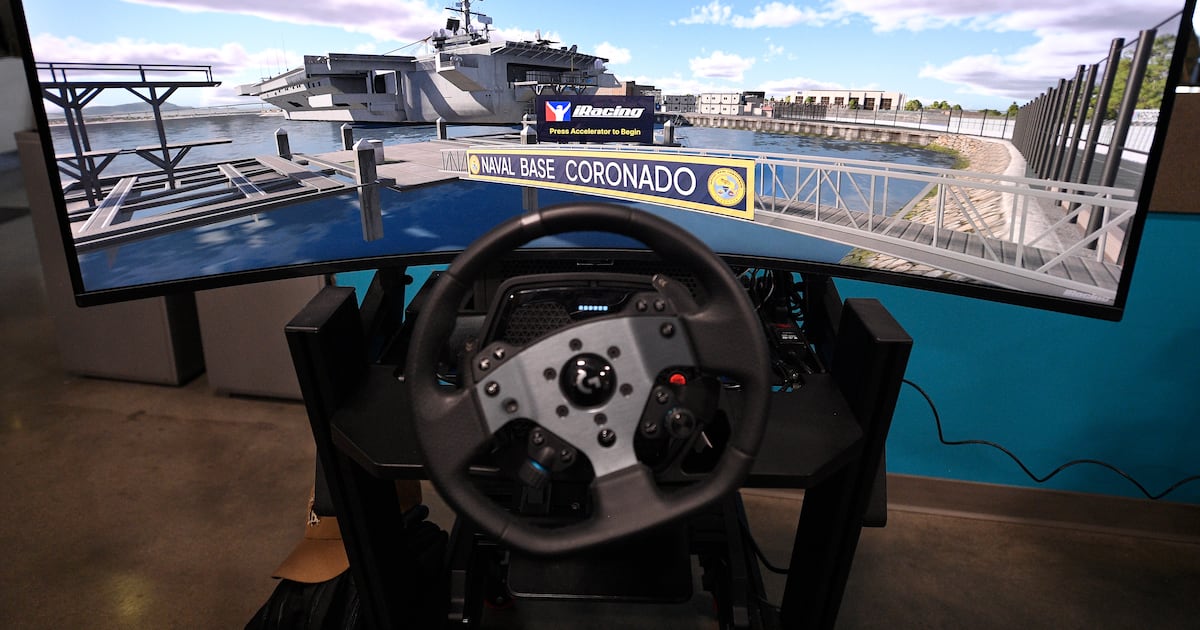
“I feel the need for speed” — Tom Cruise in Top Gun
SAN DIEGO — Turning a base into a race is apparently right up the military’s alley. Out here in the most southern town of California, where the surf generally meets the turf — not pavement — they’re cutting the ribbon this weekend on a street track that deserves a salute.
Sponsored fittingly by a defense contractor, NASCAR’s Anduril 250 on Sunday will be a 3.4-mile, 16-turn journey through Naval Base Coronado that weaves by aircraft carriers, operational runways, double-domed hangars, luxury boats, helicopters, fighter jets, a beach and the infamous I Bar. If the Clash at the Coliseum was a retrofit and the Chicago Street Race was an inner-city dream, then this race at the base –- during an active war in Iran — is the anomaly that can happen when cars and commanding officers unite.
“I’m equal parts terrified and excited at all times because truly we are taking over a United States military base,” said Amy Lupo, president of NASCAR San Diego.
If it sounds unprecedented, that’s because it is. NASCAR has never staged a race at an active military site, and this one has its roots in a San Diego hunt two years ago and concludes this weekend with “SVG” (Shane van Gisbergen) and “Wookie” coming together as one. Buckle up.
The origins are in the Clash at the Coliseum in L.A., where, first in 2022, NASCAR transformed the USC football field into a quarter-mile track. Lupo helped lead the event, and following the Clash’s third and final rendition of 2024, she said, “We started to look, ‘Well, how do we keep racing in Southern California?’ The Coliseum was never meant to be a permanent fix.”
When NASCAR COO Ben Kennedy was in L.A. for SBJ’s World Congress of Sports that year, he joined a group that included Lupo, NASCAR SVP/Design & Development Derek Muldowney and NASCAR Sr Dir of Design & Development Jeremy Casperson for a tour down the coast.
One of the initial stops was about 100 miles south at the Del Mar Racetrack in North County San Diego — a charming and historic 89-year home to horseracing described famously by the Bing Crosby song, “Where the Surf Meets the Turf.” The idea was to cover the dirt with concrete, but Lupo said it took about five minutes to say, “This isn’t going to work.” First of all, there’d be horses running from July to November — making the timing complex — not to mention the coinciding San Diego Fair on site every summer.
Since San Diego is a military town, they hightailed it farther down I-5 to the Marine Corps Air Station Miramar, near La Jolla, which already housed the annual Miramar Air Show. “But that’s completely run by the Marines, so it takes a lot of resources for them to put that together,” Casperson said. “So I think them having two events of that size would’ve been pretty challenging.”
They drove farther down I-5 to the Point Loma peninsula, where Sports San Diego CEO Mark Neville had one more locale in mind. He had them climb specifically to the Cabrillo National Monument, 422 feet above sea level, and said, “Hey now, let’s look over here.”
There it was, the Naval Air Station North Island (NASNI), in all of its massive glory. They couldn’t visit in person because they didn’t have military clearance, because the runway was a premier aviation hub, because it was a training home to Navy SEALs and commands such as Amphibious Construction Battalion One.
“But we were like, ‘Yeah, let’s do that,’” Casperson said.
They searched it on Google Earth and consulted Muldowney, a native of Dublin who had spent time living in San Diego. He informed the group, “We can put a track there,” beginning a process that would soon cross cultures.
They were eventually permitted to tour the base, hosted by NASNI’S then commanding officer Capt. Ladislao Montero, whose call sign, or nickname, was “Monty.” The military seemed enthusiastic. As talks advanced and the street race was greenlit, Montero was replaced in June 2025 by a new just-as-helpful commanding officer, Capt. Loren Jacobi. Whose call sign was: Wookie.
“You’ve got to learn each other’s languages,” Casperson said. “The Navy speaks a different language, and we [at NASCAR] speak a different language. Most of them are aviators, so they have a call sign. And so on the radio, you’re hearing, ‘Wookie.’ If I just said ‘Wookie’ to you, you’d be like, ‘OK, who’s that?’ And they’ve got other terms. You’ve got to learn things like SECCO and OPSO — which is security officer and operation officer. They have a lot of acronyms and, man, I catch myself talking to my wife all the time in different navy lingo.”
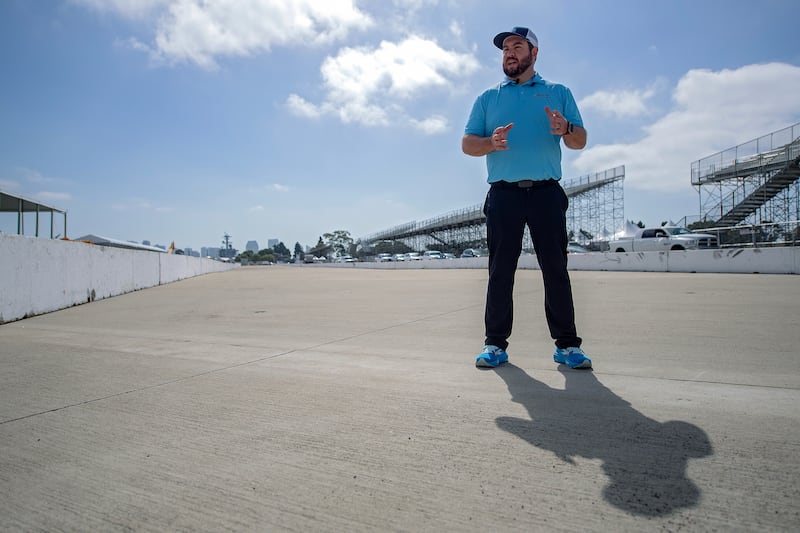 Senior Director of Design and Development at NASCAR, Jeremy Casperson speaks to the media at the San Diego Naval Base street course on June 09, 2026 in Coronado, California. Photo by Orlando Ramirez/Getty Images
As the partnership evolved and the course began undergoing construction on June 1 — all while the base was active and the country still at war — the languages officially crisscrossed. To help with the build, NASCAR borrowed members of the Navy’s skilled Amphibious Construction Battalion, otherwise known as Seabees (or CB’s). In military settings, Seabees “build and defend military infrastructure in hostile or austere environments” and, in April, they expertly rescued NASA’s Artemis II crew from the Pacific Ocean. But now they were getting to … build a race course?
“Believe me, there’s a sense of ownership and gratitude they have for it,” Casperson said.
Together, over 17 total days, NASCAR and those Seabees built a racetrack — dubbed the Qualcomm Circuit — that has just under 3,200 concrete barrier sections. In all, 2,000 loads of materials were used to prop up 40,000 grandstand seats, hospitality tents and a driving surface that goes on for days.
“The sheer size of it,” Lupo said. “I mean, the track itself is 3.4 miles. Our colleagues at Talladega Super Speedway … typically do social media posts, and they’ll show six of the Alabama football fields inside Talladega. We can fit Talladega inside of San Diego’s track. It’s crazy how big this place is.”
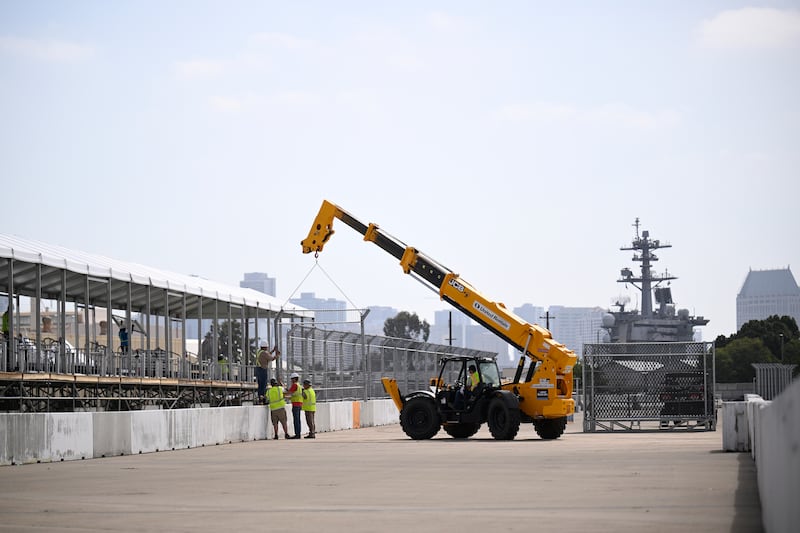 CORONADO, CALIFORNIA – JUNE 09: A general view of construction workers installing fencing to the top of concrete barriers for the NASCAR San Diego course at the Naval Base Coronado on June 09, 2026 in Coronado, California. (Photo by Orlando Ramirez/Getty Images) Getty Images
Somehow, they overcame the language barrier along the way. NASCAR officials would say, “Hey, the grandstands go in Turn 3,” and the military wouldn’t know what a Turn 3 was. The military would say, “It’s in the stern of the car,” and NASCAR would say, “You mean at the back of the car?” NASCAR would say, “Chicane” or “Pit Road” or “Front Stretch,” and there would be military blank stares.
“One email would turn into six, just trying to explain exactly where we’re at,” Casperson said.
But they figured it out in the end perhaps over a beer at I Bar — the Coronado drinking establishment that inspired the bar scenes in the movie “Top Gun” — and the mammoth street course was easily completed ahead of time. The jets for the flyover will actually take off from the base and land on the base. They’ve even held an on-base fantasy draft, of sorts, where every command unit has been assigned one race driver to root for.
Word is SVG’s biggest fan is … Wookie.