


Listen to this article
Estimated 3 minutes
The audio version of this article is generated by AI-based technology. Mispronunciations can occur. We are working with our partners to continually review and improve the results.
New data from Statistics Canada shows Alberta’s population growth still isn’t over, even as the federal government clamps down on immigration.
According to the report, an estimated 5,057,077 people lived in Alberta as of April 1 — a 0.2 per cent increase from the previous quarter.
That might not seem like a big increase, but the populations of British Columbia, Ontario and Quebec each fell by 0.2 per cent in that same time period.
“The only large province breaking the trend on that one is Alberta, which has not experienced a single drop, a single quarter of population decline,” said Stéfane Marion, chief economist with the National Bank of Canada.
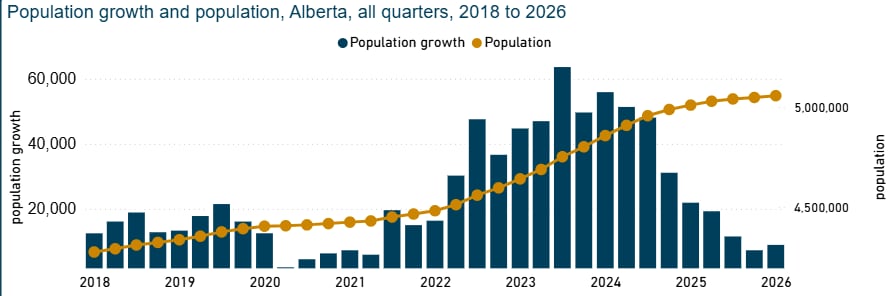 Alberta’s population has been growing at a rapid pace for years, but an analyst with Statistics Canada said the growth is starting to stabilize. (Statistics Canada)
Canada’s overall population, meanwhile, fell by 0.1 per cent to an estimated 41,417,056 people.
Fewer immigrants move to Alberta
Though Alberta’s population continues to grow, fewer immigrants are moving to Alberta.
Statistics Canada said the number of immigrants who moved to the province in the first quarter of 2026 (11,139) fell by 18.2 per cent.
In addition, the population of non-permanent residents in Alberta — that’s anyone who isn’t a Canadian citizen or permanent resident — dropped by 3.7 per cent from the previous quarter.
So what’s driving the growth?
Stacey Hallman, an analyst at Statistics Canada’s Centre for Demography, said interprovincial migration is offsetting the losses. She said Alberta still leads the country in interprovincial migration.
“More people are moving to Alberta than are moving from Alberta to other provinces and territories in Canada,” she said.
That’s been the case for years — since around the time the Alberta government, led by former premier Jason Kenney, launched its Alberta is Calling campaign.
 Stéfane Marion is chief economist with the National Bank of Canada. (Colin Hall/CBC)
Marion said it’s a stark difference from other large provinces in Canada.
“All the other provinces — think about Ontario, think about B.C. — they’re still seeing inflows of permanent immigrants on a year-over-year basis. But the outflows of foreign students and temporary workers is greater than the inflow of permanent residents,” Marion explained.
“In Alberta’s case, it’s neutral. So that makes the overall population grow.”
According to Hallman, Alberta’s population growth is slowing down after the record highs seen in recent years.
“It seems like the trends and growth are kind of returning to what we saw before the pandemic.”