
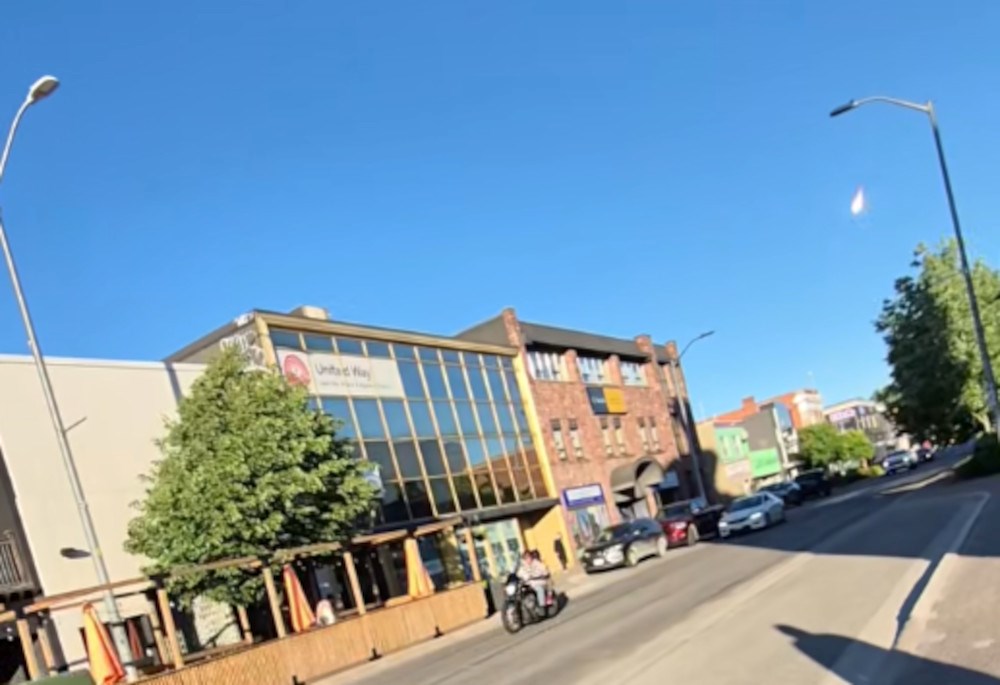
A fireball seen in the Sault last night resulted in meteorites touching down on an island in Lake Huron, according to a professor who specializes in the study of meteors
A leading expert in the study of meteors is describing the fireball seen streaking across the sky last night as one of the most “promising meteorite falls” he’s seen in many years.
Western University professor Peter Brown says the fireball witnessed in Sault Ste. Marie is something that people might see once or twice a year — but last night’s event was significant because it produced a large amount of meteorite debris that hit the ground.
According to Brown, a fireball is a type of meteor — a light phenomena that happens when a rock from space hits the atmosphere — that’s brighter, larger in size and produces a high amount of energy.
“It’s not super rare, but for most people, it’s a once-in-a-lifetime event to be at the right place, right time, and see it,” said Brown, who is a member of the Western Meteor Physics Group at Western University.
“The fact that this happened in daylight is a little unusual, just because it means the meteor — the fireball — had to be pretty bright to get people’s attention.
“The sonic booms are one manifestation of the fact that the object got pretty deep into the atmosphere.”
The fireball was observed in Sault Ste. Marie and surrounding area at 8:13 p.m. on Friday, resulting in 93 eyewitness accounts from Ontario, Michigan and Ohio being reported to the American Meteor Society overnight.
The meteor probably weighed hundreds of kilograms when it first hit earth’s atmosphere, Brown says, which led to a fraction of it landing on the ground.
Brown says radar measurements have indicated an “extensive group and a fairly significant mass of meteorites” that landed on the northeastern side of Cockburn Island, a heavily-wooded, sparsely-populated island in Lake Huron.

Dr. Peter Brown is a professor and meteor physicist in the Department of Physics and Astronomy at Western University. Photo supplied
The meteor physicist believes the meteorite debris covers a 30-square-kilometre portion of the island, which is located east of St. Joseph and Drummond islands.
“The rocks would be black on the outside, heavier than normal and often will be magnetic,” Brown said. “The fall area really is fairly confined.
“It doesn’t seem to go too much into the lake — it’s right over the island.”
Although meteorite debris can be difficult to find in a heavily wooded area like Cockburn Island, Brown says the meteorite fall appears to have produced so much material that a search for rocks there may be worth the effort.
“I think it’s something worth pursuing, and indeed cottagers on the island, I would encourage them to go out and just look around your yard,” he said.
The public is encouraged to submit photos of potential meteors to the Western Meteor Physics Group via email at [email protected].