
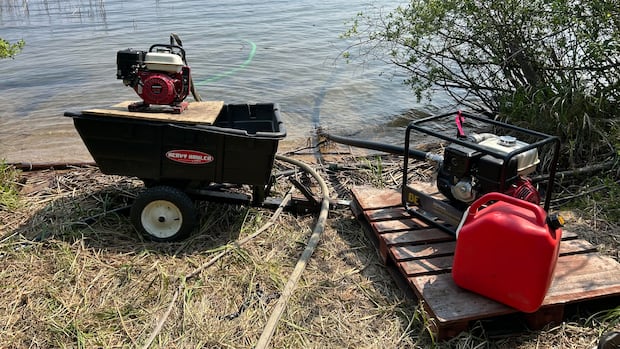
Creighton fire chief Dwayne Wenger remembers last year’s wildfires, and the equipment he could have used.
“We were not prepared for it. We were prepared for a smaller-scale fire, but nothing like what was coming towards us,” recalled Wenger, whose community about 430 kilometres northeast of Saskatoon was one of the worst affected by Saskatchewan’s brutal 2025 wildfire season.
Since then, the town of about 1,200 residents has bought a large truck and trailer equipped with sprinklers, tanks and pumps. He guesses the cost is over $100,000.
“We felt there wasn’t enough resources, so we went ahead and wanted to be a little bit more prepared in case something like this was to happen again,” said town administrator Paula Muench.
As wildfires grow worse in the province, some northern towns and residents have spent thousands to prevent and fight them.
The provincial government’s new FireSmart grant program will offer some compensation for mitigation efforts, but some say they could have used the help sooner.
Wadin Bay receives first grant
Wadin Bay, a small cottage community about 25 kilometres north of La Ronge, is the first community to receive a grant of up to $40,000 to boost wildfire mitigation.
The province has said it’s committed to improving its response to wildfires, after a report released last week pointed out issues with last year’s efforts.
Michael Weger, Minister Responsible for the Saskatchewan Public Safety Agency, is in charge of the grant program.
“My vision for the FireSmart grant is to use the community of Wadin Bay as the example, really the shining example of what can be done,” Weger said in an interview with CBC Saskatchewan’s Blue Sky.
Wadin Bay residents pooled their money to became the first “FireSmart” community in the province in 2015. FireSmart is a program for educating firefighters and residents.
Denis Renaud, president of the Wadin Bay Cottage Owners Association, said community members wanted to organize the funding themselves so they could be more resilient.
Starting in 2006, they consulted with professionals about clearing out vegetation, then decided to buy their own equipment.
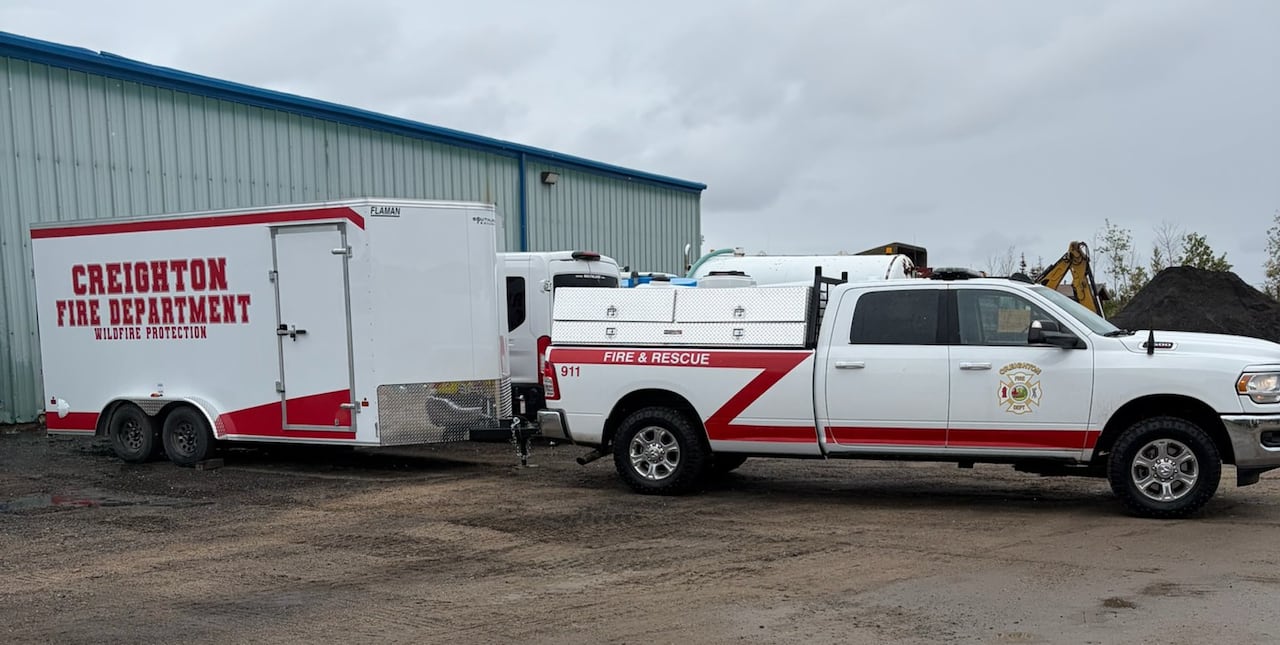 The truck and trailer Creighton bought to prepare for future fires. (Submitted by Dwayne Wenger)
Last summer, they coordinated with suppliers to obtain truck-trailers and a bulldozer. They also had to pay to feed their crew of 25 people.
Renaud said even without the provincial grant to reimburse them, it would still have been worth it to spend the money.
“I’m sure there’s others out there that would definitely pay $40,000 to get that back again if they could.”
Weger said the nine days the community spent fighting the fire was a factor in awarding the grant, and that the costs of firefighting didn’t fall under emergency relief funding.
Essential equipment
Cindy Ouellet said she witnessed how communities needed to buy firefighting equipment themselves last summer and she has doubts about the grant being enough.
“I guess it’s a nice gesture, but it would have meant a whole lot more had they supplied equipment and personnel at the time when it was needed and when the fire started,” she said.
“I feel like whatever they do now, it’s good, but it’s a little late.”
Ouellet’s husband stayed in the Denare Beach area to be a volunteer firefighter last summer while she lived further south to send supplies north, a skill she developed from running a fishing camp.
LISTEN | Sask. minister reponsible for wildfires respond to ‘damning’ report’:
Blue Sky51:11Sask. minister responsible for wildfires responds to ‘damning’ report
An independent review of Saskatchewan’s wildfire response found gaps, poor communication and a system strained by increasingly severe fires. Saskatchewan Public Safety Agency Minister Michael Weger outlines how the province will improve its wildfire response, and climate change and soil science professor Colin Laroque examines where the government is still falling short.
She provided fire hoses and radios to local fire departments that they desperately needed, and she and her husband ripped out a water holding tank and loaded it onto a flatbed truck for a mobile source of water, she said.
“At the time, you don’t think about what’s the cost of this or you know, should I do this? You just do it because it’s something to help.”
She wishes the SPSA had taken over that process instead of leaving it to everyday people, she said.
“They should have been able to do exactly what regular people were doing much more efficiently.”
Expert calls for more
Colin Laroque, a professor and department head of soil science at the University of Saskatchewan, said the grant program is indicative of a broader lack of advance preparation by the province.
He said it’s admirable that community members volunteer to mitigate the risks and fight fires themselves, but the government should better organize efforts.
“If there’s a fire on your neighbour’s property, you’re gonna go and help them stop it because you don’t want it to come to yours. And so you see that kind of ethic coming through in the Saskatchewan people, and I love it,” he said.
“At the same time, they could harness it better.”