
Your support helps us to tell the story
From reproductive rights to climate change to Big Tech, The Independent is on the ground when the story is developing. Whether it’s investigating the financials of Elon Musk’s pro-Trump PAC or producing our latest documentary, ‘The A Word’, which shines a light on the American women fighting for reproductive rights, we know how important it is to parse out the facts from the messaging.
At such a critical moment in US history, we need reporters on the ground. Your donation allows us to keep sending journalists to speak to both sides of the story.
The Independent is trusted by Americans across the entire political spectrum. And unlike many other quality news outlets, we choose not to lock Americans out of our reporting and analysis with paywalls. We believe quality journalism should be available to everyone, paid for by those who can afford it.
Your support makes all the difference.Read more
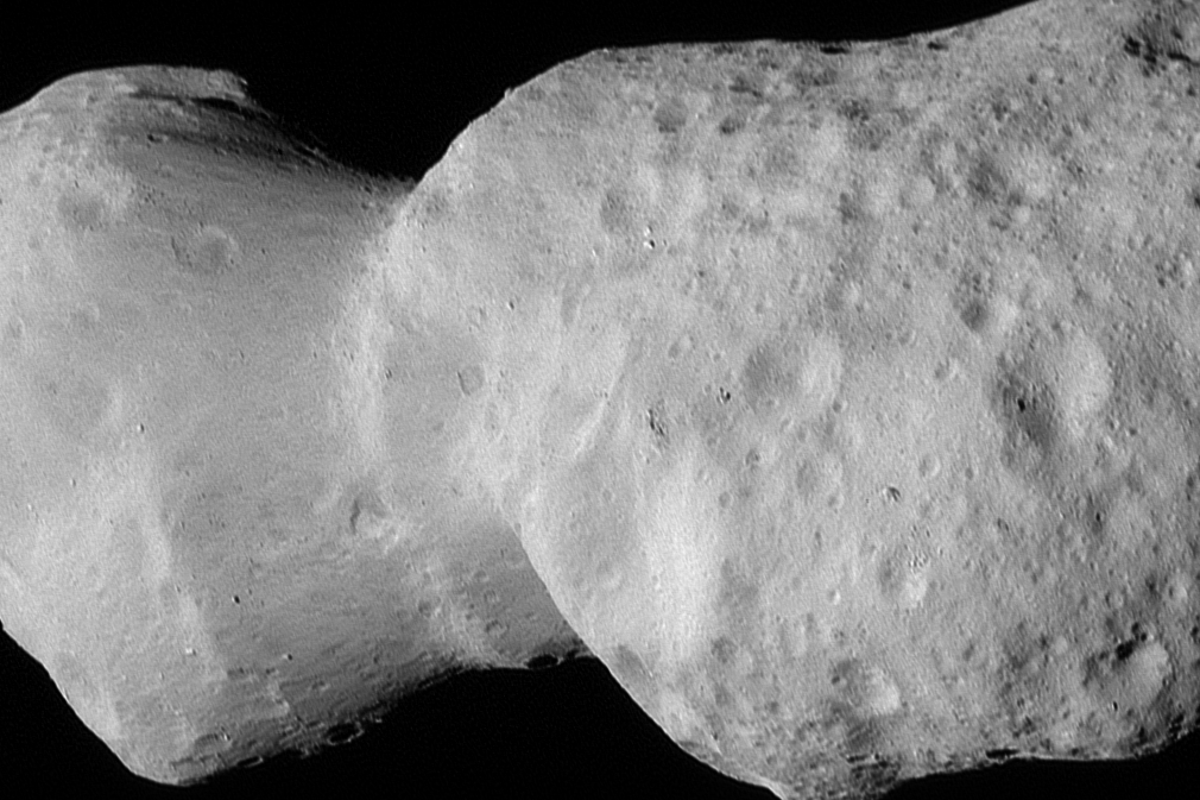
Scientists have found a “wobbling peanut” in space.
Researchers studied the asteroid Donaldjohanson and found that it seems to turn around on two axes, leaving it wobbling as it travels through the solar system.
Researchers at the Southwest Research Institute made the discovery using Nasa’s Lucy spacecraft. The flyby of the asteroid is primarily a test of that spacecraft – which is named after the man who discovered Lucy, one of the oldest human ancestors ever found, which inspired the mission’s name.
“This is just one of many surprising things learned since Nasa’s Lucy spacecraft flew by Donaldjohanson on April 20, 2025,” said Simone Marchi, deputy principal investigator of the Lucy mission and the study’s lead author. “Lucy images confirmed its elongated shape, initially suggested by Earth-based telescope observations. The flyby revealed that the small asteroid, half a mile in diameter, resembles a peanut, with a two-lobed structure connected by a narrower neck.”
It also found iron-rich clay minerals that were formed near liquid water. They suggest that the asteroid was likely made up of pieces of a bigger, carbon- and water-rich asteroid, that broke up 155 million years ago after a collision in the main asteroid belt.
The encounter with the asteroid Donaldjohanson will allow Nsa to test how Lucy will perform when it flies by the Trojan asteroids, two swarms of ancient objects that fly around Jupiter, as it orbits around the Sun.
Scientists hope that they will be able to use the asteroids in those swarms to understand the early life of our solar system, since they have been preserved since they were formed.
This encounter gave us an opportunity to test our instruments and our procedures to make sure we are ready when we get to Jupiter’s Trojans,” said Dr Marchi. “Once we start learning more about the Trojans, a completely different population of space rocks with very different histories, our understanding of solar system formation is likely to be challenged.”
The work is reported in a new paper, ‘The Lucy flyby of (52246) Donaldjohanson: A bilobed asteroid with tumbling rotation’, published in the journal Science.