
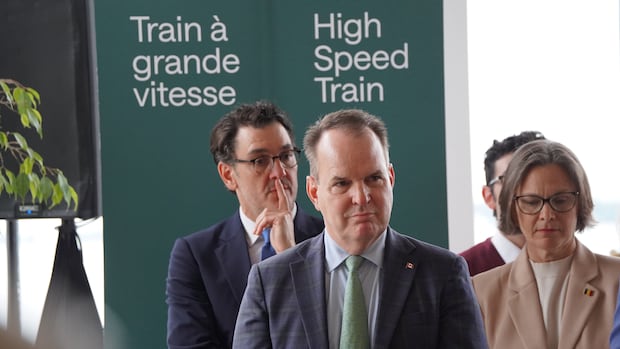
The Liberal government is weighing a significant change for the Alto high-speed rail project that would move the line’s corridor south toward the shore of Lake Ontario.
The proposed line from Quebec City to Toronto — which Prime Minister Mark Carney wants to start building in four years — was announced late last year with planned stops in Trois-Rivières, Laval, Montreal, Ottawa and Peterborough.
Transport Minister Steven MacKinnon told reporters in Kingston on Monday that the decision to consider another route was informed by feedback gathered during Alto’s 100-day public consultation process.
He said his office is “going to take a very, very, long, strong and positive look” at the possibility of including Kingston in the future of Canada’s first high-speed rail line.
“This is a project for, literally, the common good. This is a project for people,” he said. “Designed for people, to help people, to help communities to allow people to more freely live, work, play across the corridor and also attract visitors.”
MacKinnon said the decision was also informed by consultations with Indigenous people that took place from October 2025 through June 2026 across the Toronto-Quebec City corridor.
While there has been some opposition from people living along the proposed route, the mayors for Kingston and the Township of South Frontenac have taken a different position.
Alto has proposed two routes. One is an essentially straight line between Peterborough and Ottawa. The second is a southern track that dips to within a half-hour’s drive of downtown Kingston.
The two mayors met in March to voice support for a third scenario that would see the track for the Alto rail line run further south — along the Highway 401 corridor — and stop in Kingston.
“There’s a lot of opposition to both the northern and southern corridor, so we’re urging Alto, rather than just pushing through that opposition … [to] listen to the feedback [and] listen to the voices that they’re hearing,” Kingston Mayor Bryan Paterson said.
“In this case … you’re getting a very strong yes with a couple of key conditions that are technically feasible and make a lot of sense from a business and economics perspective.”
Regional Via Rail travel as a ‘feeder’ for Alto
Councillors for both Kingston and South Frontenac had already voted, in separate motions, in support of telling Alto and federal officials they oppose the route unless it goes all the way to Kingston and stops there.
MacKinnon says Kingston is the fourth-busiest Via Rail station in the country, and services in and out of the city can become “a feeder” of the high-speed rail network. He said a Kingston Alto stop would be widely used by students at Queen’s University.
“Yes it is a longer route, but it does not add enough time such that it would dissuade people from … taking a short airplane ride, or getting in their car or using some other mode,” he said.
In an earlier statement, the minister said a Kingston stop would be “subject to technical feasibility and project requirements.”
Ontario Premier Doug Ford previously backed a southern route for Alto along the 401 with a stop in Kingston.
The 1,000-kilometre rail line, using all-electric trains reaching speeds of 300 km/h, is expected to cost between $60 billion and $90 billion.
Since the project was announced it has faced opposition from people who own land along the route and could have that land expropriated for construction.
The Budget 2025 Implementation Act contained changes to the Expropriation Act and other laws that make it quicker and easier for the federal government to acquire land for the new railway.
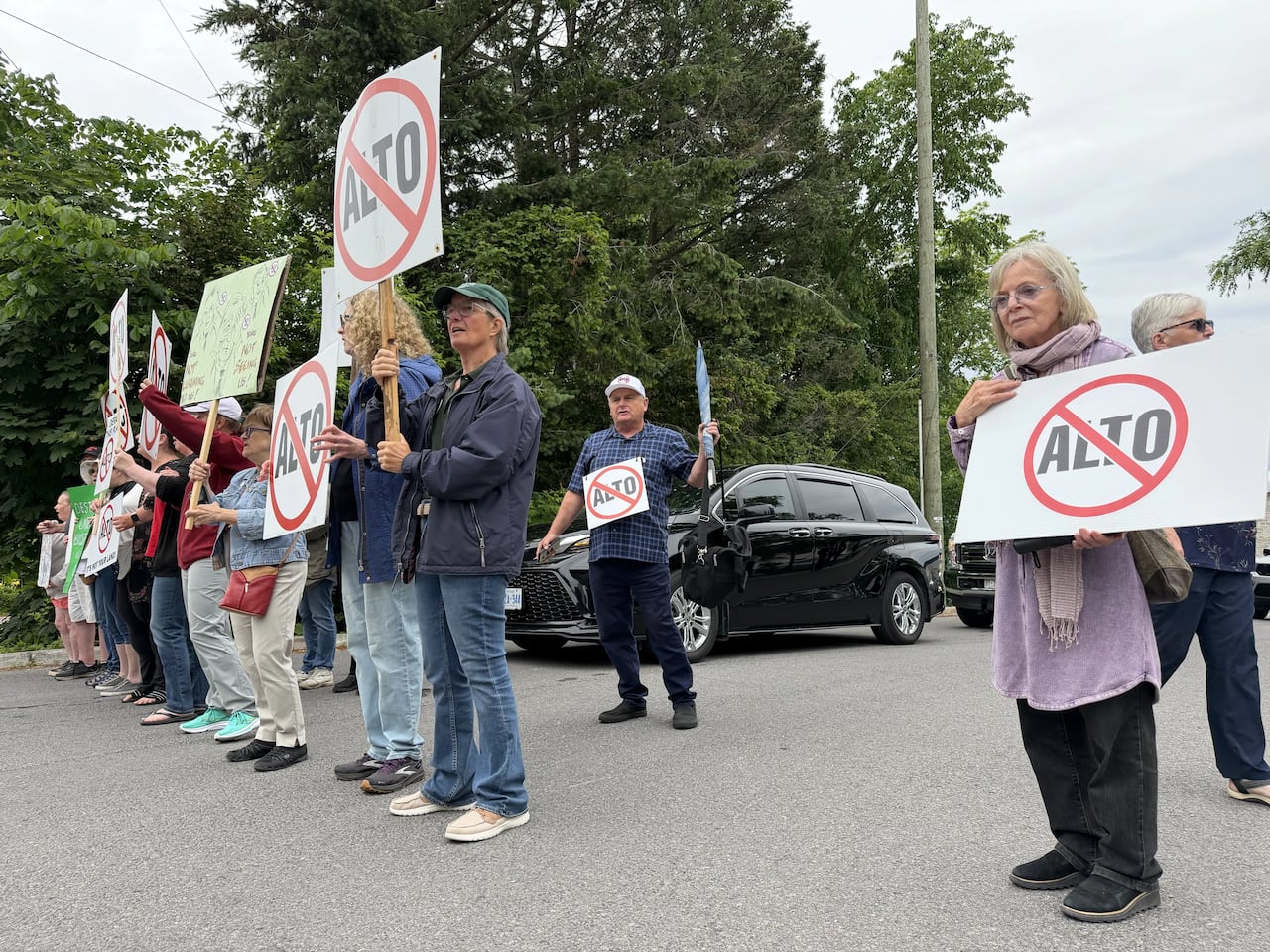 Protesters in Kingston express their opposition to the federal government’s project to build a high-speed rail line between Quebec City and Toronto. The protesters blocked the exit to the Isabel Bader Centre in Kingston where the minister made his announcement before police were called in to disperse the crowd. (Dan Taekema/CBC)
MacKinnon said, as someone from a farming family, he understood the attachment to the land that people along the route feel.
As the exact route starts to take shape, he said his preference would be to see a federal right-of-way to pass through the land but admitted in some cases that land will have to be expropriated.
“I have directed Alto to proceed with extreme sensitivity, to respectfully deal with landowners who will end up along this route, this 60-metre-wide corridor, that has to in most cases travel in a straight line,” he said.
WATCH | ‘There will be expropriations,’ says transport minister: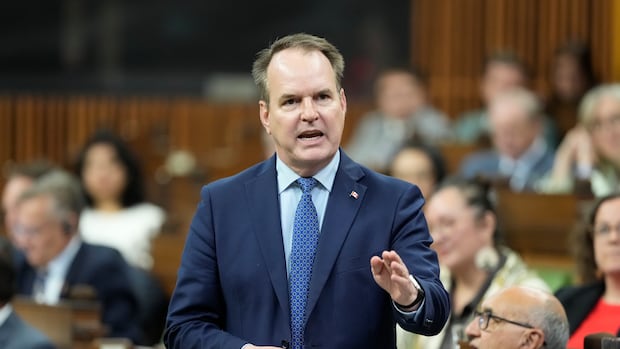
‘There will be expropriations’ in high-speed rail project buildout, says transport minister
Although Transport Minister Steven MacKinnon said ‘our obvious preference’ is to acquire land for the Alto high-speed rail project from willing sellers, he added the government will have to expropriate property from owners in some cases.
The minister said he will ensure the project makes the smallest possible impact on properties and the environment along the route.
“We will not cut corners when it comes to respect; we will not cut corners when it comes to sensitivity,” he said.
Expropriation lawyer Shane Rayman has previously told CBC News that both provincial and federal laws on land expropriation for major projects, and the way those laws have been treated in court, demonstrate their intent is to ensure landowners are made financially whole for the losses they may suffer in an expropriation.
WATCH | Poilievre says Alto will cost taxpayers: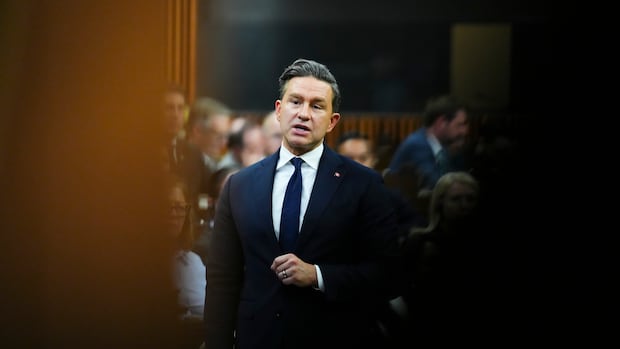
Poilievre pans high-speed rail project as Liberals explore possible Kingston stop
Conservative Leader Pierre Poilievre said ‘let’s focus on bringing down the cost of living’ as the Liberal government considers a route change for the Alto high-speed rail project that could run through Kingston, Ont. ‘Let’s improve the transportation of every single Canadian by taking the GST off used cars,’ Poilievre said. ‘That would give a real, tangible savings to real people.’
Speaking in Vancouver, Conservative Leader Pierre Poilievre dismissed the suggestion that Canadians would choose Alto over travelling by car. He said it would be smarter to spend the money being used for high-speed rail on cutting taxes, including the GST paid on used cars bought through dealerships.
“If this project ever gets built it will be 15 years from now and it will cost every family $8,000 in higher taxes,” Poilievre said. “It won’t take a single car off the road it will just take passengers out of airplanes.”
The Conservative leader has called for the government to cancel the project entirely.