
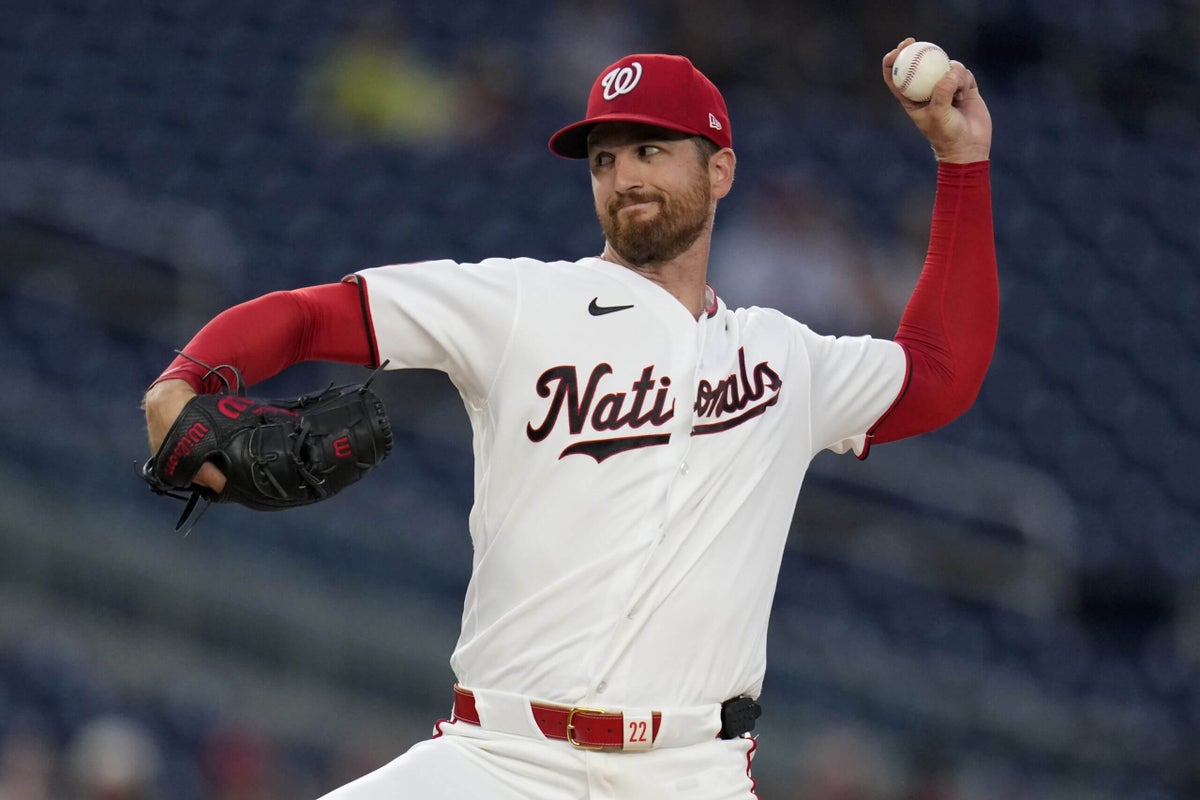
WASHINGTON — In the seventh inning of a one-run game, in the opener of the most important four-game set that Nationals Park has seen in a long time, the most valuable pitcher on the Washington Nationals reached for the PitchCom on his hip.
“Every starting pitcher, you’re gonna have 30 to 35 starts — there’s only gonna be four to five where you’ve got everything,” veteran lefty Foster Griffin said after Monday night’s 4-1 win over the Philadelphia Phillies. “I would say tonight was one of those nights.”
Griffin dotted six pitches at the edge of the zone before Phillies second baseman Bryson Stott reached for a pitch he could not touch — the reliable cutter that Griffin finally decided to throw far off the plate. Griffin’s ninth strikeout of the night punctuated his seven innings, which then became a career-high 7 1/3 when Nationals manager Blake Butera sent him back out to the mound in the eighth at 99 pitches.
If there is indeed a postseason future in Washington — and that premise has made the team’s trade deadline plans a whole lot more complicated than they were supposed to be at the start of the year — Monday night’s victory made it as clear as ever that the Nationals cannot reach it without Griffin.
Washington’s front office has plenty to weigh over the next six weeks leading up to the trade deadline. The National League wild-card race is congested. Monday’s win moved the Nationals back into a tie for the final wild card spot. There has been no definitive declaration about which direction this team will take.
Foster Griffin was signed for $5.5 million. Curtis Mead was traded for last year’s sixth-round pick. The former gave the Nats 7 sharp innings, the latter just gave them a three-run lead with a two-run homer.
— Spencer Nusbaum (@spencernusbaum_) June 23, 2026
A significant sell-off at the deadline — led by the departure of soon-to-be two-time All-Star CJ Abrams — would crush a desperate fan base and could ruin the buy-in from a clubhouse that has been exceptional in part because of its buy-in. Conversely, an overzealous slew of additions in early August could be foolish, given the Nationals’ slim postseason odds and inexperienced pitching staff.
And, so it might seem, the most rational plan is the one that threads a needle, the one where they hold on to Abrams but trade at least one player who could fetch a good return in a seller’s market. On this roster, the most obvious candidate to fit that description is Griffin.
Except: Reaching the postseason, much less going on a deep run, would feel like even more of a stretch without him.
The Nationals have received fewer innings from their starting rotation than any other team in MLB, and can only sustain this pitching chaos because Griffin is around to save the bullpen every fifth day.
They have a handful of intriguing arms in Triple-A Rochester, but no one who the team could set and forget to own a 3.15 ERA, as Griffin does; no one who would see the Phillies lineup, with an incandescent Bryce Harper and Kyle Schwarber, and think of this as just another game with “a white ball and a round bat,” as Griffin said he did after Monday’s triumph.
Never mind someone who studies opposing hitters, then helps the rest of the staff with pre-game reports. Never mind someone who has shut down multiple postseason lineups over the course of the season. Never mind what it would be like to project out a potential postseason rotation without Griffin’s left arm in it.
At the moment, the Nationals would theoretically throw righty Cade Cavalli in a postseason series. If they kept Griffin around, he would go in there, too. The other options include an opener, two pitchers with an ERA over 5.00 (Miles Mikolas and Zack Littell) and a 27-year-old rookie (Andrew Alvarez) who the Nationals have thus far capped at facing an order twice through.
When Butera was asked after the game about how Griffin’s presence benefits him and the rest of the coaching staff, he did not mention the lack of depth in the rotation. Instead, the first-year skipper let out a soft whistle.
“He does stuff like he did tonight,” Butera said.
About a month ago, Griffin spoke to The Athletic in the visiting clubhouse at Cincinnati’s Great American Ballpark and talked about the noise in America compared to Japan, where he played before arriving this offseason on a one-year deal for a relatively modest $5.5 million (that can reach $6.5 million with incentives).
Outside of the stadium, he said, it was quiet, as if the world had been reduced to a murmur. Inside the stadium, though, it was a raucous endeavor. It was a sound he had only experienced when he pitched at Citizens Bank Park in Philadelphia. That felt like a postseason environment.
Griffin, 30, may lack big-league experience — he is still, somehow, a rookie — but he has consistently lived up to these big moments.
“I don’t know the exact data, but I want to say we’ve had one of the harder schedules, too,” Griffin said. “I feel like we’ve played a lot of playoff teams, and we’re up there above .500, and we’re pushing for a wild-card spot, and you never know what can happen.”