
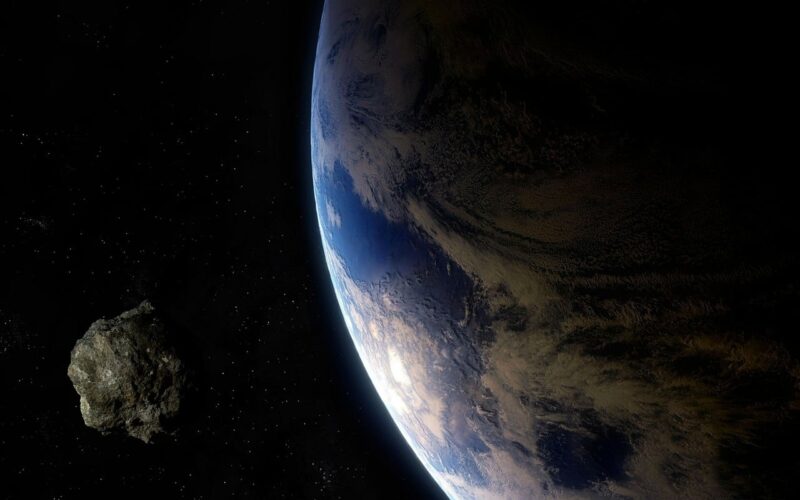
 Artist’s concept of an asteroid passing Earth. A large asteroid – some 60 times wider than the Chelyabinsk meteor that exploded through our atmosphere and broke windows in 6 Russian cities in 2013 – will pass Earth safely on June 27. It’ll be so close that telescope users will be able to see it as a starlike object moving in the sky on a timescale of minutes. Image via Batman111/ Pixabay.
Large asteroid to pass Earth safely
A large asteroid will soar safely past Earth on June 27, 2026.
The asteroid is estimated to be 0.6 miles wide (1 kilometer wide). That’s some 50 to 60 times wider than the Chelyabinsk meteor that tore through Earth’s atmosphere above Russia in 2013, creating a massive sonic boom and a shock wave that broke windows in six Russian cities. That event sent some 1,500 people to seek medical treatment, mostly from flying glass.
The Chelyabinsk meteor came from the direction of the sun. It wasn’t known beforehand and surprised everyone!
The June 27 pass is a known asteroid, called 1997 NC1 (its permanent asteroid number is 152637). The Near-Earth Asteroid Tracking system on Haleakala in Hawaii discovered it. It will pass on June 27 at a much-greater distance than the Chelyabinsk meteor, at some 1.5 million miles (2.4 million kilometers). That’s just under 7 times farther away than the moon. So there is absolutely no danger from this asteroid.
The last time an asteroid as big as this one came this close was in January 2022. That famous flyby was asteroid 1994 PC1, comparable in size to 1997 NC1, but passing slightly closer at 1.23 million miles (1.98 million km, or about 5 times the moon’s distance).
What would happen if asteroid 1997 NC1 came as close as the Chelyabinsk meteor did in 2013? The 2013 event caused an explosion 18 miles (30 km) up in Earth’s atmosphere. But a 1-kilometer asteroid like 1997 NC1 would punch straight through our atmosphere completely intact. It would strike the ground at roughly 20,000 mph (32,000 km/h), instantly vaporizing itself and the impact site. It would leave behind a crater roughly 6 to 9 miles (10 to 15 km) wide and over a mile deep.
If it landed near a city, the collision would level concrete buildings. And it would strip the landscape bare for hundreds of miles around the impact zone. The blast would send pulverized rock, dust and soot high into Earth’s stratosphere, blocking sunlight for months or even years. Global temperatures would plummet. Crops would fail. Civilization probably wouldn’t end. But it would create a global food crisis that could last for years.
That is why astronomers now routinely track asteroids.
How to see the large asteroid 1997 NC1
Astronomers with big and small telescopes will be watching 1997 NC1 fly by. You would need a 6-inch-or-larger-diameter (15 cm) telescope to be able to see it. If that’s you, see the star charts below to know where and when to point your telescope and witness this unique astronomical event.
The asteroid will be moving at a speed of 19,886 miles per hour (32,000 kph). But space is vast, and so we won’t see it move very quickly. Instead of streaking across the sky like a shooting star, asteroid 1997 NC1 will look – to those with a 6-inch or larger telescope – like a faint star (around magnitude 10). It will not be visible to the eye alone.
It will gradually drift against the background constellations, so that those with telescopes can easily notice its changing position, by checking back just 5 to 7 minutes later!
The best dates for observing the asteroid using a telescope will be June 26, 27 and 28.
1997 NC1 is categorized as an Aten-type (Earth-crossing) asteroid.
The combination of its large size and relatively close pass by Earth means the asteroid has earned the classification of a Potentially Hazardous Asteroid.
For finder charts, look at the bottom of this article.
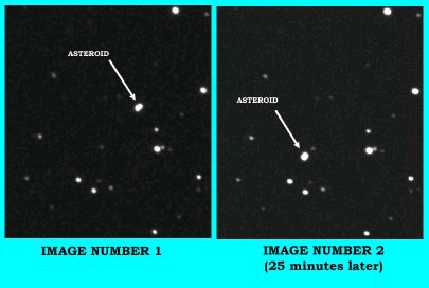 From Earth, asteroid look just like stars. But, over time, you can see them move in front of the star background. See The Problem of Finding Asteroids from Gettysburg.edu.
Professional astronomers will also take a look
In a big or little optical telescopes, any asteroid looks just looks like a tiny, steadily-moving point of light. It looks like a moving “star.” That’s where the name asteroid came from; it means starlike.
But radar signals bouncing off an asteroid can reveal much more. By analyzing the returned signals, scientists can generate 3D models of an asteroid, revealing its true shape, size, craters, and whether it’s a solid boulder or a loose “rubble pile.”
Astronomer Lance A. M. Benner, an asteroid expert at NASA/JPL, told EarthSky:
This object has not been observed with radar previously. We will use the 34-meter DSS-26 antennas as a transmitter (7190 MHz) and the 34-meter DSS-13 antenna as a receiver to observe this asteroid on June 24, 25, and 27.
These antennas are at the Goldstone Deep Space Communications Complex in the Mojave Desert, California.
Still, it won’t be easy for scientists to get good radar images. The legendary 1,000-feet (305-meter) Arecibo telescope in Puerto Rico is the one that captured radar images of other asteroids. And that collapsed on December 1, 2020.
With the Arecibo Observatory’s main dish gone and other dishes undergoing modernization, astronomers currently have fewer tools available for deep-space radar imaging. For example, the 230-feet (70-meter) DSS-14 dish at Goldstone is currently offline until 2028 for modernization and installation of new equipment.
Meanwhile, astronomers have limited or smaller resolution tools for studying medium-sized and large asteroids that pass by Earth.
But astronomers will attempt to make other radar observations using other (smaller) available antennas in California and Australia. Benner added:
We plan to use these to help resolve some discrepancies regarding the diameter, spectral class and optical albedo [of asteroid 1997 NC1]. This will also help calibrate the Spitzer Space Telescope and NEOWISE spacecraft observations of this asteroid.
Star charts for the asteroid 1997 NC1
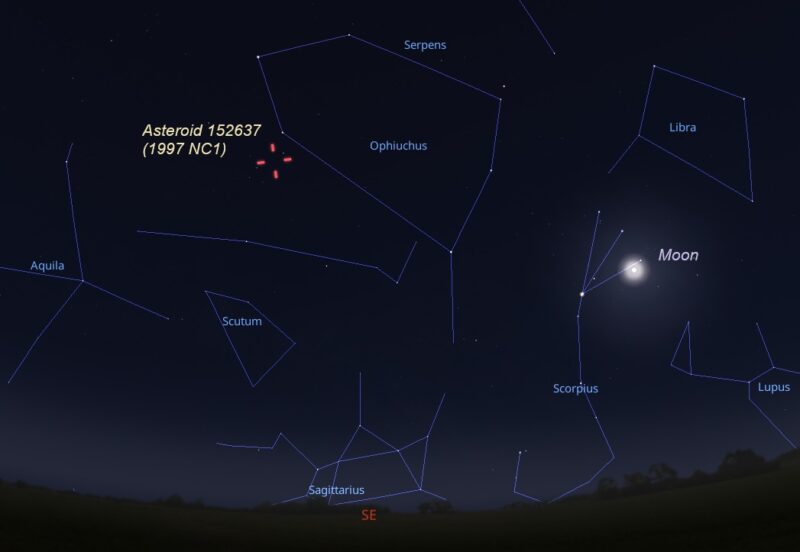 Asteroid 1997 NC1 will be visible to observers with small telescopes as it passes by Earth. This is where the asteroid will be around 10 p.m. CDT (3 UTC) on June 26, 2026. Image via Stellarium/ Eddie Irizarry.
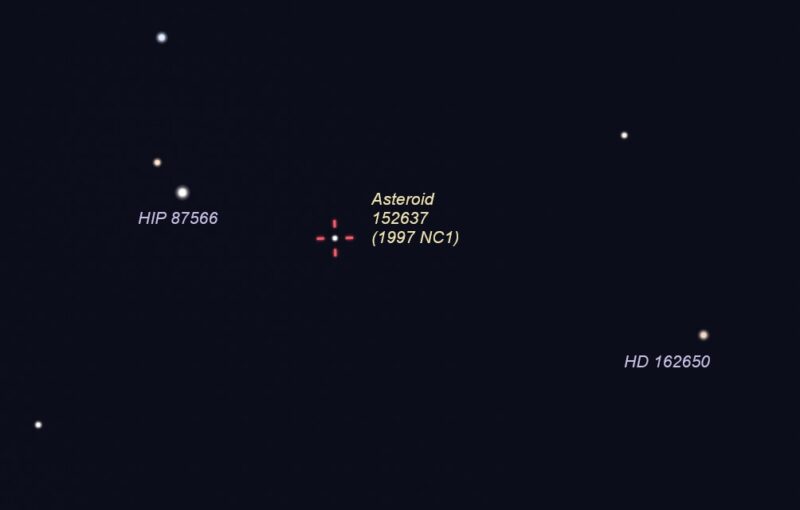 Here’s a closeup view of where the asteroid will be around 10 p.m. CDT (3 UTC) on June 26, 2026. Image via Stellarium/ Eddie Irizarry.
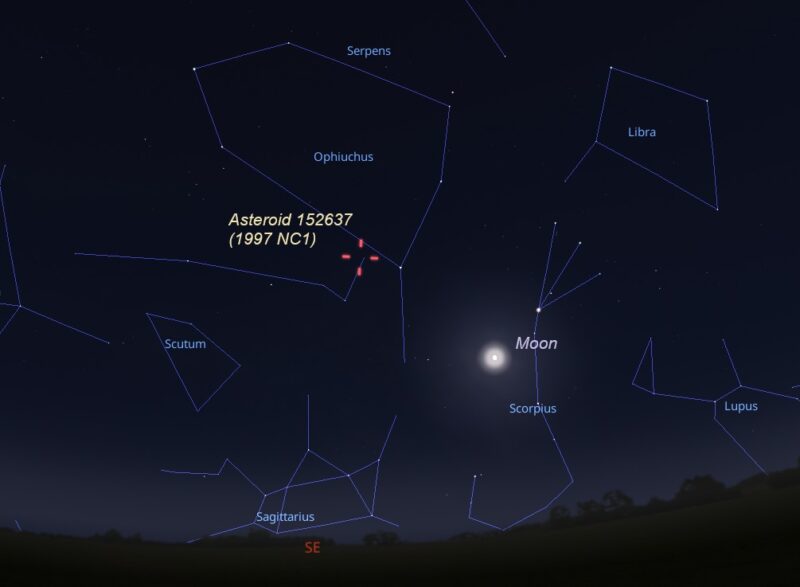 Look for the asteroid above the Teapot of Sagittarius the Archer around 10 p.m. CDT (3 UTC) on June 27, 2026. Image via Stellarium/ Eddie Irizarry.
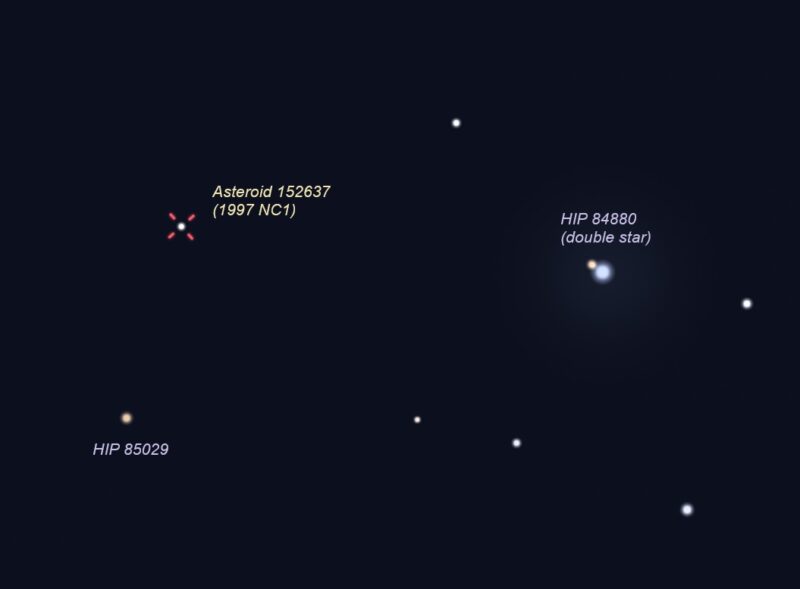 This closeup shows where asteroid 1997 NC1 will be around 10 p.m. CDT (3 UTC) on June 27, 2026. Image via Stellarium/ Eddie Irizarry.
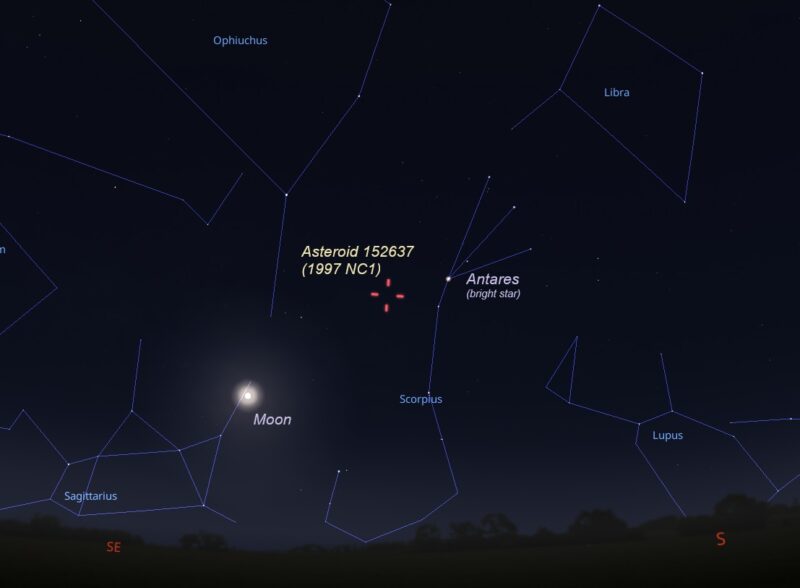 The large asteroid will between the moon and Antares, the brightest star in Scorpius the Scorpion, around 10 p.m. CDT (3 UTC) on June 28. Image via Stellarium/ Eddie Irizarry.
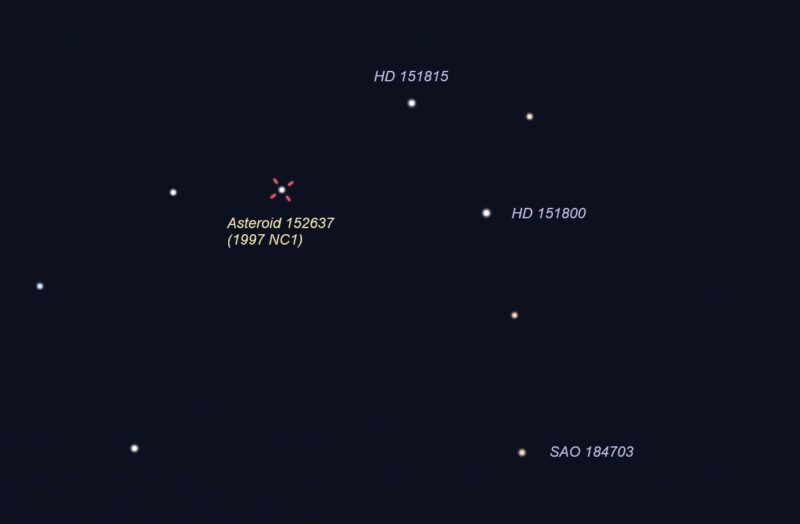 This closeup view shows where the asteroid will be at 10 p.m. CDT (3 UTC) on June 28, 2026. Image via Stellarium/ Eddie Irizarry.
Bottom line: On June 27, 2026, a large asteroid will safely pass close to Earth. Observers with small telescopes can watch the asteroid sail by. Finder charts here.
Read more: Asteroid or comet? Meteor or meteorite? Answers here
Read more: Dinosaur-killing asteroid created an abode for life
Eddie Irizarry
View Articles
About the Author:
Eddie Irizarry of the Sociedad de Astronomía del Caribe (Astronomical Society of the Caribbean) has been a NASA Solar System Ambassador since 2004. He loves public outreach and has published multiple astronomy articles for EarthSky, as well as for newspapers in Puerto Rico. He has also offered dozens of conferences related to asteroids and comets at the Arecibo Observatory.
Asteroid 33012EddieIrizarry, a 7.8 km space rock, has been named in his honor.