
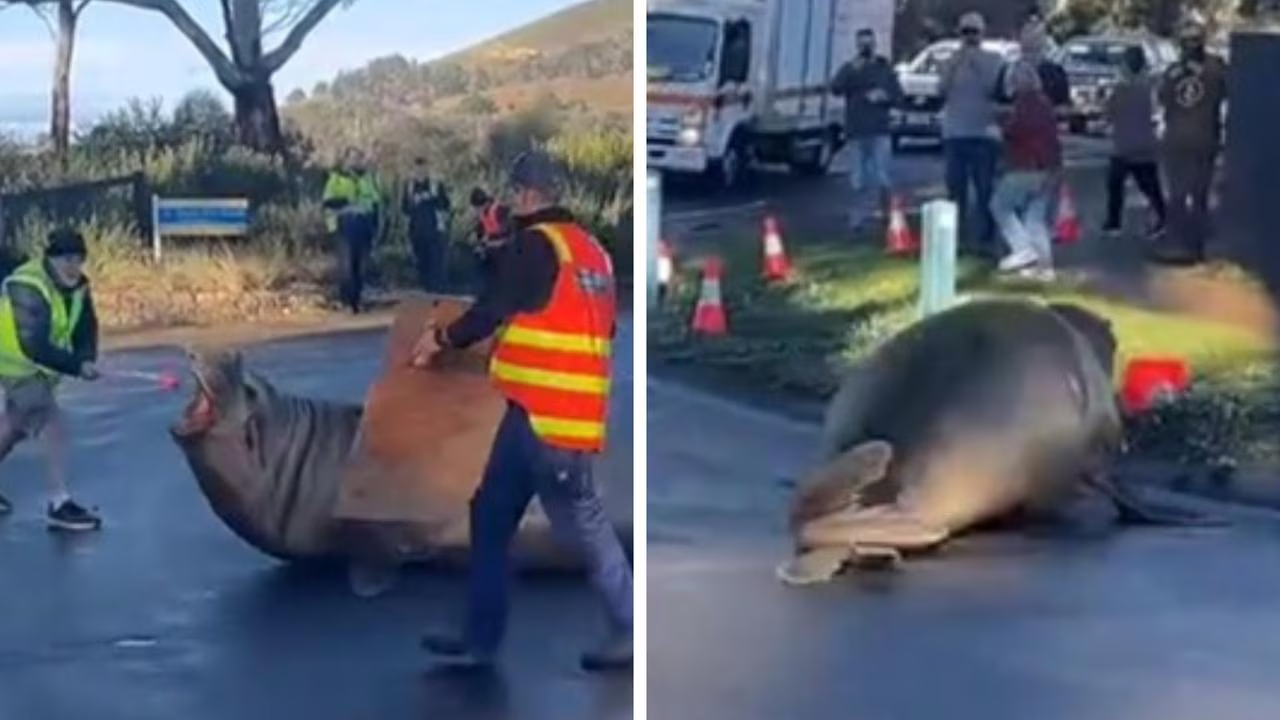
Footage of Tasmanian icon Neil the Seal being herded off a road by wildlife workers has sparked fierce debate online over treatment of the 600kg mammal.
The southern elephant seal has gained fame in recent years as popular local attraction in Primrose Sands, 45-minutes east of Hobart, where he is often spotted galumphing around the beach — and sometimes further ashore.
The Marine Conservation Program (MCP), under Tasmania’s Department of Natural Resources and Environment, has even created an Instagram page for Neil, tracking his movements and sharing updates with the community.

On Wednesday, MCP workers were called in after Neil refused to budge from the middle of a nearby street.
Two workers, one armed with a board and another with a stick, were seen whacking and shoving Neil as the animal reared up and lashed around.
“All they needed to do is get a big traffic cone to lure him off the road … but, no, they want to whack him,” influencer Jason Howlett, who runs a popular Neil the Seal TikTok page, says in the footage.
“I don’t agree with it. They’re trying to get him back on the beach and then they’re going to electric fence the track to keep Neil on the beach. I would have used the traffic cone to lure him without hitting him.”
Neil the Seal is known to have a particular fascination with orange traffic cones.
The battle continued for around two minutes before Neil finally conceded defeat and shuffled towards the pavement, to cheers from the crowd.
“There he goes,” Howlett says. “Well done, boys!”
Sharing the clip on TikTok, Howlett asked followers their thoughts on Neil’s “roadside removal”.
“Watching the rangers use boards and sticks and guiding tools to shift him can look pretty jarring if you don’t know the protocol behind it,” he wrote.
“It’s a stark reminder of how incredibly difficult it is to manage a massive wild animal who treats the local public roads like his personal mattress.
“What are your thoughts on how the state handles him? Is it time for better strategies to keep him away from high-traffic infrastructure entirely, or do you think these temporary roadside escorts are the only viable option we’ve got? Let’s keep the discussion respectful in the comments.”
The feedback from viewers was overwhelmingly negative.
“Poor Neil he is so upset. Stop being mean to Neil!” one wrote.
“They’re not doing a very good job,” another said.
“I can’t even watch this,” a third wrote.
Neil fans said he was being “antagonised” and “harassed”, with one calling the footage “disgusting”.
“You should never hit an animal. Ever,” one wrote.
“Such an aggressive response to this situation,” a second agreed.
“Marine conservation and they have no f**king idea. Leave him the f**k alone,” another wrote.
One argued that MCP “should know Neil by now and how to move him”. “It’s not their first rodeo,” she said. “I definitely don’t agree with the electric fence. He’s going to wind up getting hurt. Or they will when he gets aggressive. I don’t see that ending well at all.”
Another agreed that “this is just going to make him have aggression issues towards humans and make him dangerous”.
“This is the opposite of the way that this should be handled,” she said. “Kindness and care for the animal, not fear and abuse.”
The Department of Natural Resources and Environment has been contacted for comment.
Last year, Howlett was fined $1200 by Tasmania’s Parks and Wildlife Service for allegedly disturbing Neil.
He launched a GoFundMe page to cover the fine, claiming he was simply observing Neil from a distance at the time of the incident in November 2024.
“I have nothing but respect for Neil’s boundaries and have educated the general public in doing so,” he wrote.
“I have never disclosed his location on my TikTok as they are saying I do. I have never tried to make money out of Neil this whole entire time.”
Howlett has been contacted for comment.
Southern elephant seals, like Neil, migrate to various sub-Antarctic Islands from September to November for breeding.
Between January and April, they shed their hair and skin.
They are the largest members of the seal family, with males weighing as much as 3000kg and females up to 900kg.