
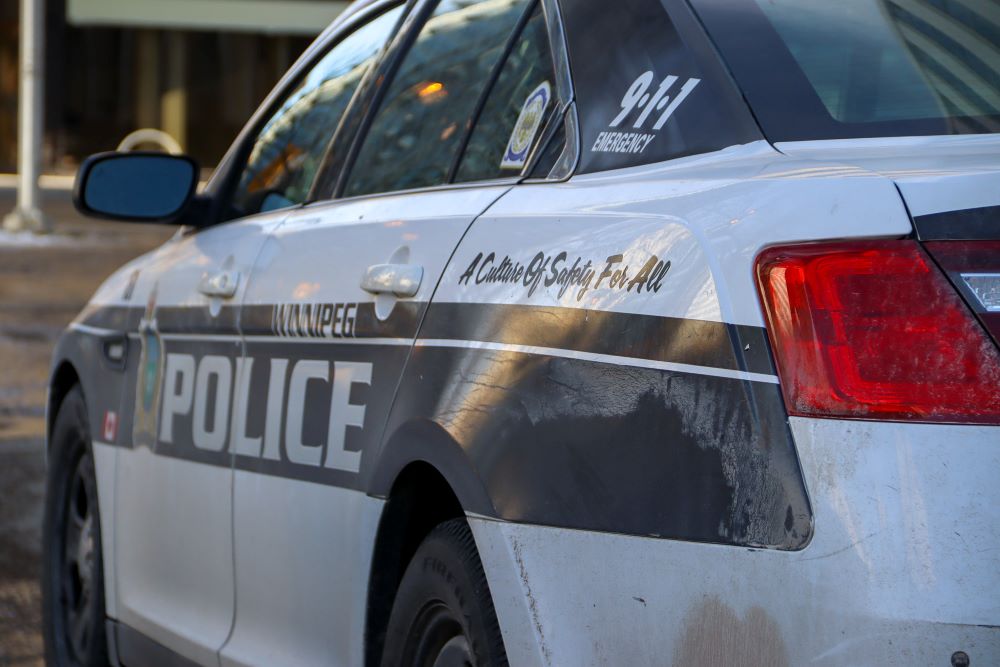
Since launching the Just Slow Down campaign, the Winnipeg Police Service (WPS) has issued 2,700 speeding violations in 2026. Officers say that is just the tip of a deeper issue in Winnipeg.
“In 2025, police officers issued more than 13,000 speeding-related violations,” Inspector Helen Peters, commander of the traffic division for Winnipeg Police Service, says.
Peters says that the total is collected from different areas. “These are offence notices that are given by police officers who are out there on the roads addressing community complaints that get in that are viewing the data that we collect through radar devices that monitor speed levels, but also looking at the information we receive through collision events.”
RELATED STORIES:
Stats in 2026
While WPS investigates several motor vehicle collisions each year, they have seen the damage done already this year. “In 2026 to date, we’ve issued over 2,700 speeding offences related to the behaviour of our drivers on the roads. Also investigated six collisions where speed was deemed to be a contributing factor. And there were people with multiple injuries as a result of that, some life-altering and, unfortunately, one fatality.”
In May 2026, an incident on Chief Peguis Trail made headlines after drivers were found to be racing at speeds exceeding 200 km/h.
“We’re very open and public about it. We let the public know that we’re doing this and we’re still finding drivers that are driving 80 kilometers over the posted speed limit of 80 kilometers, which is resulting in significant risk to the public because drivers have less control and with less control you have less ability to respond to unpredictable events that we know can happen.”
Effects of dangereous driving
While many believe that speed can result in getting to the destination quicker, Peters warns that there would be more consequences.
“We often think that speed gets us there faster, but the speed has a lot more consequences than just getting somewhere slightly faster than we would have if we just drove to the posted speed limits, which has been stated as safe for the environment in which we’re driving in.
“What we’re seeing with street racing and careless driving is it really does impact everybody. We see collisions with fixed objects, with other completely uninvolved motorists, pedestrians and cyclists. So the impacts are big. If you’re driving 80 kilometers over a posted 80 kilometer speed limit, it will take you two lengths of a football field to come to a complete stop unless you collide with something else first.”
Excess speeding during summer months
Peters says that as the seasons change and driving conditions improve, WPS saw the impact. “We really saw the impact of that nice weather a few weeks ago where it truly felt like summer and the driving conditions would be considered a lot more favourable and safer because they’re dry and the roads are clear. However, that does not equate to safe driving when you’re speeding in excess of 150 kilometers, 170 kilometers, 200 kilometers an hour.
“Even if it’s at a time of the day or night where traffic is light, the posted speeds are for a reason because every kilometer you’re going in excess take greater risks.”
Putting themself at risk
Peters says that when a driver speeds, the one most at risk, is themself. “They want to see what their vehicle is capable of doing compared to somebody they race. That is just unacceptable within speed limits because truly the person at greatest risk is the driver themselves. It takes the smallest change in the road, the smallest bump, the smallest lack of concentration. You might clip a curb and that can have such a great impact on your vehicle and your inability to control it at that speed.”
Consequences for motorists for street racing and dangerous driving is more than just a fine. “This often results in immediate seven-day vehicle impoundments. And Manitoba Public Insurance (MPI) are going to do a license review with those drivers that receive serious offense notices. The officer themselves has to report prescribed serious code, criminal offenses and highway traffic offenses to the registrar at MPI. It’s not just getting an offense notice from an officer, it’s how it impacts your insurance moving forward.”