
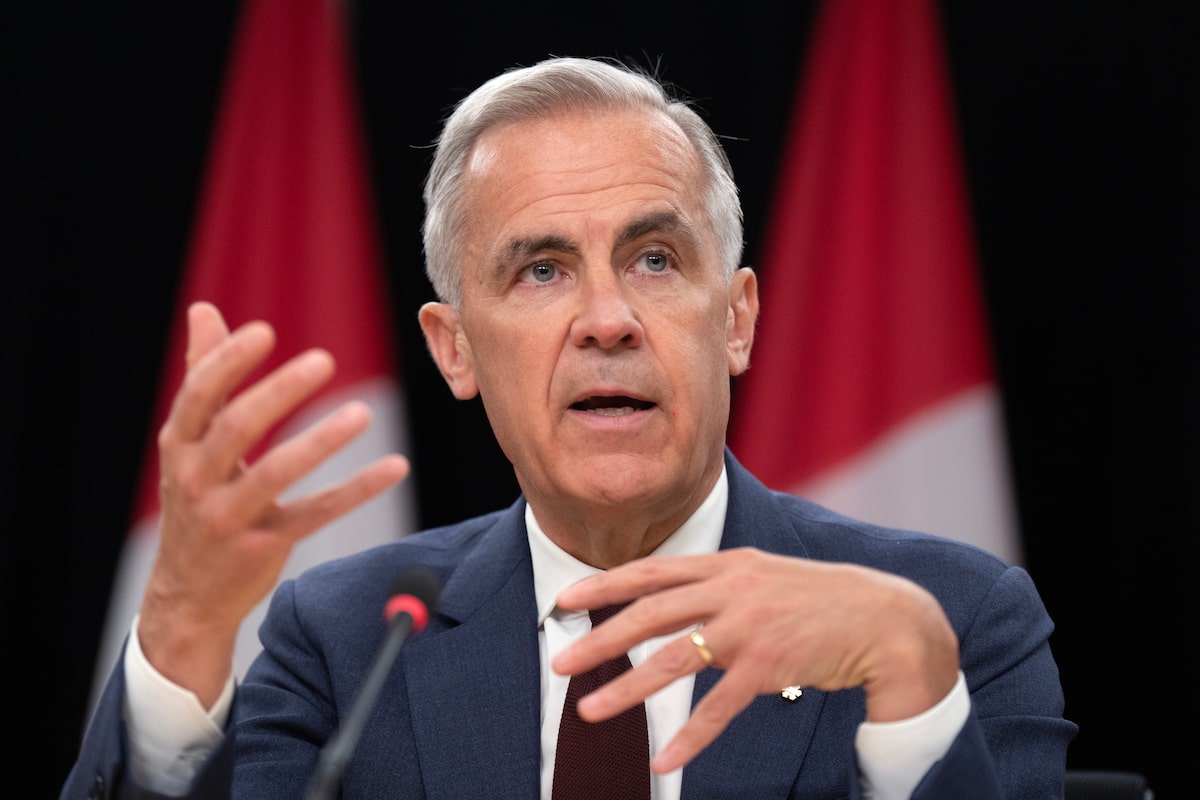
Prime Minister Mark Carney responds to questions during a news conference in Ottawa on Thursday. The formal six-year review date for the United States-Mexico-Canada agreement is July 1.Adrian Wyld/The Canadian Press
Prime Minister Mark Carney pushed back at comments from U.S. envoy Pete Hoekstra, who recently said Ottawa and Washington are nowhere close to a deal to renew the United States-Mexico-Canada Agreement.
Speaking to reporters Thursday in Ottawa at a press conference, Mr. Carney said it’s not that simple and that the window for a deal can arise quickly under U.S. President Donald Trump.
Mr. Hoekstra recently said the two countries remain far apart in talks to extend the USMCA, the continental trade pact with Mexico that will expire in 10 years if not renewed.
Trump says he would ‘rather not’ have USMCA
Campbell Clark: A little peek into the Carney-Trump trade dynamic
“What I have seen with the President is that you’re not close to making a deal – and then you make a deal,” Mr. Carney said.
“So both things can be true.”
He added this requires that Canada be ready to cut a deal, with all the advance work done, if an opportunity arises.
“It means being prepared, having done the work, knowing what you want,” the prime minister said.
Mr. Hoekstra, whose comments came in an interview with CTV, said he believed the next steps toward a trade deal should be at the presidential and prime ministerial level.
The Prime Minister said he agreed that “ultimately a breakthrough” in talks would be at this level.
He said Canada’s USMCA approach is not simply leader to leader.
“We operate a little differently: We are very team oriented here in Canada, so it matters,” Mr. Carney said, noting the lead negotiator Janice Charette, the minister responsible for Canada-U.S. trade Dominic LeBlanc, ambassador to the United States Mark Wiseman, as well as provincial premiers.
“There’ll come a point” where the “possibility emerges” for a deal, Mr. Carney said.
But, he cautioned, Canada will not sign just any deal.
“I mean, we could sign a bad deal this afternoon, right? We could have signed a bad deal a year ago. We’re not going to sign a bad deal, so it has to be a real deal.”
Mr. Carney, who spoke with Mr. Trump Wednesday, said this conversation, which was sparked by a call from the President, didn’t touch on the USMCA.
He said the Wednesday call with Mr. Trump, which at times included officials such as Secretary of War Pete Hegseth, covered a range of issues, including the western NATO military alliance, as well as Iran and the broader Middle East.
Carney speaks with Trump during the G7 summit in Evian-les-Bains, France, on June 16.Christopher Katsarov/The Canadian Press
The Prime Minister said there were things he’s working on with the Americans, but declined to elaborate, saying “I think those are best left till they come to fruition.”
He also reiterated a message that NATO partners are spreading in anticipation of Mr. Trump’s participation at the upcoming alliance leaders’ meeting in Turkey: that Canada and others have boosted defence spending.
Mr. Carney emphasized Canada’s aid to Ukraine and its deployment in Latvia as part of a NATO deterrence mission. “We are at the front lines in Latvia with Operation Reassurance, and we are one of the most important contributors to support of Ukraine, including security guarantees for Ukraine.”
The formal six-year review date for the USMCA is July 1.
USMCA heads into unpredictable new phase with no extension likely
The three countries have the option to renew the deal for 16 years. If that doesn’t happen, the treaty will remain in place but move into a period of annual reviews for 10 years. Any of the countries can also withdraw from the deal with six months notice.
Officials from all three countries have said they expect negotiations to continue beyond July 1, meaning the annual review scenario is more likely than an outright renewal.
Mexico and the U.S. have already scheduled a third round of negotiations for late July, three weeks after the review date. Canada and the U.S. have yet to even start formal negotiations.
Mr. Trump himself can’t seem to make up his mind about the agreement he signed in his first term. “I’d rather leave it unsigned, I’d rather have it terminated,” the U.S. President told reporters last week at the G7 conference in Évian-les-Bains, France. “But I may sign it.”