
Inspired by the way colonies of ants and bees work together like a single superorganism to efficiently collect resources, Adelaide University researchers have tested lab-scale robotic swarms that could lead to safer, more efficient, and less energy-intensive ways to explore, excavate, and transport minerals critical to modern society.
“Nature has spent millions of years developing efficient ways for groups to work together,” said Noune Melkoumian, who led the study. “By learning from these systems, we can develop new technologies that are more flexible, reliable, and efficient.”
With many of the most accessible and highest-grade deposits already mined, mining companies are increasingly turning to new technologies to safely and efficiently extract mineral resources. While automated mining equipment is already being deployed to increase productivity and access areas unsafe for humans, many of these systems are coordinated from a central control center and can lack the flexibility to adjust to unforeseen conditions.
The next phase of mining automation could more closely resemble the teamwork seen in nature.
“Social insects have developed very efficient ways of solving problems together,” said Joven Tan, who carried out the study as part of his PhD at Adelaide’s School of Chemical Engineering. “By applying these ideas to robotics, we can create systems that are more efficient, adaptable and reliable for industries such as mining.”
To explore this concept, an Adelaide research team used Zumo 2040 microrobots in a laboratory ecosystem designed to mimic a mine.
Measuring less than four inches on each side, weighing roughly nine ounces, and built around Raspberry Pi RP2040 microcontrollers, Zumo 2040 robots are designed to excel at line-following and maze-solving.
The researchers used a swarm of these robots to test three autonomous ore-collection strategies:
• A basic system similar to conventional mining, where robots collect ore and immediately return.
• An ant-inspired system, where robots share tasks.
• A honeybee-inspired system, where robots first explore and map an area before collecting resources.
Instead of relying on a central controller, the robots in the test operated as a swarm, with each making its own decisions while working as part of the larger collective. This allowed the swarm to continue carrying out tasks even if one or more robots dropped out.
In a 52-foot route with eight ore blocks, the honeybee-inspired strategy performed best. By first exploring the area and remembering where resources were located, this method reduced travel distance by up to 80%, cut energy use by about 50%, and completed ore delivery tasks up to 60% faster than the basic robotic collection strategy.
The ant-inspired system also outperformed the basic strategy by dividing the work between robots, with one locating resources while another transported ore.
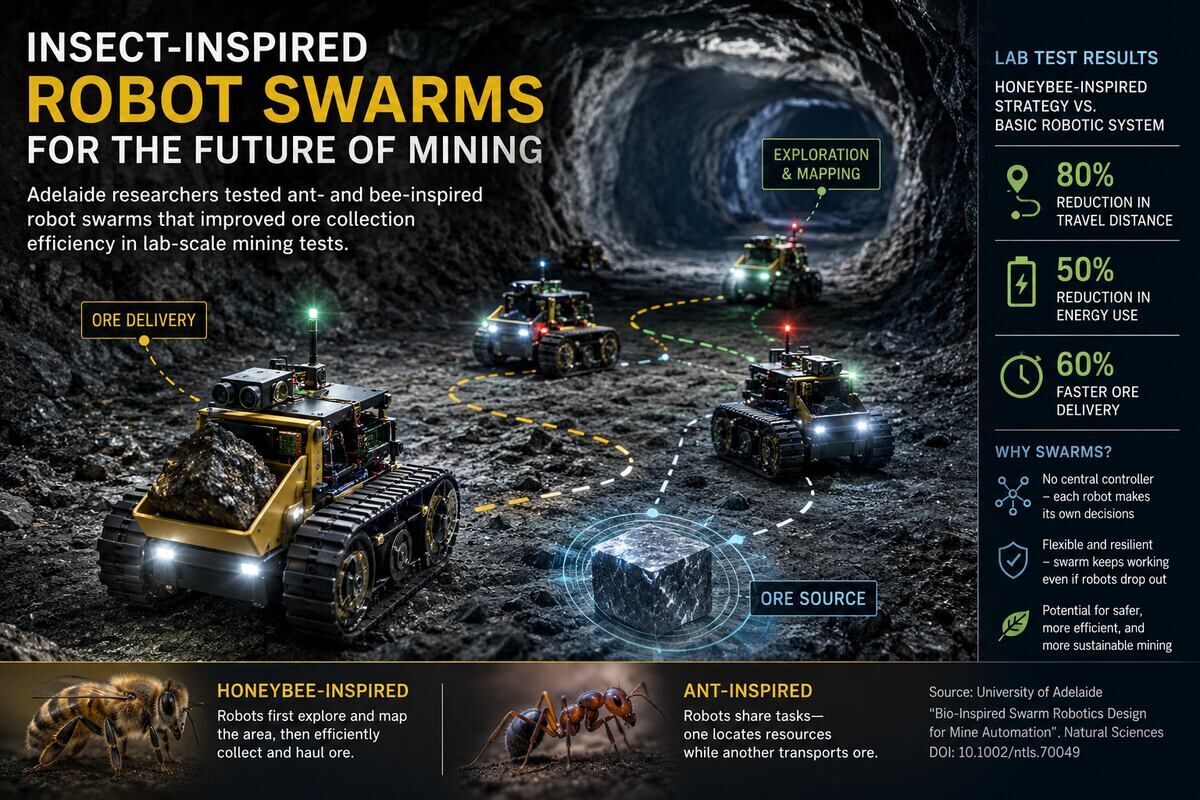
Data Mine North via ChatGPT
While bio-inspired mining methods have previously been considered, prior studies have largely leaned on computer simulations for their confirmatory data. The testing performed by the Adelaide team moved validation beyond software and into a physical laboratory test bed with real robots, demonstrating that the concept can work in practice.
Melkoumian says the experiment demonstrates that resource collection methods observed in nature can be adapted to practical technologies for humans.
“Our research shows that swarm robotics is no longer just a theoretical idea,” he said.
“These systems can be built, tested and operated in real environments, with the potential to change how resources are explored, excavated and transported.”
Though the laboratory tests are a step toward adapting bio-inspired behavior into robotic mining systems, the Adelaide researchers say that improved sensors, longer-range batteries, and the ability to adapt to unpredictable mining conditions will be needed before commercial applications can be considered.
These initial tests, however, demonstrate that robotic swarm mining could make mining more efficient here on Earth and could offer avant-garde systems for securing resources as we explore our solar system.
“Swarm robotic systems could be used in dangerous or difficult-to-reach mining areas, reducing risks for workers while improving productivity,” Melkoumian said. “They could also play an important role in future space mining missions, where fully autonomous systems will be essential.
A paper published by Natural Sciences covering the study can be read at “Bio-Inspired Swarm Robotics Design for Mine Automation.”
Author Bio
Shane Lasley, Metal Tech News

With more than 18 years of covering mining, Shane is renowned for his insights and in-depth analysis of mining, mineral exploration, and technology metals.