
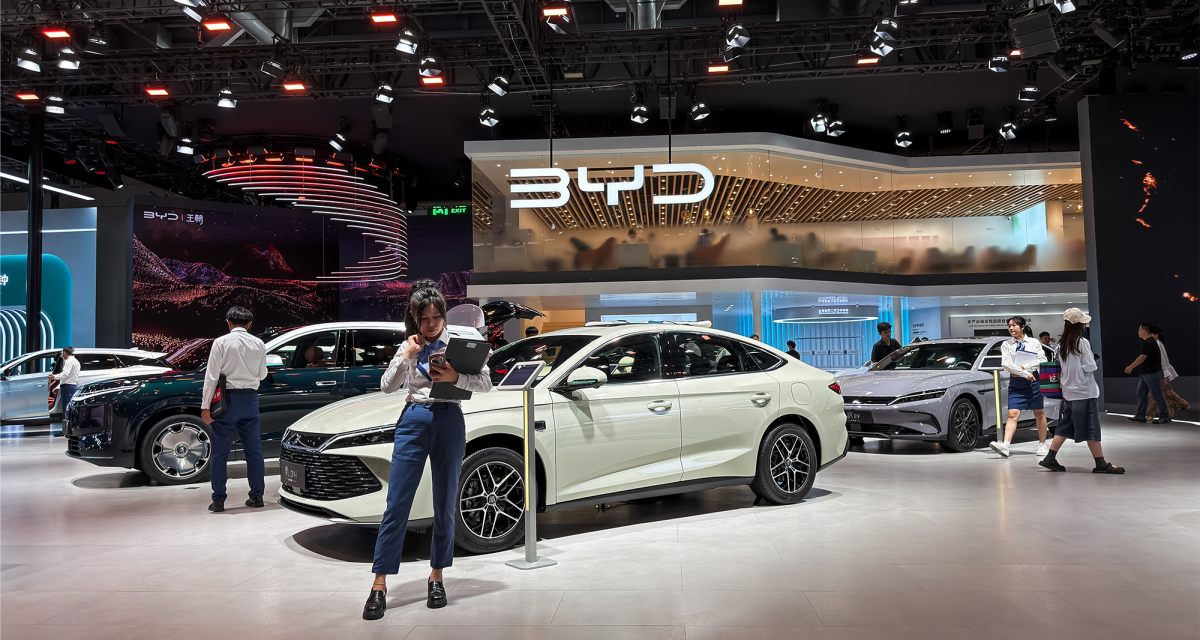
BYD’s successful growth is the result of three interrelated factors.
Sustained Industrial Policy
Beginning in the late 2000s, Beijing identified new-energy vehicles as a strategic emerging industry. National and local governments supported the sector through consumer subsidies, tax incentives, government procurement, research funding, industrial policy, charging infrastructure, and preferential treatment for domestic producers.
These policies helped foster a dense domestic manufacturing ecosystem connecting mineral processing, battery production, components, vehicle assembly, and charging infrastructure that facilitated rapid iteration. Concentrating supplier networks within China’s borders enables real-time interaction between manufacturers, designers, and software developers, reducing design-to-market time by roughly one-third. This is an advantage for BYD that is proving difficult to replicate globally.
However, Chinese government support for the EV ecosystem alone does not fully explain BYD’s success. Competition within China’s crowded automotive market has also forced companies to innovate rapidly and lower prices. But the scale, duration, and co-ordination of China’s industrial policies provided conditions that automakers in most other countries did not enjoy.
Vertical integration
Most EV makers depend heavily on external suppliers for batteries, semiconductors, and other critical components. BYD produces many of these inputs itself. Its operations extend across battery cells, battery packs, power electronics, vehicle semiconductors, electric motors, and vehicle assembly. It is also pursuing access to upstream mineral resources. This integration is distinctive among most of its Chinese competitors, though Geely has begun comparable in-house battery development.
Vertical integration provides greater control over costs, production schedules, and technological development. BYD can redesign components across the vehicle rather than negotiating changes with multiple suppliers and faces less exposure to supply disruptions and mark-ups. However, vertical integration requires large and sustained investment in research, manufacturing capacity, and supply-chain management. But at BYD’s scale, the model has helped it compete aggressively on price while continuing to introduce new products for a broad range of price points.
Batteries
BYD began as a battery company, and batteries remain central to its competitive advantage, not only in its own EV lines, but as a separate revenue stream and source of market influence.
BYD’s dominance in lithium iron phosphate (or LFP) batteries exemplifies this approach. LFP batteries generally cost less and rely on more widely available inputs than battery chemistries containing large amounts of nickel and cobalt. They also offer advantages in durability and thermal stability, although they have historically had lower energy density than some competing chemistries.
BYD’s battery advantage extends into charging infrastructure. In 2025, BYD unveiled a high-powered charging system that it said could add hundreds of kilometres of driving range in minutes and is involved in vehicle-to-grid projects, which allow EVs to return electricity to the grid. While unproven at scale, these innovations position BYD to influence the trajectory of global EV markets and sustain its competitive edge.