
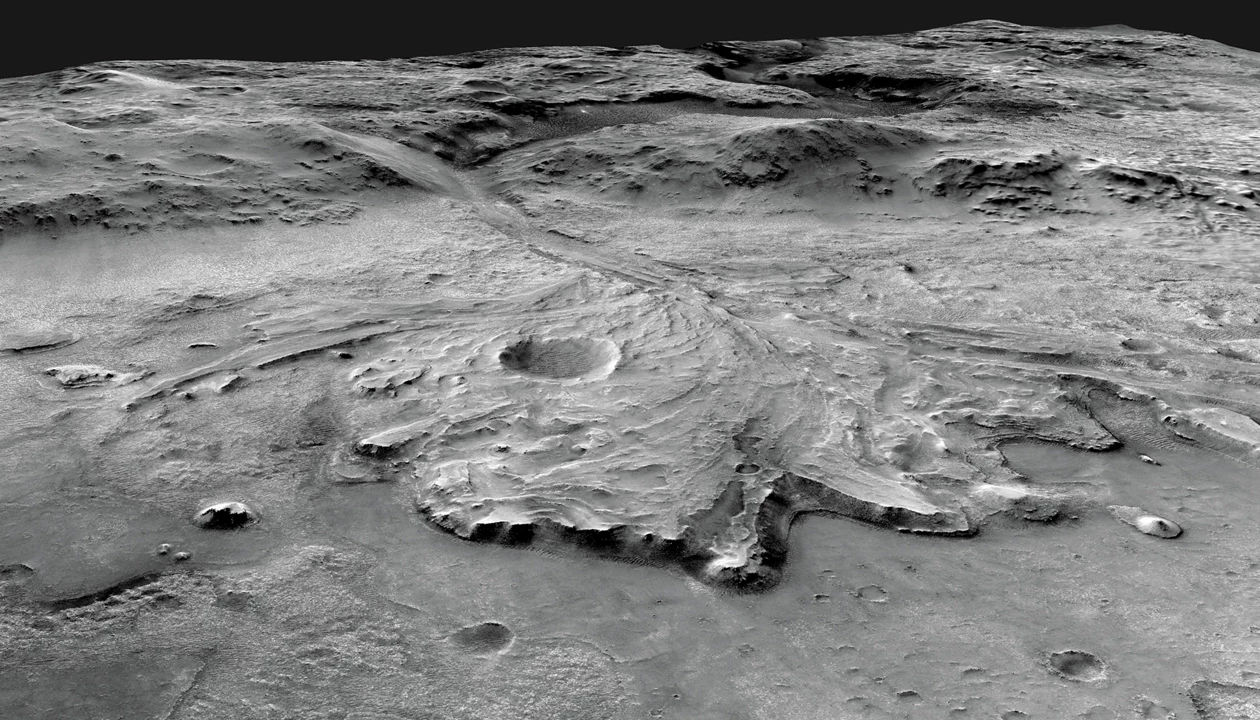
Scientists using NASA’s Perseverance rover have detected complex organic carbon in rocks from Jezero Crater, adding to growing evidence that organic material can persist on Mars for billions of years (Sci. Adv. 2026, DOI: 10.1126/sciadv.adx0047).
“Carbon is the primary building block for life on Earth, and all living things are made up of complex organic macromolecules,” says Ashley Murphy of the Planetary Science Institute, an astrobiologist and the study’s lead author. On Earth, she notes, macromolecular carbon is often found in extremely old rocks and can sometimes represent the only remaining organic evidence of ancient microbial life.
In space, however, organic compounds present near the planet’s surface can be slowly transformed and degraded by ultraviolet (UV) radiation and galactic cosmic rays. Yet researchers found the carbon in mudstones from Bright Angel, an outcrop within Neretva Vallis, an ancient river channel that once fed Jezero’s crater lake. The team used Perseverance’s deep-UV Raman spectrometer to identify minerals and organic compounds.
Although researchers had found biosignatures in these mudstones in the past, the latest discovery does not constitute evidence of past life. “The specific source of the organic compounds detected in the mudstones remains unknown,” Murphy says.
“Organic matter also arrives to Mars and Earth and other surfaces in our solar system through interplanetary dust particles, meteorites, and micrometeorites that are coming in all the time,” explains Christopher House, a Pennsylvania State University astrobiologist who was not involved with the study.
If formed on the planet’s surface, the compounds can be obtained through biological and nonbiological processes. On Earth, organic carbon is found in settings ranging from fossilized microbial mats to hydrothermal systems; it can also form when water reacts with certain iron-rich rocks, a process known as serpentinization.
“The science payload of the Perseverance rover was not designed to distinguish between organics formed via abiotic and biotic processes,” says Kyle Uckert, an astronomer based at NASA’s Jet Propulsion Lab, who co-led the study. Answering that question will probably require laboratory analyses of Martian samples on Earth, he adds.
The researchers also found the carbon in association with various minerals, which may provide clues to how it formed and was preserved. In one mudstone, the organic material was embedded within the rock’s original silicate-rich sediment. In another, it appeared alongside carbonate and sulfate minerals that likely formed when water later altered the rock.
“Understanding the present and ancient carbon cycle would be ideal,” House says. “On Earth, the carbon cycle is dominated by this huge input of biological organic matter being made all the time, so a lot of our understanding of geochemistry is based on it. When you go to another world, you get humbled.”
The findings build on a recent Curiosity rover study that identified large organic molecules preserved in mudstones within Gale Crater, more than 3,000 km away. “People thought that the soils on Mars didn’t have much organic matter, but they do,” says House, who worked on the Curiosity team. “We now have two definitive locations on Mars identified where there’s identifiable organic matter in mudstones.”