
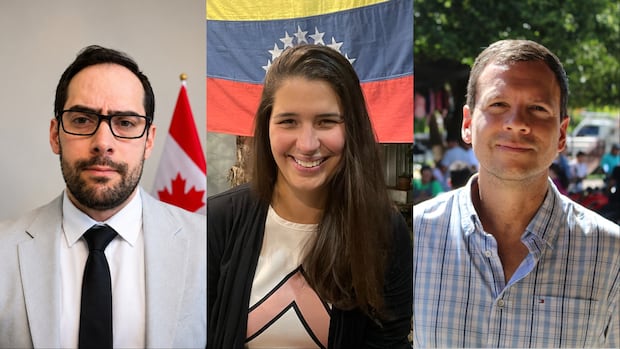
Venezuelans living in Ontario say they are worried about their friends and family after a pair of earthquakes struck Venezuela on Wednesday evening, and the death toll continues to rise.
Just after 6 p.m. local time, a 7.2 and 7.5 magnitude quake struck one minute apart in Morón on the Caribbean coast. It caused several buildings to collapse in the capital of Caracas, which is just east of the epicentre.
“Some of our family members saw how the walls in their house cracked, and some of the things were dropping from the walls: TVs, pictures, and things they had on shelves,” said London, Ont., resident Rosy Lopez Gross, whose family lives in Caracas.
“In some neighbourhoods, people watched how full buildings collapsed before their eyes. Lots of people were afraid to go back to sleep in their apartments, so a lot of people slept in their cars last night”
WATCH | Aftermath from earthquakes in Venezuela: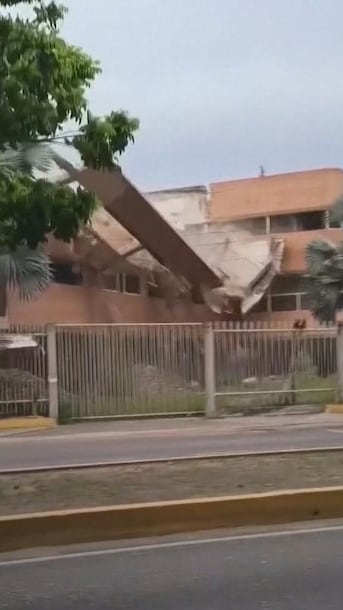
Videos from Venezuela show building crumble, piles of rubble after quakes
Video gathered by social media users and news agencies show the aftermath of powerful earthquakes that rattled parts of Venezuela, sparking frantic rescue efforts in hard-hit communities.
As of Thursday afternoon, 188 people were dead, another 200 trapped and 1,500 injured in Caracas, said the president of Venezuela’s National Assembly.
The death toll is expected to reach at least 10,000, according to estimates from the U.S. Geological Survey.
London resident Adan Machado has family in La Guaira, north of Caracas, which was devastated by the earthquakes. He said his cousin, who is eight months pregnant, and her four-year-old son were still missing after their apartment collapsed.
“I cannot think about this as just a cousin. I can describe this as a father as well,” Machado said. “Her husband was working in Caracas, and once he could reach the building, he saw that it had collapsed. I cannot imagine the scenario.”
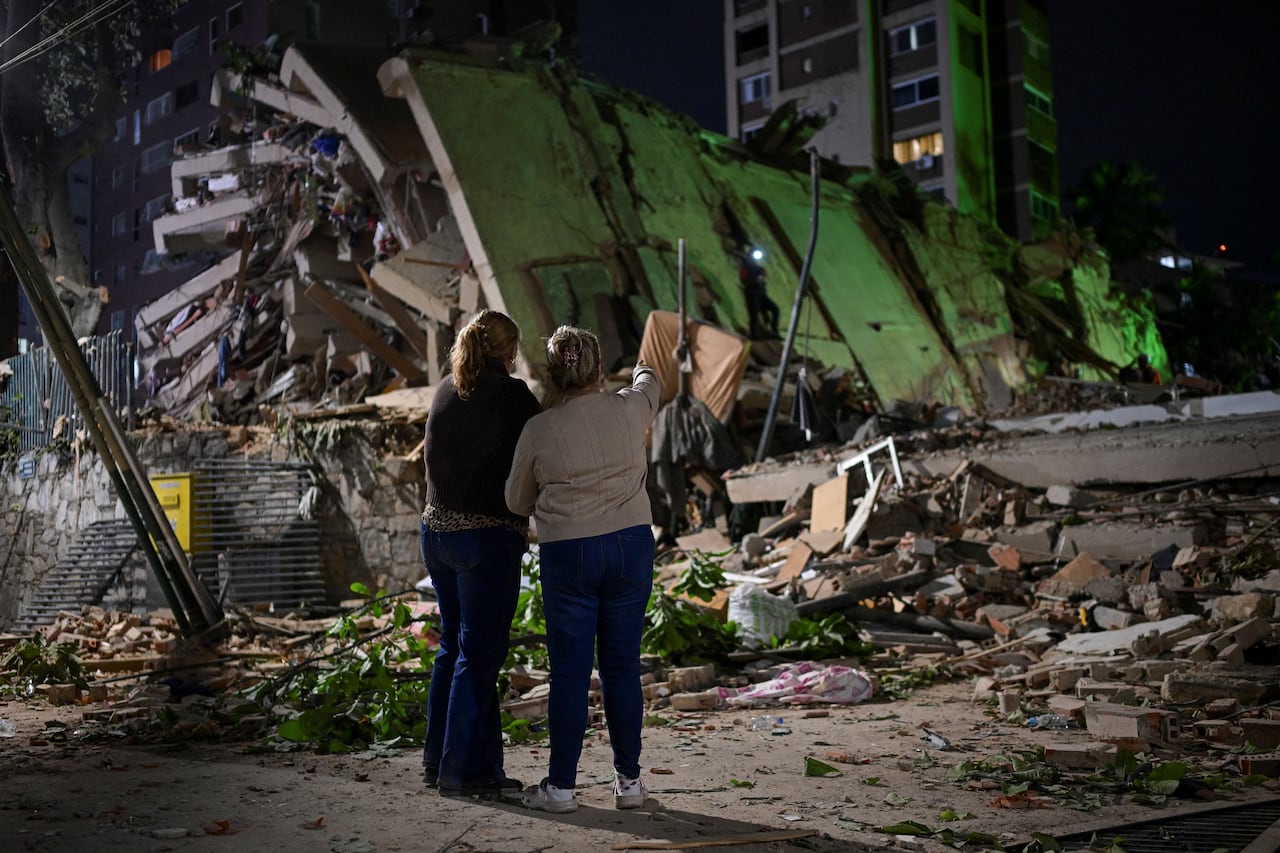 Fanny Nasri waits at the site of a collapsed building as emergency workers search for her son, Antonio Nasri, alongside Noemi Cordoba, who awaits news of her granddaughter, in Caracas on Thursday. (Gaby Oraa/Reuters)
Venezuelan officials have not yet released figures for those killed and injured in La Guaira. Machado said it’s challenging to be far from home as the earthquake’s aftermath unfolds.
“I know my family is suffering there, and I don’t have enough ways to help from here,” he said.
Luis Mendez of Windsor is trying to reach several family members in Venezuela. He was gutted to see footage of the devastation in his home country, which he says is finally gaining optimism after years of economic and political strife.
“If my roof got blown off, I have insurance,” he said. In Venezuela, “people don’t have that. Even if they haven’t lost their lives, they’ve lost their homes. It’s just a tragedy.”
Venezuela’s ‘vulnerable’ infrastructure
London-based filmmaker Juan Bello, a Western University professor, said he also has family members in Venezuela who’ve been impacted by the earthquakes.
He said many people in the city live in tall apartment buildings and his family members told him stories about rushing down to the ground floor for safety.
“It’s a life or death moment,” he said. “That’s what you hear from family or friends: that for a moment, they thought this was the end.”
LISTEN | Venezuelan in London reacts to destructive earthquakes:
Afternoon Drive7:53Venezuelan Londoner describes aftermath of two major earthquakes
Juan Bello, a Western University professor and a member of London’s Venezuelan community, joins Afternoon Drive to share his reaction to destructive and deadly earthquakes in Venezuela’s capital, Caracas.
Gross said she got in touch with her closest friends and immediate family, who are all physically safe but have experienced damage to their homes. Some of her distant relatives, family, friends and other acquaintances are still unaccounted for.
“The level of sadness is indescribable, especially because this is happening at a time when Venezuela is most vulnerable in terms of infrastructure,” Gross said, adding that the country often faces power outages and many of its buildings are old.
Machado said he expects it will be challenging for Venezuela to continue its rescue efforts now and rebuild later.
“Venezuelan infrastructure, emergency response capabilities and healthcare systems have been under severe problems for years. Many hospitals lack resources, equipment, medicine and personnel needed to respond effectively to a disaster of this magnitude.”
Canada preparing aid
Canadian Foreign Affairs Minister Anita Anand said Thursday afternoon that the federal government will provide an initial $5 million in humanitarian aid to support emergency relief efforts in Venezuela.
All three Londoners said they hope Canada prioritizes rescue missions in the coming days.
WATCH | Canada sending aid to Venezuela: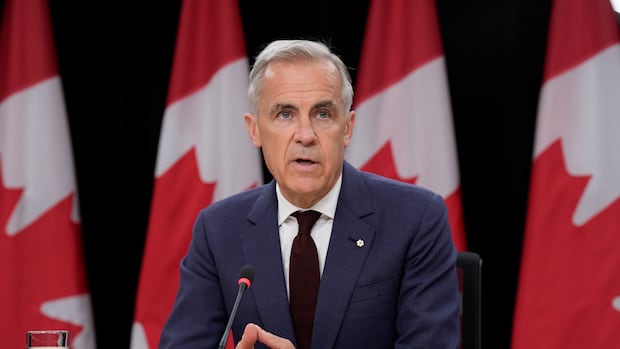
Canada to provide Venezuela earthquake humanitarian aid, Carney says
Prime Minister Mark Carney said Canada is looking to direct humanitarian aid to Venezuela as death tolls rise after two earthquakes struck near the country’s capital on Wednesday. Carney added that Venezuela and Iran are examples of countries where Canada lacks a diplomatic presence, ‘and that puts us at a disadvantage.’
“People in Venezuela are very solidarity, so I know that our people are going to support each other. We’re going to make sure that we’ll share what we have … but there are areas in Venezuela where they’re not getting any rescue teams at this time,” Gross said. “That’s where most of the help is needed. “
Gross said Venezuelans in larger Canadian cities have started fundraising efforts, and many have also started sending donations through the Red Cross.
Machado said community aid will be essential in the coming days.
“The support is not going to come from the government. It’s probably going to be the community itself,” he said.
“Venezuelans are known as resilient, but resilience alone is not enough in moments like this.”