

Listen to this article
Estimated 4 minutes
The audio version of this article is generated by AI-based technology. Mispronunciations can occur. We are working with our partners to continually review and improve the results.
Recent heavy rainfall and high water levels along the North Saskatchewan River have been hitting Edmonton’s river valley trail system hard, resulting in the closure of multiple low-lying trails.
After last weekend’s deluge, two primary trails in the central and eastern portions of the river valley are temporarily closed, while a third has been shut down indefinitely due to more extensive damage.
Braeden Holmstrom, the City of Edmonton’s supervisor for river valley parks, said the massive amounts of rain and elevated river levels created a “perfect storm” for damage.
“This sort of extreme amount of rainfall we’ve gotten definitely impacts the trails in a very negative way. Paired with the high water, you see a lot of the impacts on those lower-lying trails,” he said.
Holmstrom noted that the trail areas primarily affected are further downstream in the central and eastern portions of the river valley.
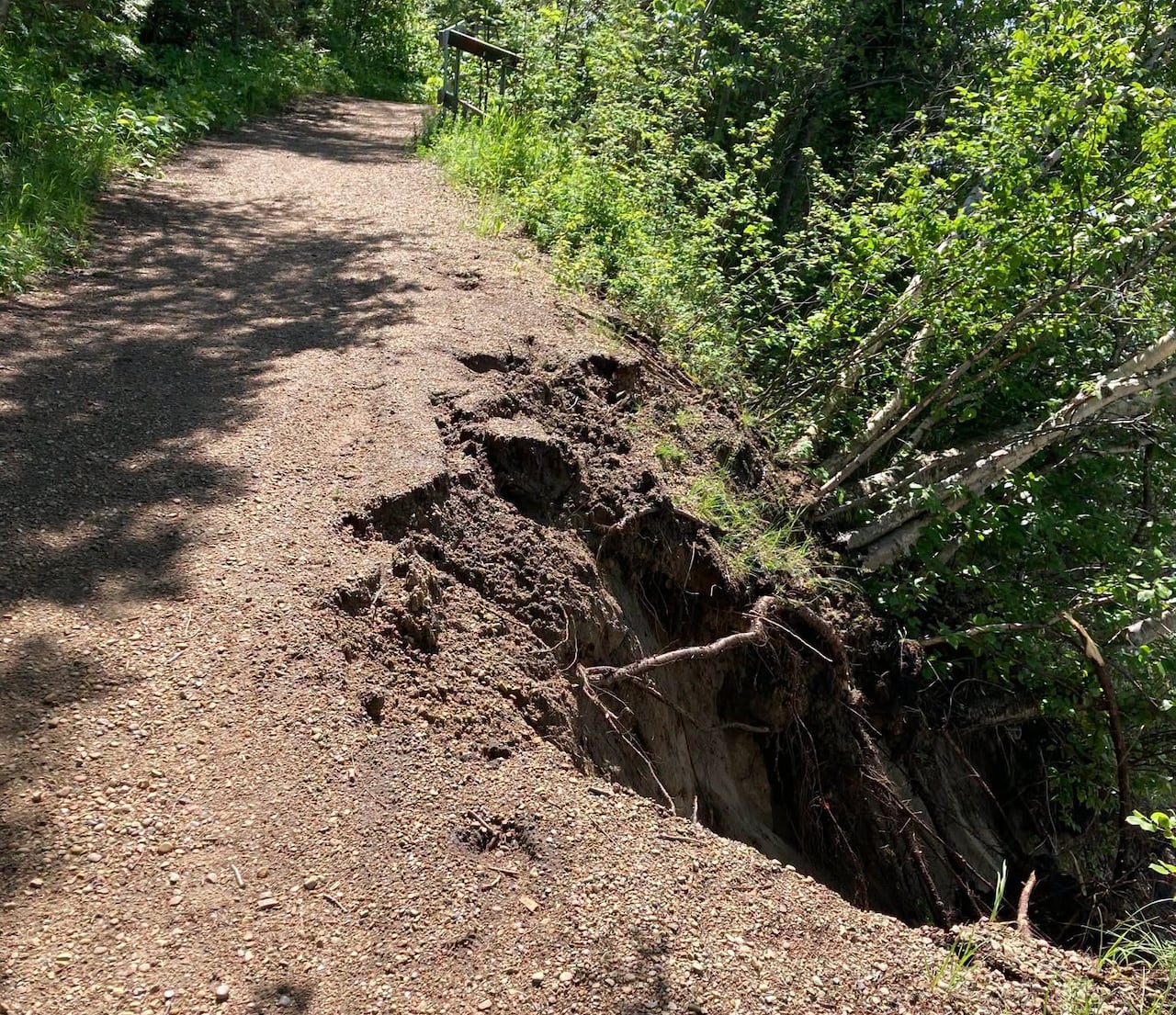 A section of the Capilano granular trail in east Edmonton has collapsed due to erosion from heavy rainfall. The trail was closed indefinitely by the City of Edmonton on Tuesday, June 23, 2026. (City of Edmonton)
According to the city’s online trail cautions and closures map, the Emily Murphy to Kinsmen Park trail near downtown and the Gold Bar to Capilano Park trail in the city’s east are both temporarily closed due to exceedingly high river levels.
Holmstrom said rising water levels present a major safety concern.
“You never know what the river is going to do. It could keep going up at a really quick rate,” he said.
“So we close the trails just to make sure that people aren’t on them, until that water level goes down to a more sustainable level.”
Once water levels start trending down, these trails could reopen as early as next week pending an assessment, Holmstrom said.
However, the heavy rain has caused extensive damage requiring extended closure in other sections.
The Capilano lower granular trail is closed indefinitely due to slumping, according to the city’s trail cautions and closures map.
Holmstrom said the major trail slumping is due to high river levels and extensive overland drainage from the recent rainfall.
In a social media post, the City of Edmonton said the area near the trail is fenced off, and pedestrians are advised to use the paved trail running parallel to the closure, close to Hardisty Drive.
With between 40 and 70 millimetres of rain predicted for Edmonton and central Alberta this weekend by Environment Canada, Holmstrom said the city will closely monitor the Capilano lower granular trail for further damage.
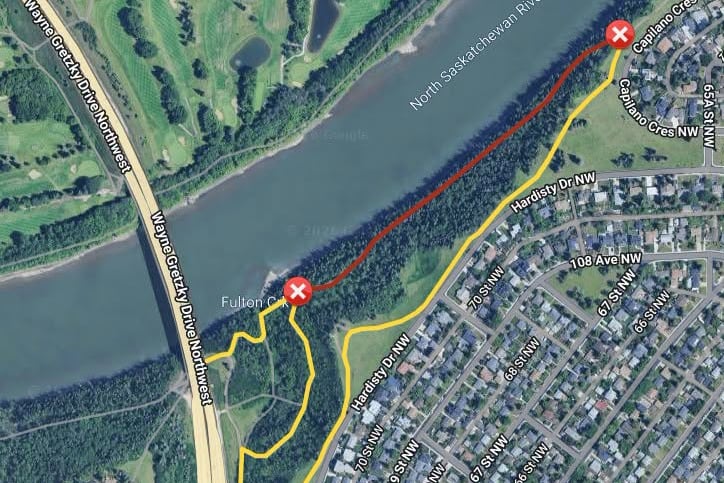 A map posted to the City of Edmonton’s official Facebook page shows the section of the Capilano granular trail that is closed, as well as the suggested detour route. (City of Edmonton)Issues outside the river valley
The impacts also extend beyond the river valley trail system, disrupting pedestrian infrastructure elsewhere in Edmonton.
Above the river, the east sidewalk on the High Level Bridge and portions of the left-turn bay on 109th Street just past the bridge will be closed until further notice due to “slope instability,” according to a social media post by the City of Edmonton. The west sidewalk will remain open.
The closure followed a Thursday inspection completed as a precaution following the recent downpours and upcoming forecast, according to the city’s social media post.
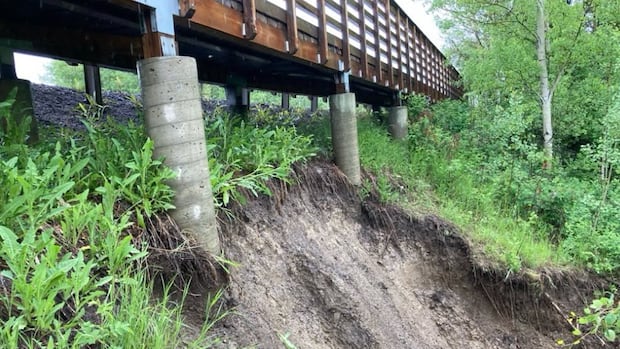
In northwest Edmonton, the pedestrian footbridge at 137th Avenue over Horseshoe Creek has also been closed due to erosion from the heavy rain.
With more rain on the way, Holmstrom said calling 311 or using the Edmonton 311 app is the best way for residents to report any trail damage.
“[Those calls come] directly to our team, who can then dispatch staff to go out, review, put up signage, put up closures and make sure the area is safe for the public.”