
Primary care numbers for 2025 show the province was still struggling to connect New Brunswickers with a family doctor.
The New Brunswick Health Council released its 2025 primary care survey results on Tuesday, which showed that 73 per cent of respondents reported having a permanent primary care provider in the province.
Premier Susan Holt referenced the number of New Brunswickers without a family doctor in her state of the province address in January.
“That’s a number that keeps me up at night,” she told the crowd at the time.
“I would call it the most important metric. It is our top priority, and it is the worst one of the bunch.”
In 2024, 77 per cent of respondents had a family doctor, according to the health council.
 At the annual state of the province speech in January, Premier Susan Holt said the number of New Brunswickers without a doctor keeps her up at night. (Silas Brown/CBC)
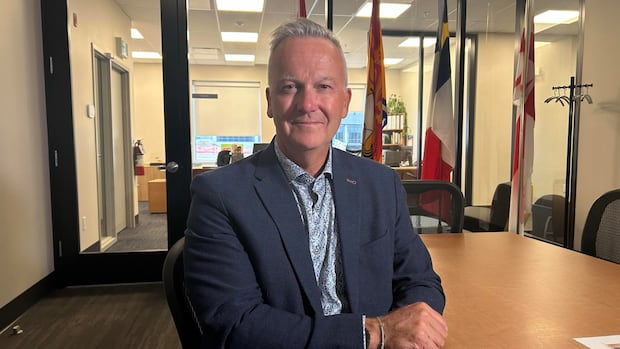
But Stéphane Robichaud, the CEO of the New Brunswick Health Council, an arm’s-length watchdog agency, said the province’s $270-million agreement with the New Brunswick Medical Society may help.
That agreement includes financial incentives for doctors to work in collaborative care clinics, alongside nurse practitioners and other health professionals.
The survey “was too early to see the impact that may come from the recent agreement between the provincial government and the medical society,” Robichaud said.
CBC News requested an interview with the Department of Health, but one was not provided.
In a statement sent on Wednesday, the Department of Health said the survey does not capture recent progress made since it was conducted.
The government has since announced five additional collaborative care clinics with plans to announce at least seven more by the end of 2026, a statement attributed to Health Minister John Dornan said.
“We are more than halfway toward our commitment of establishing and supporting 30 collaborative care clinics by 2028,” Dornan said.
The province also said it is working to build new data infrastructure that would reduce dependence on survey-based methods and provide more accurate and timely attachment numbers going forward.
According to the New Brunswick Health Council’s website, the primary care survey is done using a random sampling method, which means eligible individuals are chosen randomly to answer the survey over the phone or online.
New Brunswickers who are 18 years or older and living in a private household are eligible, the website says, so children and residents of special care homes are automatically excluded.
This makes it impossible to extrapolate the precise number of New Brunswickers without access, Robichaud said.
2 regions hit hardest
The steepest drops in the access to primary care were in two regions — Fredericton and Miramichi.
In the Fredericton area, 56 per cent of respondents had access to primary care, down from 63 per cent in 2024. Meanwhile, in Miramichi, the rate dropped sharply to 72 per cent from 83 per cent.
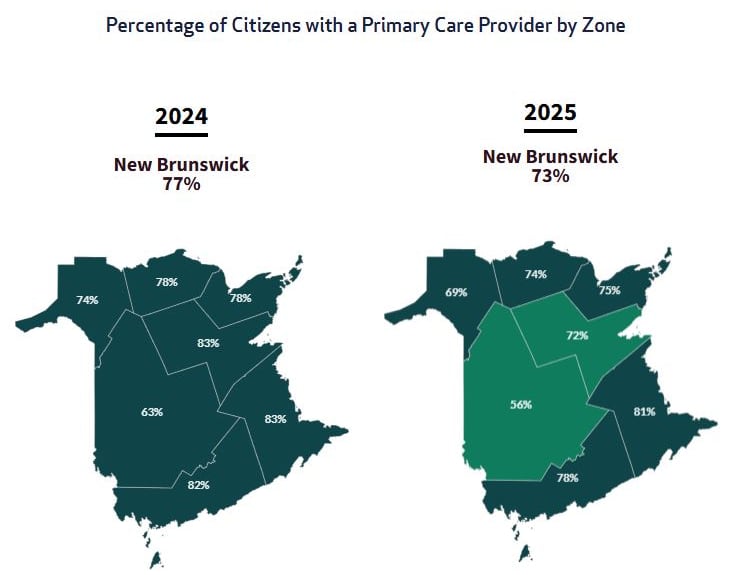 The New Brunswick Health Council’s 2025 primary care survey shows overall attachment dropped from 77 per cent to 73 per cent provincewide. The Fredericton and Miramichi areas saw the steepest declines. (New Brunswick Health Council website)
Robichaud says the Miramichi drop comes down to a cluster of physician retirements happening at the same time.
“Sometimes it’s as simple as having a few doctors in a given zone that happened to be retiring at the same time and that’s a big impact,” he said.
15 new doctors — but province promised 30
The province recorded a net gain of 15 family doctors in the 2025-2026 year — short of the 30 the Holt government had committed to adding.
In the statement from the Health Department, Dornan said the regional health authorities hired 153 new physicians in 2025-2026, resulting in a net increase of 67 physicians overall, which includes the 15 net new family doctors.
Robichaud says having doctors isn’t enough and it comes down to how they’re being used. Some split their time between family practice and hospital services, meaning fewer patients are getting primary care even when doctors are technically available.
“In one community, maybe all five are working full-time in their family practice and in the other you may have three working full-time and two that are only doing hospital services,” Robichaud said.
“From a primary care provision perspective it’s not the same level of resources.”
Team-based care seen as the fix
The province is trying to improve access to primary care with team-based collaborative clinics that bring together doctors, nurse practitioners, social workers and other health professionals so each patient sees the right person for their needs rather than waiting for a physician.
Sixteen clinics have already been announced, but Robichaud said implementation matters.
“It’s not enough to simply group professionals together — that doesn’t make them a team,” he said.
Still he said he believes the potential is there.
“If all of them were truly organized in a team context we could catch all New Brunswickers through primary care settings,” Robichaud said.
Vulnerable groups still falling behind
The data also reveals persistent gaps for the province’s most vulnerable residents.
Immigrants report a rate of access to primary care of just 42 per cent. Racialized groups sit at 44 per cent.
New Brunswickers earning less than $30,000 annually report an access rate of 63 per cent. Francophones report worse experiences with their providers than anglophones.
Robichaud says the council doesn’t yet have a clear explanation for why these gaps exist, but acknowledges the connection to limited resources.
“If our resources are scarce, our ability to meet more specific needs is likely lower,” he said.